
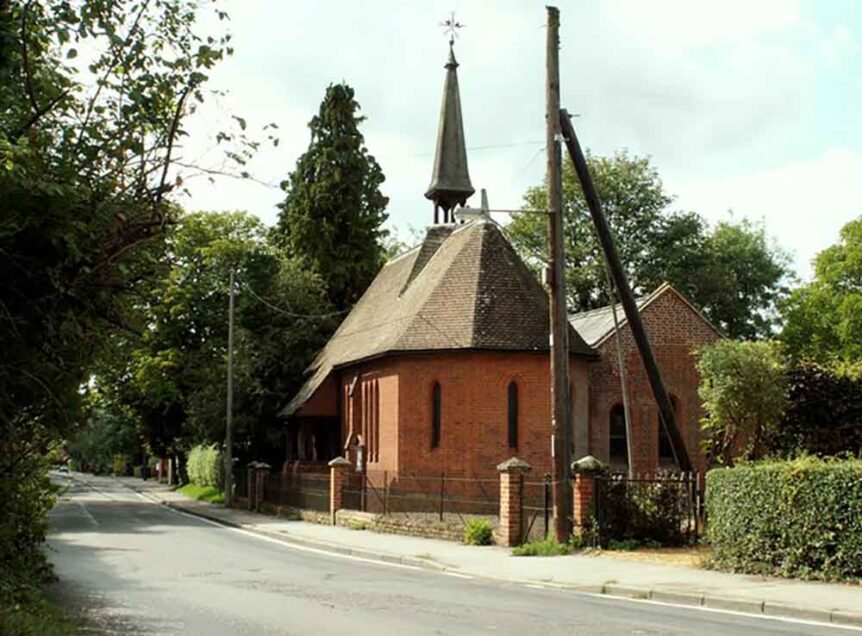
The above featured image of St. James Church Sewards End is © Robert Edwards
© Christopher Rudd. First published in Saffron Walden Historical Journal No. 30 Autumn 2015
The first 18 years of my life were spent on a small farm known as ‘Woodside’ in between Sewards End and Ashdon with my parents, Frederick and Doris Rudd. Frederick was from North London, though the family originated in Norfolk in the late 1700s. Doris, whose maiden name was Halls, was a native of Radwinter and again, the family had lived there since the 1700s. My parents moved to ‘Woodside’ after their marriage in 1937 and I was born there in 1938, my brother the following year and my two sisters in 1948 and 1952. Thomas Halls, Doris’s widowed father also lived with us.
Life at Woodside was, of course, dominated by the demands of the farm, its livestock (poultry), the crops and the seasonal activities associated with them. Because it was a relatively small farm (35 acres in total), there was never any likelihood of employing labour. Consequently, it was the case that everyone helped, according to age and ability. This situation was, of course, commonplace in rural communities then and is probably still so today. The 1940s were also greatly influenced by the 1939-45 war and its aftermath bringing, as it did, great changes to people’s lives and to agriculture.
Early Memories
My earliest memories are from the age of four onwards. In 1942 the war was at its height, but its impact on a four-year old would not have been great. I do remember being told that if my brother and I heard the air-raid siren while playing outside we were to run indoors at once. We did not have an Anderson air raid shelter as many household in the towns and cities did, but our father had reinforced the ceiling in parts of the bungalow with sheets of corrugated iron and a chain had been placed across the front door to prevent it being blown in. These were probably wise precautions since there were three military airfields within two to three miles of the farm, which would have been potential targets for enemy bombers. Woodside was relatively isolated, being a mile from Sewards End and a quarter mile from the nearest road. In the early days the track from the road to the farm was not surfaced at all. This meant that although in the summer months it was quite passable, in winter it became very muddy. The situation was not improved when a radio transmitter station was installed about halfway between the road and the farm, which was manned by American servicemen who were billeted in the Grammar School in Ashdon Road in Saffron Walden, using Jeeps as transport. These vehicles were designed to overcome such obstacles as muddy tracks, but their continuous passage reduced the surface in the lane to the consistency of ‘porage’ about a foot deep, making walking virtually impossible. Our father constructed a raised earthen walkway along one side of the lane, but walking still required care.
One night, Grandfather Halls was returning from Sewards End, where he had been visiting the Fox public house, when he missed his footing, fell from the walkway and landed in the ‘porage’. Unable to extricate himself he was fortunately spotted by the transmitter crew arriving for their next shift, who picked him up and brought him the rest of the way home. I should add that, although he had been to his local, he was not ‘under the influence’ at the time of his mishap! Because of the impassability of the lane deliveries of bread, milk and mail still had to be collected from a little wooden box where the lane joined the road. It was not until after the war that it was possible to put down a hard surface of any kind, using cinder ash from the gasworks in Saffron Walden, chalk rubble and gravel. The lane was also vulnerable to drifting snow, and on several occasions was blocked by drifts several feet deep.
The house at Woodside was a bungalow, constructed around 1935. At the time of its construction there was no gas, electricity, mains water supply or drainage. Water was obtained from a deep well, pumped into two-hundred gallon storage tanks and carried into the house in buckets. The scullery and bathroom were connected to a drainage system which terminated in a deep pit, the site of an unsuccessful attempt to locate a source of water. Heating was by open fireplaces burning either coal or logs. Cooking was done on a coal-fired kitchen range, backed up by oil stoves. Lighting was by either oil-lamp or candles. There was a built-in ‘copper’ in the scullery for boiling laundry and heating larger volumes of water for bathing. Water for tea or (occasionally) coffee was heated in a kettle, either on the range or on an oil-stove.
The pump which lifted water from the well was driven by a small petrol engine, both being located in a shed near the house. During the war petrol was strictly rationed, so water used for washing and bathing was rainwater collected in tanks from the bungalow roof. An added bonus was that the rainwater was ‘soft’ and therefore used less soap than the ‘hard’ well water. In winter the house was very cold, especially as winters then were, in general, colder than they have been in recent years. The kitchen was the principal living-room, while the ‘front room’ was only used on Sundays and holidays such as Christmas.
Play
The farm environment provided many opportunities for outdoor games and adventures, although, because of the relatively isolated location there was little or no contact with other children before starting school. Activities such as haymaking and harvest would allow exciting trips on tractors and carts. Manufactured toys were fairly scarce, but our father was a very accomplished woodworker, so we boys had wooden tractors, trailers, battleships and lorries. The tractors were ‘crawlers’ which ran very realistically on cotton-reels, while the trailers were equipped with ‘ladders’ for carrying hay or corn, just like the real thing. Also, the front axle of the trailer could be detached and, with imagination, could be used as a seed-drill for sowing corn. The battleships were rather too large for naval engagements in the bath, but were ideally suited to floating in the two-hundred gallon water tanks outside. Among the manufactured toys was a clockwork train-set, modelled on the ‘Coronation Scot’, a pre-war streamlined locomotive. Sadly, we were too young to appreciate its finer points, but I can remember seeing it run on its oval track, with sparks emitting from its smokestack. Other manufactured toys included clockwork cars and lorries, modelled on contemporary vehicles such as military staff cars and fuel tankers. These could be run and raced on the kitchen floor, which was covered in linoleum and, therefore, an ideal surface for these operations. A little later, after the war, many more toys became available. Firm favourites were Dinky Toys, which, with new models appearing at regular intervals, were ideal for collecting.
Reading, or when young, being read to, was a major source of entertainment. Even during the war books seemed to be fairly available and there was also the library run by Glover’s, the newsagents in Saffron Walden, which loaned books for a small charge. (The County Library did not arrive until later). The radio or ‘wireless’ was also important. Our receiver was battery-powered, there being no mains electricity. It used a large dry battery and a low voltage ‘accumulator’. While the dry battery would last for some time, the ‘accumulator’ only had a life of about a week before needing to be recharged. Radio Supplies in Walden High Street provided a re-charging service and taking the ‘accumulator’ in for charging was a necessary part of the weekly shopping trip. Failure to do so could result in frayed tempers if radio reception became unavailable! Television had yet to make an impact. Outdoor pursuits included cricket, football, ‘war games’, cowboys and Indians and cycling. These were, of course, in addition to farm-based activities, some of which were definitely more play than work. The cinema was another popular attraction, especially as we grew older and could make our own way into Saffron Walden. The town boasted two cinemas, The Walden, at the top of the High Street, near the War Memorial, and the Plaza, in Station Road. Saffron Walden also had an indoor swimming pool in George Street and during the summer months we would often visit two or three times a week. Sewards End also maintained a modest level of social activity. The Village Hall was the venue for whist drives and dances. Our parents went to these, but not frequently, and on these occasions we were ‘babysat’ by our grandfather Thomas, who was roped into boisterous games and unwitting extensions of bedtime. The dances and whist drives were mostly used as fund-raisers for the war effort and later for local causes such as the village Scout Troop and the Sunday School.
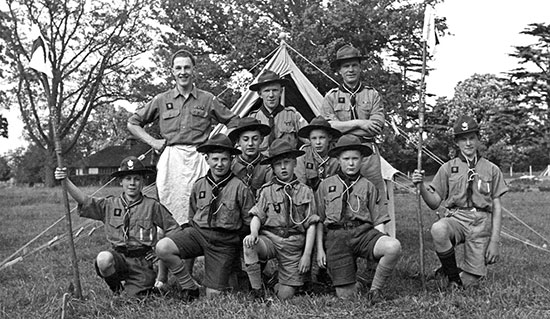
The Scout Troop was run by Bill Mulcahy, Angus Turnbull and Arthur Coote, often with help from servicemen based at RAF Debden. They managed to introduce us to most scouting activities, including camping, tracking and out-door cookery (Fig. 1).
A branch of The Girls’ Life Brigade, run by the Misses Wiseman provided similar facilities for the girls. After the war annual highlights were outings to seaside venues such as Clacton, Felixstowe and Great Yarmouth, usually in the ‘Viceroy’ coaches from Moore’s garage in Bridge Street. Such expeditions were impossible in the war years due to the lack of fuel for coaches and the exclusion of the public from beach areas by barbed wire and anti-tank obstacles. It is probably true to say that there was far more emphasis on actively generating one’s own amusement rather than the more passive approach of today.
School
I started school shortly before my sixth birthday in the spring of 1944. It should have been sooner but my health had not been good during the preceding winter months. The school at Sewards End was attended by the village children and children from the surrounding district. The latter were taken to school and returned home by a taxi service operated by Mr Leonard Lord. The age range of pupils was from five to fifteen. Those aged five to nine or ten were taught in one classroom while those up to fifteen were taught in another. The classes were subdivided into ‘standards’ which were linked to academic achievement. This was a Church of England school, which opened in the late 1800s. The building served as a church on Sundays, as an outlying parish of Saffron Walden. During the week the altar and sanctuary, located in the smaller of the two classrooms, was closed off by a curtain and it was strictly forbidden to look or to go behind this curtain. Two teachers were employed – Miss Downham, the head teacher, taught the older pupils, while Miss Barker, and later, Miss Dench, taught the younger ones. In addition to the usual lessons there were periods devoted to handicrafts, country-dancing and ‘music and movement’, a programme broadcast on the radio, aimed at improving co-ordination and fitness. The country dancing was, I suspect, more appreciated by the girls than the boys. It was performed to records played on the school’s wind-up gramophone. Since this was a Church of England school, pupils were instructed in the Catechism and the Ten Commandments. There were regular visits by the Curate from Saffron Walden (I remember a Mr Southgate, and later, a Mr Humphrys), and an annual examination by a Church examiner, an elderly gentleman with a long grey beard, who came from either Hempstead or Sampford.
Milk for the mid-morning break was collected in jugs from Mr Rupert Giblin’s farm across the road from the school. School dinners were delivered in large tins from a kitchen in Saffron Walden and served up by Mrs Andrews, assisted by some of the older girls. Folding tables and benches were set up in the larger classroom. The playground was quite small, with a hard surface (probably tarmac), which was very abrasive on young hands and knees. Part of the space was occupied by an air-raid shelter, built from brick, with a strong cast concrete roof. When the weather was good the whole school would go to the ‘Park’ for team games such as ‘rounders’. The ‘Park’ was a series of meadows adjacent to a large house known as The Towers. Another highlight of the school year was an annual garden party, hosted by Mr and Mrs Welch, who lived in Cole End Lane. The party included tea and games, such as a treasure hunt. There were also occasional visits from the educational film unit who gave shows of documentary films using a portable projector. Less welcome were the visits by the school dentist, whose surgery was a specially-equipped caravan. The dreaded drill was driven by a treadle and the noise and sensation it produced were most unpleasant!
In the autumn of 1947 the school was closed, presumably due to falling pupil numbers. Children were allocated to schools in Saffron Walden, boys going to The Boys British School in East Street and girls to South Road School for girls. Others may have been placed in the mixed school in Castle Street. Needless to say, this constituted quite an upheaval, especially for the younger pupils.Those who managed to pass the Eleven-plus (scholarship) exam went on to study either at Newport Grammar School or at the Friends’ School in Saffron Walden.
The War
It is difficult to assess the impact of the war. Certainly it was something that one was always aware of, and must have been a far greater source of anxiety for adults than it was for children living away from the cities and major industrial targets of enemy bombing. The impact on farming was more tangible. It had been our father’s intention to be a poultry farmer, to which end he had established an extensive range of chicken huts and enclosures on one of the two fields he owned. He had just started similar arrangements on his second field at the outbreak of the war, but the government of the day ordered that all available land be given over to food production, with the emphasis on cereal and root crops. This meant our father had to abandon expansion of his poultry flock and embark on arable farming, of which he had little experience, except for a brief period working on a farm in Canada. The farm we grew up on was, therefore, very different from the one our father had intended.
Because the area was surrounded by airfields the main evidence of the ongoing war was the continual flying activity. There were airfields at Debden, Hadstock and Castle Camps , while slightly more distant there was Duxford , Stansted and Bassingbourn. These airfields were obviously targets for enemy bombardment, as were local railway lines. I can remember very little in the way of air raids, but there were occasions when our parents felt that precautions were necessary, and we would shelter under the table in the kitchen. I remember feeling aggrieved during one such episode because we had to stay sheltering while our father stood at the back door to watch proceedings.
Our father was conscripted into the Home Guard at some point. The local headquarters was a drill hall in Station Road near the Plaza cinema. He was issued with a full uniform, rifle and bayonet, which he kept at home. The Home Guard were deployed to guard the railway stations at Saffron Walden and Audley End as well as other potential targets, against possible enemy invasion. Fortunately, that eventuality never occurred, but there was at least one instance of the crew of a German bomber, which had crashed, being at large in the area. Another potential target was a huge underground fuel reservoir, located just outside the town on Radwinter Road, which supplied fuel to the local airfields, using either road tankers or an underground pipe network.
Other wartime memories include seeing German and Italian prisoners-of-war marching past our house on their way to work on local farms. Another major event was the destruction of a large munitions dump at Great Chesterford. We heard the explosion and saw the column of smoke from seven or eight miles away! During the evenings the sky would be filled with twin-engined Havoc bombers taking off from Hadstock and gathering in formation before departing on bombing raids. The noise was considerable! It was not unusual either to see damaged aircraft returning from these raids.
There were various fund-raising activities, often associated with displays of military equipment. I remember a display in the Corn Exchange (now the Library) of anti-personnel devices such as grenades and ‘butterfly’ bombs, together with folding bicycles, as issued to paratroop units. We were also invited to purchase war savings stamps which we were allowed to stick on a bomb, pending its delivery on the enemy. Larger items of equipment, such as tanks, armoured cars and sometimes aircraft, were displayed on the Common. During the war years there was a very strict blackout code after dark, which meant that all windows and doors had to have light-proof curtains or shutters, which had to be in place before a room could be lit. Precautions at home were a mixture of heavy curtains and thick, multi-layer paper sacks attached to wooden frames to fit inside the windows where curtains could not be used, such as the scullery and bathroom. In addition to blocking escaping light they would also prevent the glass being blown in, in the event of explosions nearby. Vehicle and bicycle lights were fitted with special devices to limit the amount and spread of light. Travel after dark must have been quite hazardous and certainly not a pleasurable experience. Other civic precautions included a large water reservoir on the Common, more or less opposite the castle. This, presumably, was to ensure a supply of water for firefighting if the mains were damaged. The arches in front of the Town Hall were filled in with sandbags. I assume other important buildings were similarly protected but those at the Town Hall were the only ones I remember.
VE Day, in May 1945, was celebrated in grand style. There was a large bonfire on the Common, together with two searchlights, whose beams were arranged as a ‘V’, and there were military bands playing on the Common and in the Market Square. I do not, however, recall any such events to mark VJ Day in August of that year, though announcements of the dropping of the atom bombs and the subsequent Japanese surrender did create a strong impression.
In keeping with almost all families at the time we did have relatives serving in the armed forces. Our father’s brothers were too old for active service but our mother’s brothers James and Maurice were both in the army, serving in Crete and Gibraltar respectively, while her nephews Ted and Albert served in the Marines and the Royal Navy. Thankfully, they all survived the conflict, but Mother’s older brother Ernest was killed in a bombing raid on London. Members of Father’s family lived in London and did lose their homes during the blitz but, again, all survived. During 1944 two of our cousins and their mother came to live with us for the summer months. This was the time when London was under attack from the V1 flying bombs. In all, I suppose the war years were an exciting time for small boys and distance lends a certain enchantment, but it was not an experience we should seek to repeat!
The Village and Villagers
Sewards End was (and is) a relatively small community, but in the 1940s and 1950s its amenities included two public houses, a shop and post-office, a garage, a blacksmith and wheelwright and a Baptist Chapel (and, of course, the school). The Green Dragon, located at the Walden end of the village, near Cole End lane and Pounce Hall hill. Our only contact with the Green Dragon was through our boyhood friendship with the landlord’s son, Michael Brown, in the late 1940s.
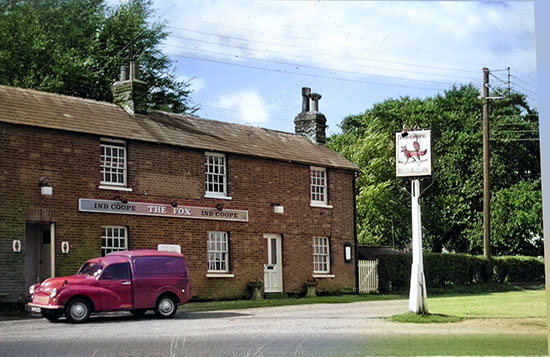
The Fox pub was on the corner of Radwinter Road and Redgates Lane (Fig. 2). The landlord in the 1930s had been my uncle Alfred (Jim) Ellis. During the war it was a Mr Canning and later, a Mr Hunt. I was reasonably well acquainted with the Fox, because it was our grandfather’s local, which he patronised two evenings a week and Sunday lunchtime.
On special occasions such as Boxing Day we were allowed inside to drink ginger beer or some other soft drink while the adults celebrated with something more fortifying. In fine weather it was also possible to sit on benches outside. It was, of course strictly illegal to give children alcoholic beverages or to allow them into licensed premises. Licensing hours were also strictly enforced, the local constable often organising his rounds to coincide with closing time. On one occasion Grandfather and a number of his companions were found drinking after ‘time’. They were summoned before the magistrate in Saffron Walden and each fined ten shillings, their misdemeanour being reported in the Saffron Walden Weekly News. Secretly, I think Grandfather was quite proud of himself, though such infringements of the law could end badly for the landlord.
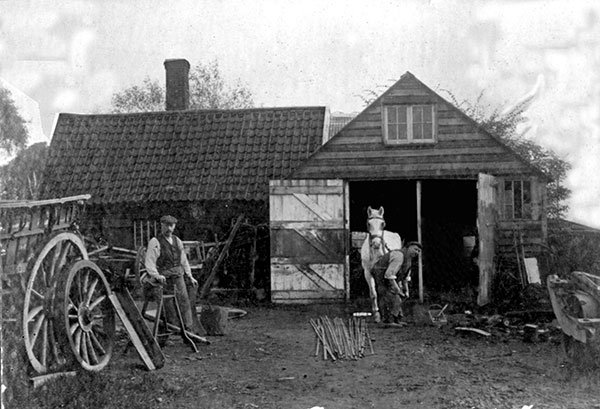
The blacksmith’s forge was just past the Fox, on the opposite side of the road. It was run by the brothers Bill and Ted Moule. Bill was the blacksmith and Ted was the carpenter and wheelwright (Fig. 3). In addition to shoeing horses they were also in demand for repairs to farm machinery and wagons, etc.
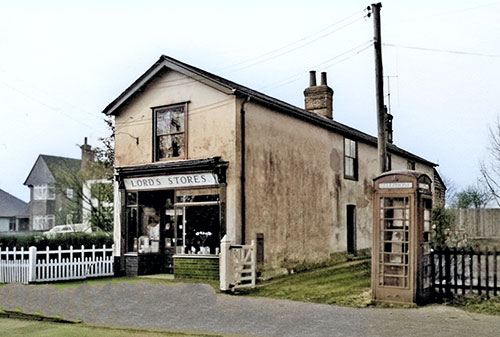
The village shop and post-office was run by Mr and Mrs Lord and their daughter, Babs, while the garage, taxi service and fuel pumps next door were run by their son Mr Leonard Lord (Fig. 4).
Mr and Mrs Reeves owned Sewards End Farm, whose house and farm buildings were on the edge of the village. In addition to their extensive arable acreage they had a herd of cows which supported a milk delivery round. Swains farm, a small dairy holding, was owned by Mr Roberts who also had a milk delivery round in the village and surrounding households, including ours.
The Baptist Chapel stood on the Walden side of the shop and post-office, but I remember little of its congregation. Last, but not least, there was the Village Hall, in Radwinter Road, recently replaced with an excellent new building. It was the venue for whist drives, dances and fund-raising activities. Our parents’ wedding reception was held there! Although I never attended dances there, I did go fairly regularly to whist drives when a teenager.
Other village notables included a Mr Barnes who was (I think) a Member of Parliament, who lived in a large house next to the school. There were also Martin and Peter Kidd, who earned their living cutting and selling wood from the surrounding woods and copses, and George Jarvis, who was a carrier, delivering items such as animal feed and flour from Holland’s Mill at Audley End. Living, as we did, a mile or more from the village, we were not as totally involved in village life as those inhabitants of the village itself, making us, perhaps, observers rather than participants.
The Farm, Life And Work
Small farms such as ours were not able to employ labour, so, for most of the time it was family members who supplied the work-force. Early on, this was our parents and grandfather – the latter had worked as an agricultural labourer most of his life and, although in his 70s, was still capable of hard manual work. His knowledge of farming methods was obviously very helpful but I think on occasions it generated some friction between himself and our father. There were two distinct areas involved, namely the poultry and their care, and the crop-growing side. Poultry care was, obviously, an everyday activity, while crop-growing and harvesting were seasonally based. The chickens were bought in as day-old chicks from commercial hatcheries, usually in batches of two hundred, in March or April. They would be reared in brooders heated with paraffin lamps for a few weeks until they had started to grow feathers, at which point they would be let out into grass runs. At four to five months they would be moved into larger huts where they would spend the rest of their egg-laying lives. It was always important to reduce the risk of disease as far as possible and to this end the huts were always thoroughly cleaned and coated with creosote before a new batch of birds was housed in them. Moving the birds was always carried out after dark when they were drowsy, as this resulted in less alarm and noise. It was quite exciting to be allowed to help with this operation when younger because it involved staying up long after normal bedtime. Needless to say, it lacked this appeal as one grew older! The adult birds were fed twice a day, first thing in the morning and again in early afternoon. Because there were no supplies of water in their runs the drinking fountains were topped up at the same time. Eggs were also collected at both feeding times, then cleaned, sorted and packed in crates to await a weekly collection. Mr George Jarvis, who I have mentioned as carrying animal feed etc. collected the eggs, usually on a Tuesday, at the same time as delivering an order of chicken feed.
During the war years chicken feed, in common with all manufactured animal feeds, was strictly rationed. To supplement the ration we grew a crop of potatoes every year, usually a half to one acre, which could be stored and used over the winter. Before they could be added to the meal the potatoes were first boiled in a large wood-fired ‘copper’ which worked on the same principle as a domestic pressure-cooker, though on a larger scale. Once boiled, the potatoes were then mashed, when they were ready for use. Later, when rationing was lifted, the potato exercise was abandoned in favour of commercial pelleted feeds. There was also a move from free-range rearing to deep-litter housing, which allowed more birds to be kept and the egg-laying and feeding day to be extended with artificial lighting.
As mentioned earlier, it had never been our father’s intention to get involved in arable farming, but this was imposed upon him by the War Agricultural Committee, which was responsible for all food production. In consequence, it became necessary to buy a tractor and other basic equipment such as a plough, harrows, a seed drill, a binder and other implements, all of which were obtained second-hand. The first tractor was a Fordson, supplied by Cleales. These were popular machines, but were inclined to be temperamental, especially when it came to starting. In cold weather it could take half an hour or more of strenuous effort on the starting handle to coax them into life. Once started, they were very reliable and could be employed for most tasks on the farm. Other implements included a Smythe seed drill, converted to tractor towing from the original set-up with shafts for horse power. This drill was only able to sow corn or other seeds, which meant that any artificial fertiliser had to be applied separately. In the absence of a fertiliser spreader this had to be done by hand, broadcasting the material like the sower in biblical illustrations. Sulphate of ammonia was a common ‘top dressing’, which, while it benefited the crops was very irritating on the skin. Eventually the Smythe drill was replaced by combine drill which was able to sow seed and add fertiliser to the soil at the same time. An Oliver plough, Ransomes cultivator and Deering binder were other necessary implements for arable farming. Where possible, the fields would be ploughed in autumn, as soon as that year’s harvest had been completed, which would allow winter-sowing of wheat and barley, and the soil to be broken down and pests killed by the cold weather. In spring, the cultivator and harrows would complete the preparation for spring sowing. Spring was also the time to plant potatoes. This was another job that was done by hand and was back-breaking. The crop also had to be hoed at regular intervals to keep the weeds in check.
In May and June it was time for haymaking, although this was never a large acreage. It was a fairly labour-intensive operation to ensure that the green grass was thoroughly dried before carting and stacking. Any dampness left in the stack could result in heat build-up sufficient to ignite the stack, as we found to our cost one year, when we lost a stack and the stack-cloth covering it. Harvest-time always seemed to generate an air of excitement and anticipation, coinciding as it did with the start of the long summer school holiday. Before harvesting could begin the binder had to be resurrected and prepared for use. This involved fitting the ‘canvasses’ that carried the cut corn up into the tying or binding mechanism, sharpening the special cutting blades and extensive oiling and greasing of the machine generally. Because every ounce of grain was important, and because using the tractor and binder on the first circuit of the field would have resulted in destruction of a tractor-width of corn all around the field, this outer strip was mown by hand by our father, using a scythe. Grandfather would follow, gathering the cut corn into sheaves and tying them with a ‘bend’ of corn stalks rather than twine. (This was a skill that I never mastered). Grandfather could remember when, before the advent of binders and combine harvesters, all corn was harvested by gangs of labourers working all day with scythes.
Harvest-time was an opportunity for even young children to ‘help’. When the corn had been cut with the binder the sheaves had to be set up in ‘stooks’ or ‘shocks’ to allow them to dry totally. This particularly was a job where children could genuinely help. We would be set to work collecting the sheaves to be ‘stooked’, often by our mother or grandfather. It was, however, a job which could entail discomfort, with bare ankles being scratched by the stubble and arms being scratched by the sheaves themselves, especially when the crop was barley, with its irritating awns. Harvesting also brought its pleasures, like tea and sandwiches in the field, so time would not be wasted walking home. Mother used to arrive with tea in an enamel bucket and a supply of bread and jam sandwiches or sometimes cheese. After cutting and shocking came corn-carting. This was always quite exciting. Sometimes we were allowed to ride on the tractor, driven by our mother, or else on the cart as it was being loaded by our grandfather. Needless to say, Health and Safety rules were not in operation in those days! The full cart, with its load secured by a rope, was taken to be stacked, which offered further opportunities for excitement climbing the ladder on to the stack and watching it get higher with each load. For small boys it was all great fun, but for adults it was very hard work, as we found out when older, and therefore able to do more ‘real’ work.
Pitching sheaves onto a cart or from a cart onto a stack was gruelling, especially in hot weather. In later years an ‘elevator’ was used to lift the sheaves from the cart to the stack but before that the sheaves were pitched direct from the cart to the stack by hand. This was quite easy when the stack was at an early stage, but as the stack got higher and the load got lower it became increasingly harder. When the stack reached the point at which the sloping roof was constructed it was necessary to have a person positioned at the point where the slope began, standing in what was known as the ‘gullet-hole’, to receive the sheaves and pass them on upward to the stacker. It often fell to our mother to ‘man’ the ‘gullet-hole’.
Because harvesting was so dependent on fine weather and was so labour-intensive, there was always a spirit of co-operation with people offering help to those who might be short-handed to get the crops in before a change in the weather. I remember us receiving such help from George Jarvis, Ken Roberts, Cecil Foster and others, especially when we boys were too young to make a real contribution. Carrying the final load of corn from the field was always attended by a feeling of relief, though never with the celebration of Harvest Supper, which reputedly was a feature of harvests in an earlier time. After the field had been cleared any stray stalks or ears of corn which had escaped the binder or had fallen out of sheaves was picked up by hand, or ‘gleaned’, for feeding to the poultry. Local farmers with larger fields allowed ladies and children from Saffron Walden to ‘glean’ the fields and keep the corn they collected for themselves. Once the corn had been stacked it was necessary to protect them from the weather by thatching. We were fortunate in that our mother’s brother Reg Halls was an experienced thatcher and was usually able to deal with our stacks. While not as heavy as the thatch on a cottage, the thatch on stacks needed to be secure enough to shed rain and snow during the winter months while waiting for the stacks to be threshed.
As we grew older, my brother and I were able to perform most tasks, from ploughing and sowing to reaping, carting and stacking, having served our ‘apprenticeship’ under our father and grandfather, but we never learned thatching. We did, however, undertake a large hedge-cutting operation one year, which took us all one autumn and winter, working on Saturdays and the school holidays. We did get paid for it, but I cannot remember how much.
The culmination of the arable year was threshing the stacked corn. This usually took place early in the New Year. Very few farms had their own threshing tackle and those that did hired them out, together with crew to operate it. In the early years we had the outfit owned by Mr Portway, a Radwinter farmer. The power for running the machinery was provided by steam traction engine, which also pulled the tackle from farm to farm. It could be heard approaching from half a mile away, puffing regally along the road at a steady walking pace. Once set up, the engine drove the threshing drum by a large belt and flywheel. Sheaves from the stack were fed into the drum, which ‘threshed’ the corn from the stalks and delivered it, sieved and separated into sacks. The straw was ejected and either packed in bales or stacked loose. It was very dusty, very noisy work. The crew started at seven a.m., while it was still dark, and worked on, with a break for breakfast and for lunch, until around four-thirty, by which time it was again dark. If threshing or setting up went over the weekend then the engine driver had to come on Saturday and Sunday to stoke the engine to ensure there was no delay on Monday morning. In later years the traction engine was replaced by a tractor fitted with a pulley, which could drive the drum and all the associated machinery, but this never seemed as exciting as the steam engine.
In the post-war years there was a rapid increase in the availability and use of combine harvesters, which, by combining the reaping and threshing elements of harvesting, greatly reduced the manpower requirements. The old jobs of cutting, shocking, carting and threshing became a thing of the past, especially on the larger farms. It was, therefore, a red-letter day when we acquired a combine. This was a relatively modest machine, towed by a tractor, not one of the self-propelled monsters as used by our neighbours. Sadly, this step to modernity was a good deal less than successful. The combine itself was very heavy and its wheels relatively small, which meant that unless the ground was dry and firm it became very difficult for the tractor to pull it. Its arrival coincided with a series of wet summers and this, coupled with falling profitability and the loss of myself to National Service brought about the demise of farming at ‘Woodside’. In late 1960 the farm was sold and our parents moved into Saffron Walden, buying a house in Beeches Close, off London Road. ‘Woodside’ became, in turn, a riding school and then a small country estate, the bungalow having been demolished and replaced by a large new building.
Note: Christopher Rudd now lives in St Ives, but spent his childhood and youth in Sewards End. This is an edited account of his memories, as part of an interview with Zofia Everett for the ERO Sound Archive.
With thanks to Gordon Ridgewell for the loan of photographs.