
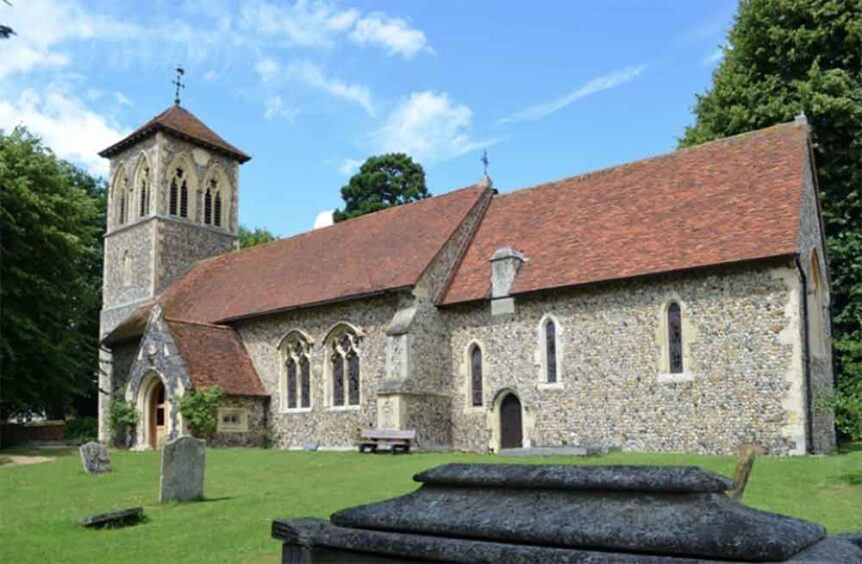
Note: The above image is of St. Margaret’s Church, Wicken Bonhunt, Essex. © Church Care
© Deborah Lowe. First published in Saffron Walden Historical Society Journal No. 33. Spring 2017
The Rector of St Margaret’s Parish Church, Wicken Bonhunt in the mid-19th century exemplified a section of Anglican clergy whose beliefs increasingly turned back to the pre-Reformation Church. During his time at Wicken Bonhunt, he put these beliefs into practice by building a rectory in Gothic revival style, rebuilding the church to reflect its medieval past and introducing High Church practices to worship. Some years after leaving his post at Wicken Bonhunt, Sperling converted to Roman Catholicism; a difficult decision which was perhaps, many years in the making.
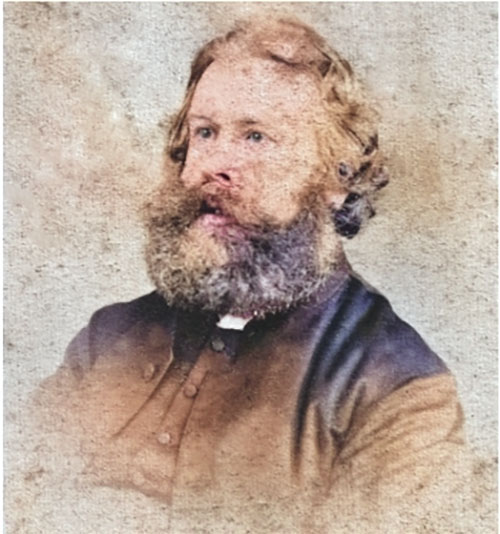
There is no anecdotal evidence of what kind of a Vicar he was during his time here. However, Sperling left a body of work which illustrates both his character and calling.Revd John Hanson Sperling was appointed Rector of St Margaret’s in 1856. It was his first post in charge, having previously been Curate of St. Mary Abbott, close to his father’s house in Kensington Palace Gardens. When he came to Wicken, Sperling was 31 years old and accompanied by his 19-year-old wife of two years, Anna, who was pregnant for the second time. Sperling arrived with a considerable reputation as an academic and an authority on church architecture. He was also extremely wealthy which allowed him to take on ambitious and expensive projects for the benefit of the Church.
Before his career with the church, Sperling attended Trinity College Cambridge graduating B.A in 1844, and M.A. in 1848. Afterwards, Oxford University awarded Sperling the honorary ‘ad eundem gradum’ meaning at the same degree for post-graduate research. The impact of his involvement with both universities was strong, lifelong and, most particularly, of their time.
Sperling was an active member of the Trinity-based Cambridge Camden Society, a club for undergraduates who shared a common interest in Gothic church design. Founded in 1839, the group went sleuthing with a tape measure and a pre-set form to complete every architectural detail of each church visited. The resulting database made the group influential in the restoration of English churches in the mid-19th century. Through its work and publications, the Society is credited with inventing ecclesiology, the science of church building and decoration. The Society had one goal: to return the Church and its buildings to medieval splendour and piety. Sperling was one of the Society’s most productive members publishing Church Walks in Middlesex, a collection of architectural details of 98 London churches researched during the summer of 1849. The introduction includes the comment that ‘chancel arches are omitted in many small churches (…) and that scarcely a rood screen remains’.
In the 1841 pamphlet, A Few Words to Church-builders, the Society unreservedly recommended the Gothic Decorated style. Stone, not brick, should be used, however flint was perfectly acceptable. The two essential parts of the church were a nave and a well-defined chancel. A tower could be in any position except above the altar. The sacred space of the chancel should be ablaze with light, contain the artefacts of ritual, and be separated from the nave by a rood screen. The font must be in the nave and near a door. Seating should not be closed in pews, but in open benches and overhead galleries were totally unacceptable. A further publication, The Symbolism of Churches and Church Ornaments, sought to prove that every architectural element of medieval church-building was religiously symbolic and signified piety.
The Oxford Movement, started at Oxford University in 1833, embodied an increased emphasis on ritualistic revival with a high regard for the sacraments. They believed that the Anglican Church was one of three branches of a single stem: the Holy, Catholic and Apostolic Church. In contrast to the plainness of Anglican churches at that time and, through their philosophy of Tractarianism after their pamphlets ‘The Tracts for the Times’, the Oxford Movement championed a return to powerful, emotional symbolism in the church with the Eucharist central. Numerous Catholic practices were reintroduced including vestments, lighting the altar and the use of incense.
By 1850, the resident lords of the manor in Wicken had been gone for more than a century and the manor house of Wicken Hall was a rented farmhouse. The population of 170 consisted largely of lowpaid agricultural workers, living in small, damp, rented cottages. Water in the wells was often polluted, spreading fatal diseases, and there were few modernisations except the railway station at Newport. The only facilities for villagers were the public house and the dilapidated church. It was not just the fabric of the church that was in decline, the church itself was under pressure from the state, from growing nonconformist churches and from absentee Vicars. It had become the norm that Holy Communion was seldom practiced.
Sperling first built a new rectory. Costing him personally £5,000, the house was a private family space set further away from the church, with splendid pleasure grounds and a long sweeping drive. The house was larger and more comfortable than any in the district. Sperling designed the Gothic revival house himself and had details published in The Ecclesiologist, the Cambridge Camden Society’s newsletter. A further 42 acres of surrounding land were purchased and added to the property of the Rectory, now totalling 44 acres.
The next project in 1858-59 was St. Margaret’s Church where Sperling was able to use his expertise in re-ordering the construction. As patron, John Sperling senior funded the majority of the work, with additional donations from the Rector’s family and friends. Sperling established that the chancel of St. Margaret’s Church was Early English in style and, having retained its eastern triplet window, side lancets, priest’s sedile and piscine, required minimal restoration.
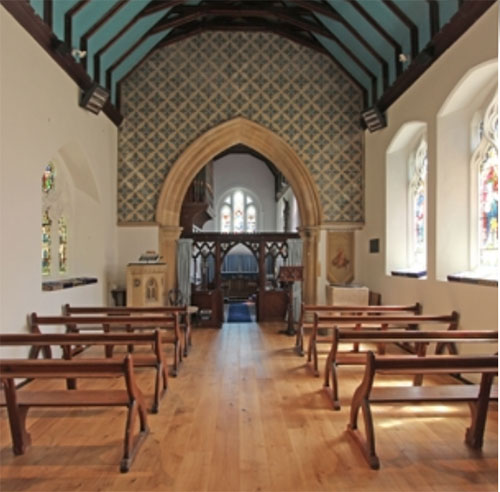
When demolition of the nave began, Sperling discovered that it was also of Early English origin, and in the demolition, foundations of an earlier round tower and the bases of a simple narrow arch on the west end. True to Ecclesiological ideals, and built from stone and flint, the nave was totally rebuilt and lengthened by 23 feet. A new tower with double recessed windows to the belfry stage and capped with a stone broach spire reached 90 feet. Finally a larger porch of flint was added to the south entrance.Inside the church, two good windows in the Decorated style were retained from the old nave, and used as a basis for new windows featuring the saints in painted and coloured glass. Seating was arranged in open benches, and a new decorative stone pulpit was added. A simple massive stone arch was erected to separate the chancel from the nave; the surrounding wall decorated with plaster relief work on a red background. Underneath the arch, a richly carved oak screen, topped with an elaborate canopy and gilt cross, emphasised the symbolism of the space (Fig. 2). The rood screen represents death and separates the nave (the church militant) from the chancel (the church triumphant). Doors in the rood screen always open inwards and never outwards. The only additions to the chancel were space for an organ and carved oak choir stalls for a lay choir.
Among the items Sperling donated to St. Margaret’s were an inscribed silver chalice, and a silver paten used for Holy Communion. Also from this period are two sets of brass altar candlesticks of Pugin design. Following the restoration, Sperling had more time for family and personal pursuits. Apart from ecclesiology, Sperling’s main interests were heraldry and genealogy. He meticulously researched and published several volumes of Descriptions of Coats of Arms in Essex, and a sample of his work on armorials is included in his parish history, Notices of the Parish of Wicken Bonant, Essex.
Wicken Rectory was gifted to the church when Sperling left in 1862 to take up a position at St. John the Baptist Church in Westbourne, Sussex. Initially wanting to remain in Holy Orders, but impossible without setting aside his family, Sperling converted to the Roman Catholic Church in the 1870s and retired from his ministry. His son Alfred became a Catholic Priest and Sperling funded a Catholic church for him in Staffordshire, while two daughters entered Holy Orders in later life. Sperling retired to his house at No. 5 Royal Crescent, Bath. He died suddenly while exploring the churches of La Spezia, Italy in 1894.
References
ERO/DP2.1.2. Parish Registers of St. Margaret’s Church, Wicken Bonhunt.
Sperling, Revd. John Hanson, Church Walks in Middlesex: Being an Ecclesiologists Guide to the Ancient and Modern Churches in that County (1883).
Anon (1862) Tymms, Samuel (Ed), The East Anglian Notices of the Parish of Wicken Bonant, Essex Vol. 1 (1864) pp.220-229.
Tracts for the Times (1833-41).
Note:
Deborah Lowe is Local History Recorder for Wicken Bonhunt.