
© Mary Whiteman
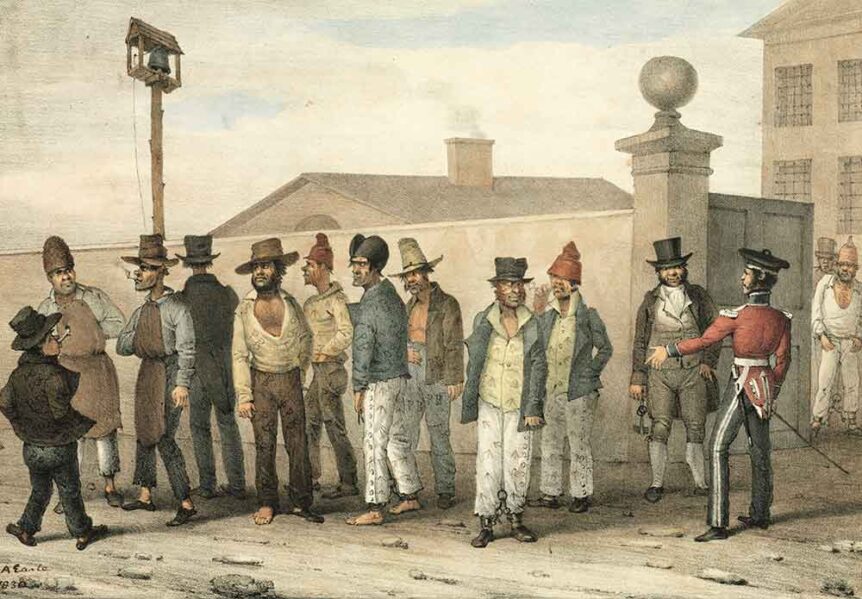
The above picture is of a government jail gang (convicts) on Macquarie Street in Sydney, painted by Augustus Earl 1830 © State Library of New South Wales
Reprinted [with 2026 updates] from: Saffron Walden History, Volume 33, Spring 1988
JAMES FISH and GEORGE LING- names taken at random from the Calendar of Prisoners tried at the Quarter Sessions held at the Guildhall, Saffron Walden on April 15th, 1833. Fish was found guilty of feloniously receiving half-a-quarter of brown malt and sentenced to transportation for seven years; Ling was found guilty of stealing one deal board and sentenced to transportation for fourteen years. We do not have a record of previous convictions but they must have been less serious for the convictions mentioned to have been so final and grim. [See our article ‘Malt Stealing Case in Saffron Walden]
The abolition of the whipping post and the stocks from the Market Place in 1818 had contributed to the more respectable appearance of the centre of Walden where these punishments had always dealt with malefactors, and transportations offered a means of disposing of the more troublesome inhabitants of the town.
Although in Walden at this time there was growing prosperity with the boom in malting – 31 maltings working busily in 1831 – this prosperity was enjoyed by the minority only. Agriculture was still the main industry in the surrounding countryside and there was a great poverty among agricultural labourers. For this was also the period of vast enclosures of land and the Second Lord Braybrooke, who had died eight years earlier than the date of these convictions, had left an estate whose land value had increased sevenfold since he had inherited. By Act of Parliament in 1803 he acquired 3000 acres of land in the Chesterfords. The enclosed land was more efficiently farmed and this applied throughout the country- but the loss of Common land increased the poverty of already poor villagers perhaps also sevenfold.
The popular jingle recorded in Tickler’s Magazine in 1821 had a ring of bitter truth:
The fault is great in man or woman
Who steals a goose from off a Common
But who can plead that man’s excuse
Who steals a Common from a goose?
The fate of men like Fish and Ling was often never followed up. Poverty could stalk their families back here in Britain, correspondence was hard for those with little schooling. A later generation would evade the stigma of a convict grandfather if it was emerging from poverty to Victorian respectability. In Australia itself a ticket of leave man who earned his freedom and had a chance of better work than in England could bring out his wife and establish himself as a straight settler. The harsh treatment, the flogging, the slave labour must be thrust into the background and forgotten. The young country developed the power to make bricks with human straw, and build a strong sound nation which at its bicentenary looks only to the future.
The U-turn in Australian families with convict founders is now complete: the old shame has turned into pride. This has never been better expressed that in a recent TV interview with a humourous elderly Australian lady:
© National Library of Australia
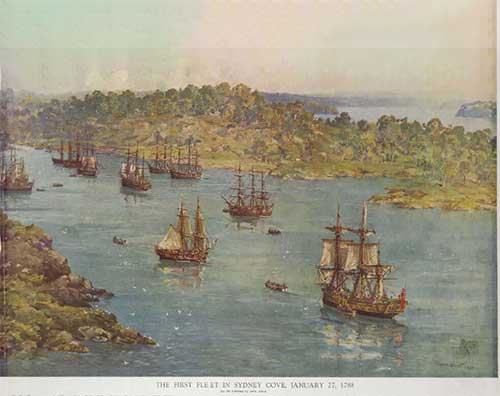
Today we look on the descendants of those early convicts as the Aristocracy of this Country. As for me, my great-great grandfather was an English highwayman transported here for life. He arrived in the famous First Fleet of 1788 with Captain Arthur Phillip and that puts our family right in the Royal Line!
She has opened the closed Book of the Past with a gallant, light-hearted flourish. A thought flashed through my mind of how the aristocracy and great estates of other, older countries might have come into being.
An English highwayman, forsooth! Yet a little village in North-west Essex sent out a youth who was to be an Australian highwayman in the true, English romantic tradition. He was William Westwood, to be known in Australia as ‘Jackie-Jackie’ Westwood. [ Jackey-Jackey] His story is told in a small book published in Australia recently and obtained for the Town Library through the Vicar of Manuden, where William was born.
He was the eldest son in a family of poor but good-living and affectionate parents. His later writings revealed some education and literary merit and there were certainly good moral values in the home. A lively boy of fourteen, his first misdemeanour was, with another boy, to rob a woman traveller of a bundle of clothes. The boys were easily caught, arrested and William was sent to Chelmsford Jail for a year, with the punishment of working the treadmill. A dreary year, but his parents were to meet him and take him home. He promised to go steady and did so for a time, but then he took up with older boys and at the job where he worked as an errand boy he was caught stealing a bag of wheat. Again he was tried at the Sessions and as a second offender was transported for fourteen years. So quickly was his future life irretrievably decided. [He was transported on the HMS ‘Mangles’]
A loving, weeping family watched the sailing ship Mangles take him out of their lives forever.
After the experience of the long voyage and the grim initiation to convict life with its iron shackles and floggings, the sixteen year old William started to work with a labour gang on an estate near Bugendore. He endured this for three years in spite of floggings for minor escapades. As there seemed no future, it was inevitable that he should make a run for it . Now the only means of survival was outside the law as a bush-ranger in this undeveloped bush country. His first ventures were surprisingly successful so he never thought of turning back. He was soon ranging further afield. His reputation began to spread.
Bushrangers were greatly feared. They were ruthless men, avenging themselves on society with vicious murders as well as robberies. But William was different: The basic values of his upbringing were never to change. It became known that he would never injure his victims, that he would rob a lady with politeness. Moreover, he was known to value a fast, high-spirited horse more than jewellery and money. He would exchange his own horse for his victim’s better one and stole only the finest horse from the best stables, making an escape on it ‘as if the devil was after him’. (Was this a re-enactment of the myth of Dick Turpin, that hero of his childhood who was born in a village close to Manuden?) A country of horsemen responded to William’s impudence and daring and so the legends grew. In 1842, as he was working the Sydney area, the press named him ‘the leading hero of the Knights of the Highway’. Increasingly Jackie-Jackie Westwood enjoyed his acts of derring-do, adding magistrates and other persons in authority to his list of victims on the road. He acquired the title of ‘Gentleman Bushranger’ when he invited a fine lady to get out of her coach and dance a jig with him. It was playing to the gallery and he must have read with pleasure the ‘tongue in the cheek’ statement in the Sydney press in May, 1841:
We are sorry to state that scarcely a post arrives from the Interior without reports of more outrages committed by bushrangers. Jackie-Jackie – in spite of all pursuit continues his depredations in various parts of the country.
However, the most brilliant of folk heroes cannot flaunt the power of authority for ever, and the troopers were called in to aid the police. Even they did not succeed. It was the publican’s assistant at an inn called ‘The Black Horse’ who floored Jackie-Jackie with a heavy hammer blow. News of the capture spread immediately and the court case on July 21st brought his spectacular rise to fame to an end.
Then it was Van Dieman’s Land as a deportee and the next five years were a record of imprisonment and daring escapes, not always successful. One attempt to swim for the mainland ended in his two companions being eaten by sharks and a scared Jackie regaining the shore, but without clothes. After four days of embarrassed nakedness he was recaptured.
Grim terms of imprisonment lay ahead, with the usual floggings and three months of solitary confinement in a black hole, where he was confined with painful irons and on a near-starvation diet. He survived. More escapes, more captures, then a revival of his bushranging. He was again caught and his death sentence was commuted because the Governor of Tasmania said, ‘I see nothing in your case of unnecessary violence; although having the means in your hands you yet inflicted no personal injury.’
There was no hope now for he was deported to Norfolk Island known as the ‘Island of Despair’.
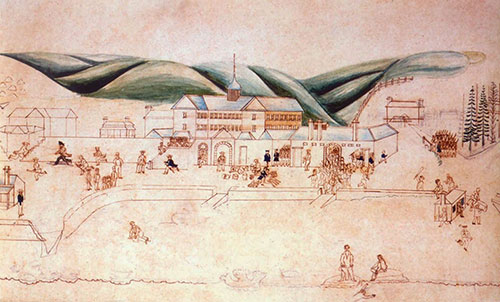
After eighteen months of suffering, William must have been himself in despair to have joined in the ill-fated mutiny that took place in the prison. [This became known as The Cooking Pot uprising]. There, as one of the leaders, he attacked and killed a constable-his only injury to another human.[ In fact he killed at least two policemen]
© Launceston Reference Library
I am reminded of a verse from Housman’s Shropshire Lad:
There sleeps in Shrewsbury jail tonight
Or wakes as may betide,
A better lad, if things were right
Than many that sleep outside.
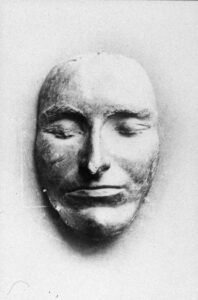
William wrote to a friend, ‘Him that I deprived of life had inflicted a lingering death on many others…. I welcome death as a friend’. For this, he was sentenced to death by hanging. He died unflinchingly; he was just twenty-six. He accepted this but pleaded that the other mutineers should be spared. They were not.[All 12 mutineer leaders were hanged]
William Westwood wrote a brief story of his life some three years before his death; it appeared in print in 1879 and we cannot tell how much it revealed of his true character, by then so scarred. [For a full report on William Westwood’s life see ‘William Westwood (bushranger)‘]
There is however a happier account, written by a descendant, of the life led by another local teenager who set out for Australia in 1858, twelve years after Westwood’s death. He was Lewis Richardson, one of the big family of Richardsons living at North End, Littlebury. Like many young men during a time of grave agricultural depression, he was tempted by the opportunities offered in this vast new country. Land -what labourer could ever own that in Essex? So at eighteen he was on his way to South-west Queensland, and it is his great-grand-daughter, Mrs. Claire Wagner, who has sent to the Town Library the photocopy of an article printed in an Australian journal. It was entitled ‘Queensland Teamsters’ and describes the life that Lewis led for nearly thirty years before he settled in the town of Charleville, to which he brought some echoes of the little market town of his youth.
He became a ‘bullocky’, the local name for the men who made the long, long trek with their herds of cattle to the ports. The hard life was for many first-generation immigrants a test of ability to thrive in a pioneer country. It was a colonial rite of passage. A successful bullocky could make some money and eventually become entitled to a grant of land. Essentially a bachelor’s life, but soon teamster families came into being.
As an experienced drover, Lewis was also able to take on work as he went along as a hawker and carrier, for the drover teams encountered a string of tiny settlements and homesteads, all wanting contacts. So this country boy soon became part of a man’s world of ‘work-a-day bush slang, the stockwhips and the bullock yokes’. In their long journeys the bullock teams frequently followed the ancient Aborigines’ tracks which would lead them to water holes and surer ground. In turn their wider tracks seemed a guide to the new railways which in time would provide yet another form of cattle transport.
In 1865 Lewis Richardson was to meet Dan Jounquay, a remarkable veteran bullocky of Hugenot descent (though now a successful trader with a house in South Brisbane). Lewis fell in love with Jounquay’s fifteen year old daughter and they were married at a little wooden Gothic church at Jondaryan. It was as well that she was colonial born for a wife’s part in a travelling teamster family was as vital as the man’s, and she was well equipped for it. In the words of Mrs. Wagner:
It was a life of unremitting toil and early rising…. To travel the average twelve miles a day the bullocks had to be mustered, the wagon harnessed and the horses saddled (the wives were all fine horsewomen). A cattle dog kept the animals together. Two or three families often travelled together and between them there could be seventy or more draught animals. Wives and children all helped with the stock work. During droughts they cut mulga grass to feed the stock. In times of flood they could be held up for months, but the wet season provided good feeding. If they could not reach a town, a baby would be born ‘under the wagon’ and the women became skilled midwives. When children were sick on the road, a well-thumbed ‘doctor book’ was consulted. However, the life was so healthy that teamster families usually survived to a good old age.
As the drover’s route was linked with the railway development so both were linked with the Richardson children’s names and the station nearest to their birthplace – Jondaryan, Dalby, Roma, all on the way to Charleville, where the track ended. Charleville was a coaching town and an important drover centre. In the 1890s Lewis Richardson decided to settle there with his family, although at that time his splendid wife must have died. He seems to have carried with him a mental picture of his earliest life. Although he opened his own shop and built a bake oven and almost at once planted a vineyard, probably the first and last that Charleville was to know, he had been, according to Mrs. Wagner, ‘nurtured in feudal forms and diverse skills in the stables and barns at Audley End’.
He made wine from his own grapes, salted fish from the nearby river; indeed there was no agrarian skill he had not mastered. Many of the men who settled in the developing town were of rural origin and, like Lewis, sought to re-create the amenities of the hand-created civilisation they had left behind. The planting of that vineyard was symbolic. ‘From all accounts, this lettered son of an agricultural labourer saw himself as a bearer of culture, channelling his heritage of skill into the planting of his own vines.’ He was to become a man of influence in the town, highly regarded and known for his strict maintenance of Victorian behaviour and manners in his own family, perhaps in memory of what he had once observed at Audley End. Thirty years of droving had not eradicated the old traditions. Mrs. Wagner says ‘Charleville inspires the same affectionate reminiscences as the Richardsons’ ancestral “village”, Saffron Walden.’
So she was herself inspired to come to Walden in the 1970s to see those three cottages at North End, Littlebury, where her story began.
Lewis had a cousin, James, of the same age, another of the Richardson clan who lived in those same cottages. He remained in the area but his daughter and her family emigrated to British Columbia before the First World War. Her descendants had the same urge to trace the roots of their family to some cottages in Littlebury. The link with Lewis was so strong it was possible to put the ‘cousins’ in touch with each other. Between them they were able to make further enquiries. Mrs. Mabel Stiglich and her daughter, Karen, of British Columbia, visited the Town Library in 1985 and went on to discover other descendants of the Richardsons.