
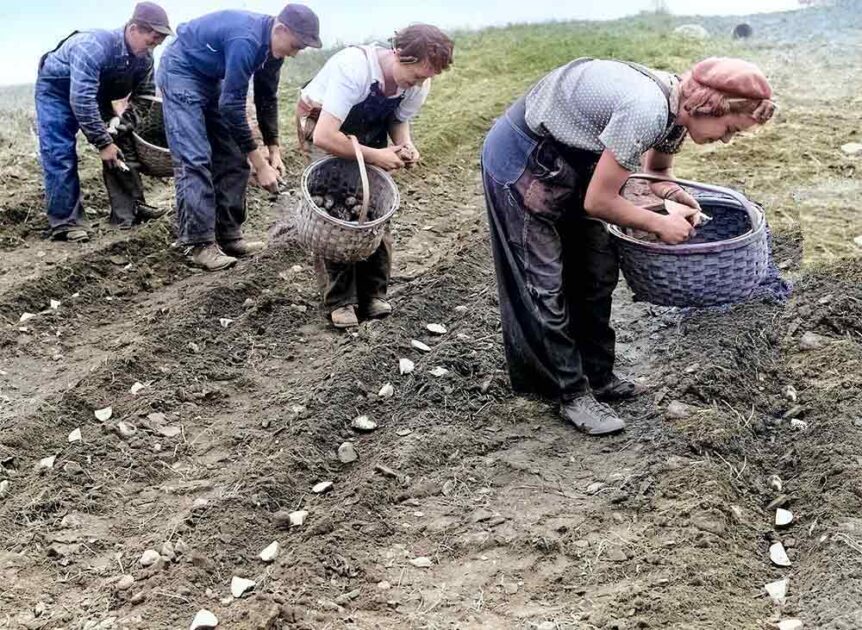
Early history and the struggle for acceptance
© Geoffrey Ball. First published in Saffron Waden Historical Journal No. 20 Autumn 2010
The first question that has to be answered is ‘why the potato?’ – surely a mundane subject for a local history journal? Well, not so, for after the introduction of the potato in to Britain in the late 16th century it was largely rejected in rural southern Britain for some 200 years, in spite of numerous attempts to get it more widely cultivated.
It was only a few years before 1800 that the tuber was generally accepted by the rural population of southern England as a valuable component of their nutrition, after which the potato could take its rightful place as a bastion against hunger and starvation, especially at times of wheat shortage. This is the story of that struggle.
The potato was first discovered by Spanish navigators visiting South America especially areas which are now Chile and Peru, circa 1560, where they found the native population cultivating the potato extensively. These navigators brought the potato to Spain circa 1570. From there it was introduced to Ireland between 1586 and 1588. It is thought probable that some Armada ships foundered on the Irish coast and were plundered by locals and potatoes carried as cooks stores (a valuable source of vitamin C) were found and subsequently planted out in the coastal areas of Kerry and Cork. Whether they came to Ireland in this way or by some other route is not proven, but entry into Ireland must have been between 1586 and 1588.1 There is no proof that Raleigh was in any way involved. From Ireland the potato travelled across the Irish Sea to Lancashire, Cheshire and Yorkshire, where it was welcomed and rapidly became part of the dietary. The first potato market was established at St Luke’s Fair in Wigan by 1700.2
South of the Trent the story is very different and progress was to remain slow and painful. The potato may have arrived here overland from mainland Europe. When the potato reached southern England at the end of the 16th century, thought to be 1590, people regarded it with suspicion. At that time farmers grew no roots of any kind in their lands, whether or not they were enclosed or still in strips of the common fields. In the common fields a potato crop not harvested until October or November would have been a hindrance to the grazing of sheep on the corn stubbles thrown open after harvest in August and September. Even in the ‘early enclosed’ parts of Essex farmers showed no interest in growing them nor consuming them. At best they were food for hogs. That is not to say farmers were unaware of root crops as carrots and parsnips were often grown from seed in their small enclosed cottage gardens. The vegetative propagation of the potato from a tuber was a cause of uncertainty and confusion as all familiar crops at that time were established from seed. Finally the question was asked why they need to grow potatoes when they did not want to eat them. Their food was bread and beef washed down with honest English ale: ‘yeoman’s fare and no Kickshaws here!’
However, very slowly the potato started to win its way into the houses of the upper classes, having been grown in their kitchen gardens in the early years of the 17th century. This now fashionable concept was brought to England by refugees from Flanders and was a new indulgence of the rich and an adjunct to their established flower gardens. Thus the potato became a luxury item, especially new ones to be enjoyed by a select few. The poorer sections of the population continued to be suspicious and refused to grow them.
An important development took place in the early 17th century in which the county of Essex became a major contributor. In the south-west of the county close to London there were established market gardens and these started to cultivate the potato. Lands around Barking, Wanstead, Plaistow and Ilford were the centres of these enterprises often using Irish migrant labour. Harvesting commenced very early in order to supply early or new potatoes, which were costly to buy but profitable to grow. Yields were low at only about two tons per acre. These potatoes were taken to London by pack horses carrying panniers and were initially hawked around the streets in the wealthier parts of the capital. Later on the newly-established London vegetable markets took an interest and began wholesaling the potato as supplies became more plentiful. The wholesale markets mainly supplied maincrop potatoes to the urban masses which were less expensive than earlies and satisfied the needs of an expanding London population.
A significant development occurred in 1662 at the recently formed Royal Society in London where the potato was discussed and a suggestion made that its cultivation should be extended ‘as a protection against famine’. This is likely to be the first occasion when the potato was recognised as a valuable national asset. A committee was appointed to consider this proposition and on 20 March reported as follows: ‘That all those members of ye Society as have Land, should be desired to begin ye planting of this root, and to persuade their friends to doe ye same etc.’ A Mr Buckland (a Somerset gentleman) was to send up what quantity he could of small potatoes to furnish those who did not have any tubers for planting etc etc.3
In 1664 John Foster wrote a pamphlet claiming that the tuber ‘furnished a sure and easy remedy for food shortages’. With wheat flour added he wrote: the potato made good bread and at half the cost of pure grain. Little or nothing happened and the rural areas south of the Trent continued to demand white wheaten bread but sometimes mixed with rye and barley. 4 This fairly harmless adulteration of white bread was to be the precursor of a number of semitoxic materials mixed into bread to save on costs – just one example was the use of alum to save on yeast. Most adulterations were illegal.
Moving on now to the 18th century, Arthur Young writing of his six-week tour of the southern counties, completed in 1765, wrote that he had never seen potatoes grown in the open or common fields.5 It was not until his northern tour in 1768 that he actually saw some growing in this type of field. He had been most favourably impressed by the potato crops in south-west Essex but they did not spread very far north of Ilford.
I was surprised to find the cultivation extended no further…. Next to hops, potatoes are the most beneficial vegetable that I have met with… The culture in Essex is exceeding profitable… Taken up in July when they are not above one-fourth grown they yielded 40 sacks per acre… and in money from £25 to £35 an acre… It is astonishing their culture is not more common… Vast tracts of land that have water carriage might convey their crops to the capital at less expense!
It should be mentioned here that Arthur Young was engaged in an experimental programme at his estate home farm at Bradfield Combust, Suffolk between 1764 and 1767. As this was a comparatively new crop he was anxious to ascertain its potential and as a result became an enthusiastic promoter of the potato.6
From 1793 England was at war with France so that the country was entirely dependent on home-grown supplies of wheat. From about 1760 the consumption of white wheaten bread could be afforded by everyone in southern England and the people wanted no other. This loaf became firmly established in spite of future problems over supply. The grain harvests of 1794 and 1795 were national disasters caused mainly by bad weather resulting in low yields and damaged grain unsuitable for milling, leading to shortages. The price of wheat escalated sharply and farmers were unwilling to sell at below market price. The price of bread rose accordingly and there were claims made of regrating, formerly prohibited but nevertheless practiced. The local sequence of events during this period are fully covered by Malcolm White.7
What can be said is that from about 1790 the potato did have a part to play in the relief of hunger and as a substitute for bread as a report in the Annals of Agriculture (Vol XXIV, 1795) recounts. The following is from Gosfield, Essex and was reported by the incumbent Reverend Thurlow. In summary the main points are as follows:
Potatoes are in great use which necessarily lessens the consumption of bread… a school of industry open everyday… supported by the Marquess of Buckingham [Gosfield Hall 1788- 1825]… breakfast and dinner given… dinner soup thickened with potatoes and bread… large quantity of potatoes boiled by themselves…. Children thus habituated to the use… no means checked by parents.
Unfortunately they were still not sufficiently widely grown by farmers to be freely available at moderate cost. However, there was another factor affecting the local shortage. In 1794 Lord Howard, 1st Lord Braybrooke took steps to relieve the food shortage situation for the poor of Saffron Walden. The means he used were explained in a letter he wrote to his relation, Richard Aldworth Neville at Billingbear, the estate in Berkshire. The following are extracts from his letter which referred to a Mr James Grenville and the potato business. He wrote as follows:
The abominable Practice of bagging them up and sending them out of the country has prevailed to that Degree in this Neighbourhood, that they are already here at the Price of 1s 9d per Bushell. Foreseeing what was likely to happen and to save our Poor from paying an exorbitant price, I have purchased 3000 Bushells [66½ tons] at one shilling [5p] a Bushell, that they may have them at this pretty reasonable price when they may be distressed. I have made a large Pit in a drie Chalk, well cover’d and thatched over under a barn of mine at Walden [Castle Street farm?] from where they will be deliver’d as the Occasions may occur: it seems upon enquiry half a peck of Potatoes [5½ lbs approx] will make a Meal for Eight Mouths including ye Children in a Family & so that I trust my Plan may have is Uses.8
The letter continues with his assessment of a Saffron Walden parish meeting that had been held earlier that day. He was evidently much concerned about the high price for wheat and the fact that the parish had purchased wheat and in the distribution of which the rich as well as the poor had benefited – this had to stop. Secondly that he expected the magistrates and mayor in particular to properly discharge their duties in this regard. Finally that the police of the place may ‘defie’ all attempts to tumult and riot and to nip these in the bud. This seems to possibly be the first occasion in Saffron Walden when someone in authority could and would take action to protect the interests of the poor and in this his purchase and resale of potatoes was to play a central role. It is interesting to reflect that it was 133 years since The Royal Society had first put forward the idea that the potato, if widely adopted as a food, could be used to feed the people in times of wheat shortage. Little had happened in the intervening years, partly at least because of opinions expressed by those who should have known better. David Davies, writing in 1795 in The Case of Labourers in Husbandry (1795, p34), expressed the opinion that although ‘the potato is an excellent root deserving to be brought into general use yet it seems not likely that the use of it should ever be general in this country. Wheat is a much superior food.’
Regardless of the precautions taken there were food riots in Walden in 1795 and troops were called in. These events are fully described by Jacqueline Cooper.9
Suffice to say that much more needed to be done to secure adequate supplies of basic foods for the poor and an answer was at hand but at the time not adopted: the provision of allotments. The first labourers’ allotments were set out in 1793 at Little Cheverell, Wiltshire, followed by some more at Ashley and Long Newton in 1795.10 Rules regarding cropping were laid down and, although the potato was central to this innovation, the maximum allowed was restricted to 50 per cent, sometimes only 39 per cent, of the total area. Soil exhaustion and disease would have resulted from growing potatoes on the same ground every year. Progress in establishing allotments for labourers was patchy in the years following these early initiatives.
In the early years of the 19th century some farmers, normally tenants, allowed their labourers to plant their own potatoes in parts of fields set aside for their use. These were known as ‘potato grounds’, not allotments. They probably did not occur in NW Essex. However, it was a step in the right direction. The farmer may have ploughed the land and maybe applied farmyard manure as well. The labourer then took over and prepared a seed-bed and planted his potatoes, weeded the ground, harvested the crop and stored them at home. There were benefits to the farmer – he got the land cleaned and potatoes were a good break-crop from long runs of cereals. These potato lands were let by farmers at ‘market rent’ on an annual basis and moved elsewhere each year. Allotments when they were eventually set up were normally on land over which the landlord had full control and let at ‘a fair rent’ and became a permanent feature.
Arthur Young returned to Essex in 1807 with the intention of writing his General View of Agriculture in Essex, which was one of a series covering many counties of England and Wales. His tour began in the south where he found an enlarged area of potatoes growing on farms as a field crop in the general area where previously they had only been cultivated in small market gardens. He makes an interesting observation about this advancement: ‘Fifty years ago unthought of as a farm crop while now there were more potatoes being cultivated in Essex than in any other southern county.’
In the intervening years since his earlier visit in 1765 potato cultivation had spread and he quotes many places where he found them growing north of the traditional areas close to London. Amongst these were Castle Hedingham, Gosfield, Ardleigh, Birdbrook, Terling, Finchingfield, and finally ‘around Saffron Walden there was above 100 acres of potatoes including a small field of them growing at Audley End under the care of the very intelligent bailiff Mr Nockold’.11 He then went on to explain at great length the method of the potato crop cultivation at the home farm to secure a good yield.
The estate was now owned by the 2nd Lord Braybrooke, Richard Neville. He had inherited the estate after the death of Lord Howard in 1797. He made many changes to the way the Home Farm was run and types of livestock kept, including the establishment of the first Jersey or Alderney dairy herd in 1811. The potato crop when harvested was stored in sheds preserved by a straw covering. Part of the crop was boiled and mixed with barley meal to feed the hogs. Potatoes were also commonly fed to fattening bullocks. It is not clear how many were used in the house kitchen at that time.12
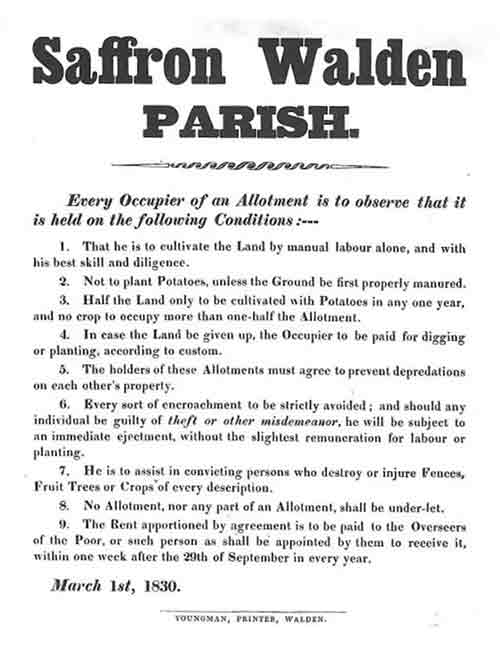
After 1807 when potatoes were more commonly grown on some local farms, no provision for labourers’ allotments had yet been made. Eventually some were set up in 1820 on glebe land at Great Chesterford, the idea initiated by the Rev Charles Blomfield. After a further period of delay, some allotments were set up by the 3rd Lord Braybooke at Littlebury in 1829 on land over which he had, as landlord, full control. Tenant farmers were generally unenthusiastic about labourers having allotments and it was left to landlords to take the initiative which resulted in new allotments in Saffron Walden. The story and sequence of these events are fully covered by Jacqueline Cooper.13 The potato was the main allotment crop and the rules expressly forbade growing them on more than half the land allocated (Fig. 1 – see rule No 3).
Quite often it would seem the other half grew wheat, an example of the attachment to white flour for bread. Slowly over time this changed and ‘greens’ were accepted but roots were always more popular. The allotment movement continued to expand throughout the 19th century and became a common landscape feature of both town and country areas.
A final word must be said about the potato in the 20th century and the role it played, not so much in providing food for the poor, but providing food for the nation during two world wars. In 1914 Britain was largely dependent on imported supplies of cheap hard wheat for bread production. Agriculture had been neglected for many years and much arable land had tumbled down to weeds and rubbish or put down to permanent grass. British agriculture was in depression and had been for many years. By 1917 the food situation had become critical as imported supplies were limited by shipping losses. Increased potato production was required and some additional acreage was obtained.
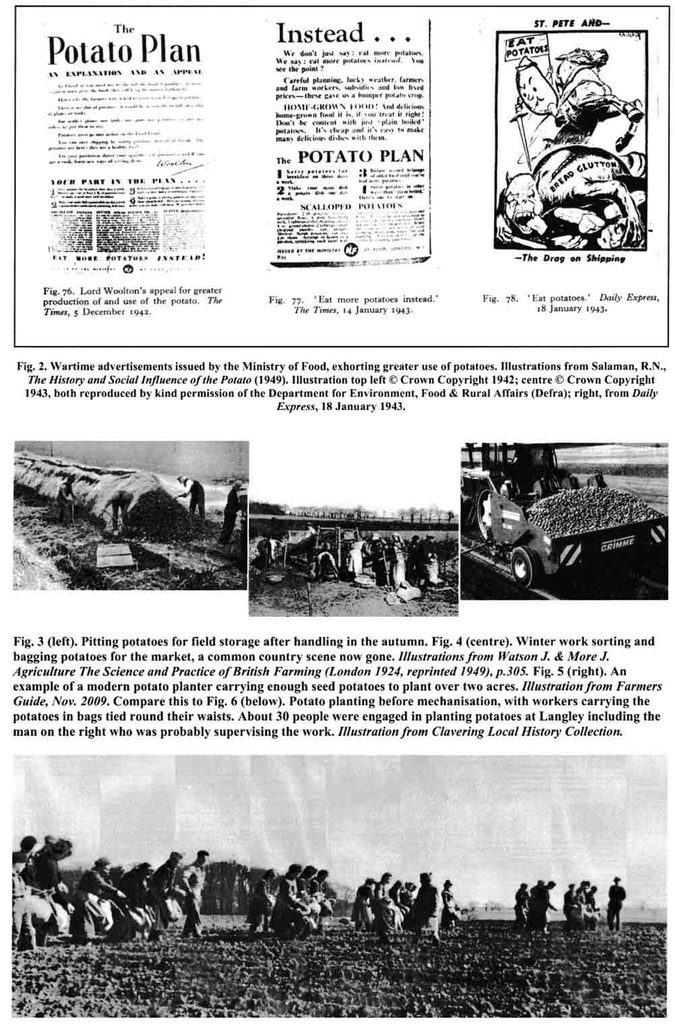
In Essex the acreage grown increased from 12,659 in 1913 to 20,586 by 1918. During the Second World War the increased potato acreage was impressive and got off to an early start. By 1943 the Essex acreage had increased from 7,416 in 1938 to 22,902 acres and by 1946 had increased yet again to 29,424 acres.14 Nationally the acreage under potato production increased by 116 per cent and it was this extra acreage rather than any increase in yield per acre that accounted for the greater availability of potatoes during the war years and increased consumption was encouraged by government at all times (Fig. 2).
Potato growing was always labour intensive especially at planting and harvest times (Figs 3 & 4). It is estimated that by the mid-point in the 1946 potato harvest some 890,000 people were engaged in potato picking, 70,000 were volunteers including school children 30,000 Women’s Land Army and a further 180,000 Italian, German and Polish men. In addition much casual paid labour was engaged.15
Production continued after the war ended and locally in north-west Essex it was a common crop to see growing in the fields. Looking back at some figures for the 1960s/70s and focusing on a circle around Walden, Wimbish and Debden, covering 40 parishes, potatoes were grown on 41 per cent of the 217 farms included. Today one has to look very hard to find any potatoes, having been largely replaced in the rotation by oilseed rape. Potato growing today is a highly specialised, fully mechanised crop grown on large acreages where full advantage can be taken of modern varieties and specialised labour saving equipment (Fig. 5).
The potato has come a very long way from its early arrival in Britain back in the 16th century. Acceptance of it as a mainstream source of human nutrition has been slow and halting, never eagerly sought after. Even in the 19th century William Cobbett continued to denigrate the potato ‘the lazy potato’ and all the rest of it.16 Today it would be hard to think of a source of human nutrition, with the possible exception of bread, more widely used in a multitude of ways and methods of preparation in the household and the food industry of Northern Europe and America.
References
1. Salaman, R.N., The History and Social Influence of the Potato (CUP 1949, reprint 1970-81), p. 157.
2. Ibid., p. 451.
3. Ibid, p. 447.
4. Zuckerman, L., The Potato (Macmillan, 1998), p. 49.
5. Young, A., A Six Week Tour Through the Southern Counties (1765) – copy in Saffron Walden Town Library.
6. Young, A., A Course of Experimental Agriculture, Vol I (1770) – copy in Saffron Walden Town Library.
7. White, M., Saffron Walden History (1991), pp. 86-90.
8. ERO D/By C4/B2.
9. Cooper, J., The Well-ordered Town: a story of Saffron Walden 1792-1862 (2000), pp. 125-7.
10. Burchardt, J., The Allotment Movement in England 1793- 1873 (Boydell Press, 2002), p. 36.
11. Jacob Nockold had been appointed as Land Steward after the death in 1802 of the long-serving Thomas Pennystone. Previously Nockold had been the nurseryman on the estate.
12. Young, A., General View of Agriculture of the County of Essex (1807) – copy in Saffron Walden Town Library.
13. Cooper, op.cit., pp. 142-159. See also article in this issue.
14. Wormell, P., Essex Farming 1990-2000 (Aberton Books, 1999), p. 312.
15. Short, B., Watkins, C. & Martin, J. (eds), The Front Line of Freedom: British Farming in the Second World War (British Agricultural History Society, Supplement Series 4, 2007), p. 129.
16. Cobbett, W., The Cottage Economy (Oxford University Press, 1822, reprinted 1979), paragraphs 78-79.