
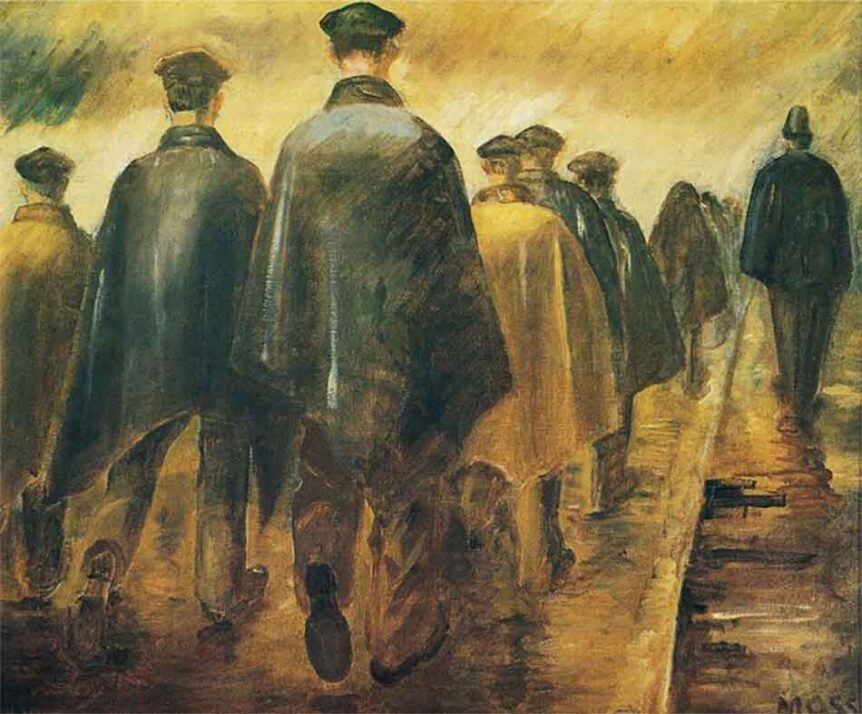
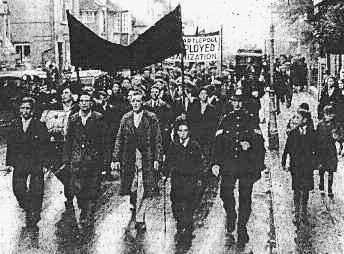
The above featured image is © Colin Moss ‘Hunger Marchers’ 1936
© Martyn Everett. First published in Saffron Walden Historical Society Journal No.32 Autumn 2016
The Hunger Marches took place in Britain between 1922 and 1936 against a background of severe unemployment, although it did not affect all areas of the country equally – the coalfields in Wales and Scotland, the shipbuilding areas of north-east England and the textile towns of Yorkshire and Lancashire were particularly badly hit. Unemployment generated poverty, malnutrition and epidemics of rickets, tuberculosis and despair.
Hunger marches were not a new tactic by the unemployed. In 1874 farm workers from nearby Exening and Newmarket who had been ‘locked-out’ by their employers for belonging to a trade union, went on a ‘pilgrimage’ around some of the northern industrial towns, and in 1905, unemployed boot-workers in Leicestershire decided to march to London in protest, and the idea spread to other industrial cities.1
The Hunger Marches of inter-war Britain differed from the pre-war marches in terms of their organisation, determination and politicisation. Most of them were organised by a single organisation, known as the National Unemployed Workers’ Movement (NUWM), and formed only a part of a much wider campaign against unemployment.
Many of the leaders of the NUWM were members of the Communist Party, as were some of the local organisers.2
The 1922 March set the pattern for the later marches, with separate contingents starting from different cities and converging on London. A total of 2,000 men took part in 1922. At that time over one million people were unemployed but by the Great Depression of the early 1930s over three million were out of work, and unemployment had spread to non-distressed areas. Other Hunger Marches were held in 1929, 1930, 1932, 1934 and 1936, becoming a major tactic in the fight against unemployment as well as way of telling people in less badly hit areas about the devastating impact of unemployment.
It is only recently that historians have started to look at the marches and how they were organised and consequently, there remains considerable confusion about them, and they are frequently mixed up with the better-known Jarrow March in the popular mind. The Jarrow March is not included here, because it did not pass through Saffron Walden.
One of the starting places for the marches was the north-east, the area that included Tyneside, Teeside, Sunderland and Durham, as well as many smaller towns, and the marchers from this area always followed a very similar route to London, which passed through Saffron Walden. This article concentrates on outlining what happened when the marchers were here, how they were perceived and received locally and what kind of assistance local people gave them. Some other details have been brought in to explain the context of each marcher and a little bit about some of the marchers themselves.
The 1920s marches
The 1922 march had very clear, immediate demands: work or full maintenance at trade union rates, but also a longer-term aim of ‘the general uplifting of the working class as a whole until emancipation from the clutches of a decaying system of society based upon Rent, Interest and Profit is achieved’. Each marcher had also taken a binding oath ‘to never cease from active strife against this system until capitalism is abolished and our country and all its resources truly belong to the people’.3
The north-east contingent on the 1922-23 march was comprised of 17 men from Newcastle and South Shields, who were joined by 27 men from Tyneside. They were principally skilled engineering and shipyard workers, miners and labourers, and many were ex-servicemen.4 I am unable to confirm if the marchers came through Saffron Walden on this march – if they did, they have left no local record of their stay, although unemployed marchers from Sheffield were reported as being in Cambridge.
It was seven years before the next National Hunger March which took place in 1929. One of the main causes of the March was the government’s Unemployment Insurance Act of 1927,which strengthened the requirement for claimants of unemployment relief to prove they were ‘genuinely seeking work’ by having a form signed by potential employers to certify they had inquired for work, even though there were no vacancies. Another pressing concern was that the new eligibility criteria prescribed by the Act was due to come into force in April 1929, forcing hundreds of thousands of men from unemployment relief onto lower rates of Poor Law relief.5
The 100 strong Tyneside contingent, consisting mainly of mining, engineering, and shipyard workers, assembled in Newcastle’s Bigg Market on 30 January, carrying banners reading ‘Baldwin Must Go!’ and ‘We Will Not Starve At Home’.According to Don Watson, author of No Justice Without Struggle, several of the marchers were so poorly equipped that many of the 6,000 onlookers took off their own coats to give to the marchers.6
The hunger marchers arrived in Saffron Walden from Cambridge on the afternoon of Tuesday, 20 February. The delegation was mainly composed of ex-servicemen, and members of the Labour and Trade Union movement, although others had no political connections. On arrival, they were told that they could not sleep at the workhouse as there was not enough room. The workhouse master also told them that the only food they would get was bread and margarine, the same as that issued to tramps. Upset, the men shouted abuse at the workhouse master, and carrying their bread and margarine aloft, they marched to the Corn Exchange in the Market Place, where they made their headquarters. Many of the men were tired and distressed and spent the evening sitting around two braziers which had been set up inside.
That evening the marchers held a meeting in the Market Place and made speeches to the crowds of local people who had come to see the marchers. One of the speakers was described in the local press as ‘Comrade C. E. Martin’. This was the nomme de guerre of George Maslin, who was not from Durham, but was born in Tylorstown, Wales. Born in 1891, he had worked down the mines from the age of 13. He was a founder-member of the Communist Party in Britain, and had been elected to the Rhondda Rural District Council two years earlier.
Attached to the north-east contingent as a speaker, Maslin attacked ‘all parties with neglect of the unemployment problem simply because they are afraid of the capitalist class.’ He criticised the Labour Party and the Conservatives:
In fact we have received better treatment from the Tories than we have from the Labour Party. At Cambridge, a Tory town, we were treated as men who were up against dire economic conditions, which were being maintained by the boss class. What of Saffron Walden? Look at the treatment we received at the Workhouse. Englishmen who were prepared to fight for their principles were given a chunk of bread and grease for a day’s meal.7
‘Where is the local Labour Party?’ he asked, ‘I should have thought that they would extend a helping hand to our fellows. They are like the rest of the parties: afraid to face this issue. Ye gods, men,’ he concluded, ‘up you rebels and fight. You must fight before the shackles are released from your hands.’8
The next morning, before continuing their march the men paraded in front of the Corn Exchange with their banners and before receiving the word to start marching again, the leader shouted the question: ‘What do we think of the Workhouse master?’ ‘Boo, boo, boo’, came the men’s response.
Wal Hannington one of the national organisers of the NUWM and of the hunger marches, described the marchers’ stay in Saffron Walden; ‘In the sleepy, one-eyed village of Saffron Walden, Beloved of all Shakespeare’s admirers, the workhouse master, an ex-quartermaster in the navy, refused to give us other than casual’s diet. In spite of the instructions we forced our way out of the workhouse that evening and marched to the market place with the bread and marg in our hands. A great indignation meeting was held, and that night, when we returned to the workhouse to sleep, we conducted a demonstration inside which outraged all the conceptions of discipline which this spike master had thought to impose upon us. The news spread and a big crowd gathered to see us march out of the spike the next morning.’
(Hannington, Story of the National Hunger March, 1929, quoted in Kingsford, p. 105).
When they arrived at their next stop, the Bishop’s Stortford workhouse, news of the rumpus at Saffron Walden had preceded the marchers, and they were fed on boiled bacon, with suet pudding and jam, followed by sausages for breakfast the next day!9
The 1930s marches
The 1930 Hunger March was smaller than its predecessor, partly because it followed on soon afterwards with little time between marches to allow for organisation, but also, and more significantly, because the Labour Party had won the General Election and was now in government. Local trades councils, trades unions, and Labour activists were all reluctant to support a protest against the government, which had only been elected nine months earlier. Under the circumstances, the combined national total of marchers was only about 350, of which about 50 came from the north-east. The Burnley contingent was comprised of 37 women marchers, some of them from the north-east. This was the first time that women had taken part in the marches, although many women were involved in the planning and preparations.10
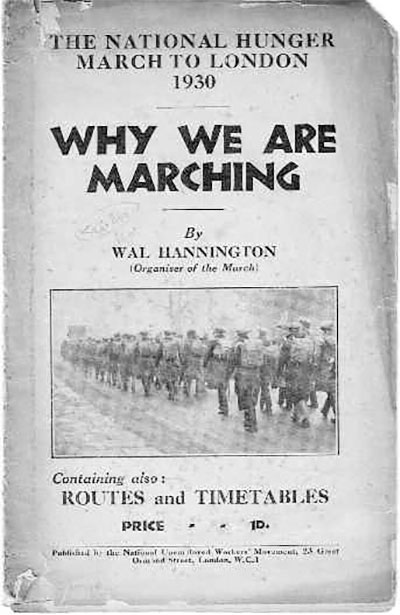
Thousands of copies of a 16-page one-penny booklet, Why We Are Marching, were printed, outlining the miners’ concerns and containing a ten-point Hunger Marchers’ Charter as well as details of the routes taken by the marchers (Fig. 1). Written in his usual uncompromising style by NUWM leader Wal Hannington, the booklet started:
We are now in the grip of a most terrible unemployment crisis, more severe than we have ever before experienced. Month by month since the General Election we have witnessed a heavy increase in the number of unemployed until it has now reached the alarming extent of over one and a half million registered , and approximately another million that are not shown to-day in the registered figures. It is estimated that six million persons including dependents are to-day the direct victims of capitalism through unemployment. The appalling human suffering has invaded millions of working class homes whilst the wealth and luxury of the ruling class is ostentatiously flaunted in the face of the poor.11
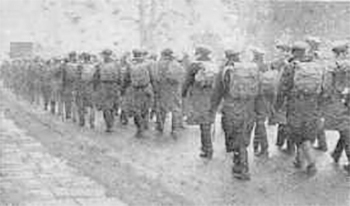
The marchers left Newcastle on the morning of Sunday 6 April, marching through Durham, Darlington, Northallerton, Thirsk, Ripon, Harrogate, Leeds, Pontefract, Doncaster, East Retford, Newark, Grantham, Stamford, resting every few days, and eventually reaching Peterborough (Fig. 2). They had a day’s rest at Peterborough, and arrived in Huntingdon on 23 April, and Cambridge on 24 April, where after another day’s rest they proceeded to Saffron Walden, arriving here on Saturday 26 April. They continued to Bishop’s Stortford and Ware, where they were joined by the contingents from Yorkshire, Nottingham and Derby before marching on to Edmonton (29 April) and Tottenham (30 April) arriving at their final destination, Hyde Park on 1 May.
One schoolboy who witnessed the Hunger Marchers in Saffron Walden, was Alexander Wylie, a pupil at the Friends’ School between 1930 and 1934. His involvement with the marchers gave him a desire to serve the community so that he entered local government with the intention of becoming a town clerk. After studying for a law degree at London University, he later became the last town clerk of Wakefield and its first chief executive officer.12
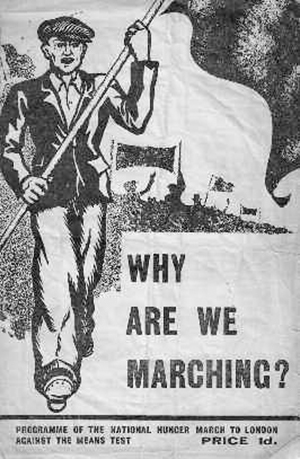
The 1932 National Hunger March was bigger and much better organised than its predecessor in 1930 and it took place against a background of protests against the Means Test and the Anomalies Act (Fig. 3). On their arrival in London, the marchers intended to present Parliament with a petition of more than one million signatures calling for the abolition of the Means Test.
This time, the north-east contingent was 150 strong, most trades were represented, and their ages ranged from 14 to 65. They were under the leadership of Bob Smith and Sam Langley. Smith was a communist who had been jailed following a protest by the unemployed in the town of Stanley in 1931, while Langley, a miner from Houghton le Spring, who had served in the Royal Navy throughout the War, was a veteran of the 1921/22 Hunger March. The marchers left Newcastle’s Bigg Market at the end of September, and were joined at Darlington by men from Teeside.13
By the time the marchers reached Cambridge, they were already bedraggled and exhausted as they had marched from Peterborough in the ‘beating rain’. Two of the marchers had to be taken by ambulance to Addenbrookes Hospital, one of them suffering from pneumonia. They stayed in Cambridge three nights and left the city on Sunday morning, headed by a drummer and accompanied by about 100 supporters, who dropped off one-by-one until by the time they reached the city boundary the marchers were almost alone. At Sawston, they were joined by a welcoming party from Saffron Walden, which had been making preparations to receive the marchers, and from the county border at Stumps Cross they were also accompanied by a ‘large number’ of Essex policemen.
Pausing at Great Chesterford, the men were given a meal by the Vicar, the Revd H. Doble and a number of Chesterford residents.14 After the meal, some of the men who were too lame or distressed to walk further so were taken to Saffron Walden by car, while the march continued.
Under the headline ‘Rain-Soaked & Distressed’, the local paper carried a report of the marchers entry into Walden:
The men – or rather boys – for they were mostly about 18 years of age, presented a pitiful sight, having marched practically the whole way in driving rain. Many of them had no overcoats, and their footwear was in poor condition, some even wearing canvas slippers. In spite of the miserable conditions the men maintained a buoyant attitude and were accompanied by an improvised band and several banners were carried high and proudly. One banner bore the emblem of the scythe and sickle, and others the inscriptions: ‘We Want Bread’ and ‘Down With the Means Test’.15
Most of the marchers were ‘of the labouring classes’ from the Newcastle area, but the contingent included clerks, and a doctor, Dr Anderson, from Edinburgh, and a 14-year old boy, who was regarded as the contingent’s ‘mascot’.
It was just before 5 pm when the marchers arrived at the workhouse in Radwinter Road, where local well-wishers had gathered to welcome them. This time, proper arrangements had been made to feed the men, who had thick hot meat soup, bread, margarine, cheese and as much tea and coffee as they could drink. A local committee, which included the Mayor and Mayoress (Cllr and Mrs J. Custerson) had raised money by subscription. Gifts such as cake and cigarettes had also been contributed by townsfolk and people from Thaxted.
The marchers ate their meal and dried their clothes before holding an impromptu concert, consisting mainly of what the newspapers called ‘communist singing’, but there were also songs from several local people including Miss E. M. Clothier, Mr A. W. ‘Jimmy’ Overall (at one time, clerk to the Rural District Council and a member of the operatic society), and Mr King Beer (a teacher at the Friends’ School). Also with the welcoming party was Father Jack Putterill, curate and later vicar at Thaxted Church, who recalled the evening in his autobiography:
In the Mid 1930s we were asked to welcome the hunger marchers coming through Walden on their way to London. We usually went out to greet them. One night I remember they were lodged at the workhouse in Radwinter Road, Saffron Walden. We joined in the sing-song and I have never known the ‘Internationale’ sung with such deep fervour and emotion.16
‘Lights Out’ was sounded at 9 pm and the men retired to two rooms, especially cleaned out for them and nicely warmed. The police were placed on stand-by but the night passed off without incident.
A substantial breakfast was provided on Monday morning, and although the rain had stopped the men remained reluctant to set off but eventually left Walden just before midday. They marched through the town, headed by Police Sergeant Warnes and five constables. With banners flying and to the beat of two side drums, the contingent of marchers left the town by way of London Road, and were escorted by a detachment of police to the county boundary, where they were met by members of the Herts Constabulary.
Before leaving Saffron Walden many of the men expressed their appreciation of the kindness shown them, which they attributed to the work and arrangements of the local committee, the police and especially the ‘excellence of the arrangements at the Workhouse’. They were grateful to the Master and the Matron (Mr and Mrs Prior) and their staff, who had done everything possible for their comfort. A final question was put to one of the men by a newspaper reporter who asked if he would take on another march.
‘Not so _ likely; the sun hasn’t shone since we left Newcastle on October 2nd’, was the reply.
According to the published itinerary for the north-east marchers, their next stop should have been Thaxted, but they had arrived in Cambridge a day later than scheduled, so a decision was taken to miss Thaxted, and go directly to Bishop’s Stortford, halting for lunch at Quendon (Fig. 4).17
All the Hunger Marches finished in London, but the 1932 march ended with several days of bitter street-fighting between the police and the 100,000- strong crowd, many of them unemployed, who had assembled to welcome and support the marchers.
On Thursday 27 October at 2.30 pm the disciplined columns of marchers rounded the Marble Arch and entered Hyde Park to take up their positions at the seven carts drawn up as platforms as over 100,000 people from all parts of London had converged on the park and surrounding roads to meet them. A total of 2,600 policemen, including 136 mounted police were on duty. This number included 758 special constables, who were stationed along the pavement from the gates into the park. Resentful of the ‘general attitude of the rabble’ they became restive and drew their batons and struck out. In the fighting that followed as the members of the crowd fought back, the mounted police charged repeatedly into the massed crowds in the park and around the platforms. Bitter fighting continued throughout the afternoon. In the crowd were two observers from the ‘No More War Movement’ who were there to see for themselves ‘how much truth there was in the statements that the police treated the unemployed demonstrations as an occasion for beating up people’. One of these observers was Reg Reynolds, a former pupil at the Friends’ School in Saffron Walden, who was by this time a journalist; the other was James Grant. Their eye-witness account was published in the New Statesman:
There was a lot of booing going on from the unemployed towards the police gathered there, but otherwise no sign of any kind of disorder or disturbance being created by the unemployed. Suddenly for no apparent reason, the mounted police accompanied by foot police began to charge the crowd right and left, the mounted police produced long wooden staves with which they began to belabour anybody who happened to fall foul of them, both unemployed and innocent spectators and passers-by. Next, the mounted police made a charge into Hyde Park at the Marble Arch end, and proceeded to lay about innocent citizens and unemployed alike with their staves.
Turning round we were faced with a body of mounted police bearing down on us, one of whom made a rush for Mr Reynolds with his stave, at the same time calling out ‘Get off the b- road or- ’. The next performance of these riders was to charge into peaceful groups standing around the meetings. People were forced to run for their lives in order to escape being trampled upon by the police horses or beaten by staves.
There was no kind of disorder at any of these meetings, and no reason at all for the police to charge into them in the wanton way they did. It would be of some importance to know just what kind of instructions are issued to the police on occasions of this kind.18
The street-fighting continued over several days, leading up to the day on which a deputation of marchers was due to present the national petition. The government was determined not to allow its presentation. Large bundles containing the petition from all over the country were left at the cloakroom of Charing Cross Station for collection by a deputation which would take it to Parliament, but as the deputation collected the bundles, the police closed the gates to the station yard, overpowered the deputation and confiscated the petition.19
The next wave of Hunger Marches occurred in February 1934 by which time there were 18 district contingents of unemployed marchers. The contingents were all different sizes, started on different dates and each took its own route to London. The Scottish contingent had the longest march, leaving Glasgow on 26 September. The north-east contingent left Newcastle-on-Tyne on 2 October, its route taking it through Sunderland, Durham, Bishop Auckland, Darlington, Northallerton, Thirsk, Ripon, Harrogate, Bradford, Wakefield, Doncaster, Gainsborough, Lincoln, Newark, Grantham, Bourne, Stamford, Peterborough, Huntingdon, Cambridge, Saffron Walden, Thaxted, Bishop’s Stortford – here they diverted from the planned route, to go via Dunmow and Braintree to Chelmsford, where they met up with a contingent from Norwich, before going to Romford where they were joined by marchers from Essex. The Essex marchers were a self-organised group, which had started with about 30 men and ten women in Southend and was joined by several more unemployed workers from Grays while en route to London.
The marchers were given a much bigger welcome on their arrival in Cambridge than on previous occasions. A large group of students (more than 100 from Trinity College alone) met them at Huntingdon and marched from there into Cambridge with them. On this occasion the students had also taken on the responsibility of feeding them, and medical students tended to injured feet. Many of the students continued to walk with them on the next leg of the march to Saffron Walden, joining in with their marching songs, ‘Solidarity Forever’ and ‘Pie in the Sky’. One of the students who joined the marchers on this occasion was then student Guy Burgess, who was later recruited into the British Intelligence service before notoriously defecting to Russia. One student, Margot Heineman, described him as wearing a yellow Pitt Club scarf and singing ‘One two, three, four. Who are We for. We are for the working Class.’ He also wore a zipped-up cardigan under which he concealed an Eton tie, which he hoped would get him out of trouble in any brush with the police.
Soon after 3 o’clock, a cyclist escort provided by about 30 Cambridge undergraduates and girl students arrived in Walden, carrying a banner inscribed ‘Cambridge University Socialist Society’. About half-an-hour later the marchers, numbering about 100 arrived with banners held high, headed by their band and a number of police. In the town centre, they were joined by the students and proceeded to the Abbey Lane schoolroom, at the rear of the Congregational Church. There, blankets lent by the Friends’ School and the Public Assistance Institution were distributed and food was provided from the marchers’ funds increased by donations from local sympathisers.20
In the evening a meeting, advertised by notices chalked on the roads, was held in the Market Place. Several hundred people were already packed into the square when the hunger marchers marched into it. Stanley Wilson opened the meeting. He had recently been elected a local councillor and had taken a key role in organising the preparations for the marchers. He thanked the Congregational minister, Revd Morley Worsam and the deacons of the Abbey Lane church for providing accommodation for the marchers.
One of the marchers then recounted the death of his own child, which had resulted from a lack of money to pay for the medicines that the doctor prescribed. Then a Cambridge student explained why they were supporting the marchers:
At a recent examination of 6,000 children, 85 out of every 100 were found to be suffering from rickets, a complaint which, it was well known was due to malnutrition. There was food in plenty, yet people were starving. Under the present system of capitalism there are no jobs for many students who went up to the University.
Next to speak was Sam Langley, the leader of the contingent:21
It would appear from the looks of the people as we entered the town that they thought the marchers were going to take their furniture and shops. (Laughter) We found practically the whole of the Essex Constabulary in the town. People are wondering why there are so many strange policemen about to-night. (Laughter)
The workers, he said, had suffered tremendous cuts arising out of the Means Test, but they were nothing compared with what was proposed in the new Unemployment Bill. The National Government had only allowed benefit to remain as it was because of the mass resistance the workers had put up. The national hunger march of 1932 forced the Government to delay implementation of its new unemployment proposals and withhold some of the worst recommendations of the Royal Commission. Langley also attacked government proposals for work camps, where the unemployed would be forced to work without receiving any payment for their labour.
Closing the meeting, Cllr Wilson said he was expecting criticism, but by presiding that evening he was doing his duty: ‘One of my friends crossed over the road to-night and looked the other way when I came along,’ he said, ‘A few local people expect trouble, but there is not going to be any trouble. Mild Labour people are regarded as “Bolshies” by some in Saffron Walden. Heaven alone knows what they thought of the marchers, some of whom are even communists.’
The meeting broke up with cheers for the marchers, and the cyclist contingent of students returned to Cambridge.
The marchers left for Bishop’s Stortford at 11 o’clock on Tuesday morning.22
The final march
In 1936 the Hunger Marches attracted more support from the mainstream Labour movement than in previous years, particularly from ‘grassroots’ organisations such as trades councils and miners’ lodges.
On this occasion the north-east contingent numbered about 150 men, all kitted out with a new pair of boots – the gift of a Sunderland businessman. This did not necessarily make walking easier, as the boots had not been worn in so the men had a lot of trouble marching in them. One marcher later recalled that by the time he arrived home he had 14 blisters on a single foot!
One of the marchers taking part in the ’36 march, was Walter Harrison, North Shields activist in the NUWM, and grandfather of the Conservative MP David Davis.
Public attitudes towards the marchers were also changing, and on this occasion they were joined at Girton by 300 undergraduates and women students who marched with them into the centre of the city. The students had taken on the entire responsibility for feeding the marchers over the weekend. The marchers were billeted in the Corn Exchange, where they had their breakfast, and some had their feet attended to by women students. During the weekend, many of the marchers were guests of students and tutors of many colleges and of a group of Cambridge clergy.
The 130-strong contingent left Cambridge on Monday 2 November and were met at the Essex boundary near Stumps Cross by Stanley Wilson, Tim Townsend and George Thompson with a loud-speaker van, which played ‘The Red Flag’, ‘The Internationale’ and marching tunes on the road to Saffron Walden. As before, a halt was made at Great Chesterford Vicarage for lunch, and the men were served by the Revd H. Doble (the vicar), the women members of the British Legion, Women’s Institute and Rotary Club. Mrs Herbert Andrews was among the helpers, and in 1976 recalled that the marchers ‘had tin mugs tied to the bundles on their backs and they looked weary, poorly clothed and yet surprisingly cheerful’, although people had difficulty understanding their north-country dialect.23
Revd Doble walked with the marchers to Saffron Walden, where they were housed at the Adult School in the High Street (now the Foot Clinic), the Corn Exchange and the Labour Club. The Corn Exchange was lent by the Borough Council while the Society of Friends entertained and fed the marchers. The remainder were assisted by public subscription raised by Stanley Wilson. Again, a public meeting was held in the Market Square, attracting a crowd of about 500. Wilson presided, and the speakers included two of the marchers, and Revd Putterill, the curate at Thaxted and Mr John Morgan.
On Tuesday morning, led by Stanley Wilson, the marchers left for Bishop’s Stortford. A halt was made at the Coach & Horses, Quendon, where tea was served by Mr George Barber and helpers. Near Stortford the marchers were met by a group of workers, and they were housed in the Schoolroom of Holy Trinity Church. Next morning, Wednesday 4 November, the marchers left Stortford for Braintree, but a halt was made at Dunmow Congregational School for refreshments, and a spontaneous dance was held in the street to jazz music provided by the loud-speaker van, with Stanley Wilson and Barbara Putterill joining in the dance.24
Arriving at Braintree the marchers had meals at the Co-operative Society’s rooms, arrangements being in the hands of Cllr K. Cuthbe (Secretary of the Maldon Divisional Labour Party). Many of the men wore medals, some from the South African and others from the Great War, and sung as they marched. After a large meal the men marched to the Braintree Market Place, where a ‘great crowd’ had assembled. The speeches were broadcast through a tannoy system. Mr Cuthbe explained the objects of the march. Cllr R. S. Elliott of Blyth Town Council thanked the Braintree Labour organisations and the Co-operative Society for the hospitality extended, and described the impact of long-term unemployment on the Durham district.
The marchers spent the night at the Braintree Public Assistance Institution. After breakfast next morning the men continued their march to Chelmsford and encountered heavy rain on the way. They arrived at the Salvation Army Citadel in Moulsham Street just before 4 pm where the Chelmsford Trades’ Council organised a reception that included an ‘an excellent tea’ before proceeding into the town, to an evening meeting in the Barrack Square. After the meeting the men spent the night at the Salvation Army Citadel, where sleeping accommodation had been provided. The following day they left for Romford.25
At each town the marchers spoke highly of the hospitality, saying they were overwhelmed by the kindness they had received from people of all political opinions.
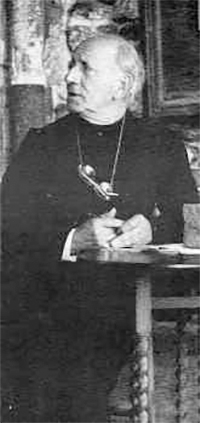
At Romford, Jack Putterill (Fig. 5) was a speaker at the public meeting:
Comrade Chairman, Tyneside marchers, and the people of Romford. I am glad to join in the welcome here to the hunger marchers. I have seen them at one or two points on the march and I know the good work they have done in Essex – how they have stirred up the towns and villages through which they have marched.
As I walked with the men along the old Roman Road from Stortford to Dunmow, their banners standing out against the brown fields of Essex, I was reminded of a previous procession that travelled this county 600 years ago. Then the peasants stormed the City of London demanding an end of serfdom.
I remembered too the splendid words of John Ball, which might well be repeated here again today:
‘Good people. Things will not go well in England till all be made common.’ This no doubt is still true but our present demands are not so sweeping. Our present demand is that this Means Test and the starvation rates must end.
In the early days I served on a Means Test Committee so I know why these men are marching to London – I know the struggle we had then to get even the bare scales, and I know how the whole family was reduced to poverty to feed its unemployed members. The burden of unemployment is on the families of the poor.
As these marchers have come through the countryside of England they have received help from all sides, from all kinds of people – from Labour parties, from Communist Parties, Co-operative parties, Liberal Parties and Religious denominations of all kinds. I was very glad to see religious bodies helping because so often religious organisations are on the other side. But these Marchers have ‘Rung our Bell’. We stand with them in their demand that all should be given the right to work and to receive the just demands of their labour. We assure them of our good wishes and thank them for marching through our County and for carrying their banners and slogans. We look forward to the time when unemployment will be abolished and a cooperative commonwealth be established here and in every land.26
Conclusion
The question can be asked: what did the hunger marchers achieve? The marchers failed to achieve their stated objective, which was work or unemployment relief at trade union rates, although they did occasionally wring some concessions from the government. However, they did promote a feeling of self-respect and independence, not just among the marchers, but amongst the communities they lived in. They did this not simply by organising against the enforced idleness and misery of unemployment in the ‘distressed’ areas, but by taking their protest to London, the centre of political and commercial power. Met with official hostility at first, the marchers steadily gained public support and admiration in the towns they passed through, resulting in the creation of local support networks that cut across political divisions. What local support meant to the marchers is encapsulated in the concluding sentence of a letter sent by hunger marcher Joe Douglas to a resident at Great Chesterford: ‘I wish to thank you for what you done for me and the other marcher. I will never forget that night and morning, the food the bed and the bath was wonderful.’27
There are times when giving someone a bed and a bath is truly a political act.
References
- See Vernon, J., Hunger: a modern history (Harvard, 2009), p. 56 ff.
- Originally called the National Unemployed Workers’ Committee Movement, a name that reflected the de-centralised nature of the movement in its early days.
- Kingsford, P., The Hunger Marchers in Britain 1920-1940 (Lawrence & Wishart, 1982), pp 33-35.
- Watson, D., No Justice Without Struggle: the National Unemployed Workers’ Movement in the north-east of England 1920-1940 (Merlin Press, 2014), p. 29.
- Watson, p. 79.
- Watson, p. 81.
- ‘Hunger-Marchers at Saffron Walden’ Saffron Walden Weekly News, 26 February 1929.
- Weekly News, op.cit.
- PRO MH 57/98 cited in Kingsford, p.105.
- Watson, p. 87.
- Hannington, W., Why Are We Marching (NUWM, 1930), p. 3.
- Pers.comm. Tony Watson, Friends’ School Archivist.
- Watson, No Justice, p. 110.
- The Reverend Doble was described by Stanley Wilson as ‘a very unusual Socialist’ who ‘never mixed politics with religion’. He conducted his services correctly and efficiently. At the same time he supported his village Labour Party and local branch of the Farm Workers’ Union, addressed labour meetings and entertained workers in his vicarage. Doble died rescuing his dog from rough seas. Wilson, S., The Mayor and the Matron, pp 57-58.
- ‘Hunger Marchers at Walden’, Saffron Walden Weekly News, 28 October 1932.
- Putterill, J., Thaxted Quest for Social Justice: the autobiography of Fr Jack Putterill , turbulent priest and rebel (Precision Press, 1977), p. 54.
- Why are we Marching? Programme of the National Hunger March to London against the Means Test (1932).
- New Statesman and Nation, 5.11.1932 (quoted in Kingsford, 1982, p. 155).
- Kingsford, pp 158-159.
- The catering was done by the local Cooperative Society. About £20 was collected in the district, the subscribers including Frances Countess of Warwick, the Revd Conrad Noel, the Revd Jack Putterill, Revd H. Doble, Cllr G. C. Maberly, Cllr C. B. Rowntree, and the staffs of the Friends’ School and the Teacher Training College.
- Sam Langley was born in 1895 in Houghton le Spring, County Durham, and started work as a miner at a young age. He served in the Royal Navy throughout WW1, and was a local leader of the 1921/22 Hunger March. He was active as a Communist and in the pro-CP Labour League of Ex-Servicemen on Tyneside in the later 1920s. During the 1920s Langley lived in Canada and the USA where he was active in the Industrial Workers of the World (IWW). (He had the IWW slogan ‘Workers of the World Unite’ tattooed on his arm.) He was deported from Canada for political activity. In the first half of the 1930s he emerged as an NUWM leader both in the north-east, and as a national speaker. He was a local leader of the 1932 and 1934 Hunger Marches; in 1932 he was jailed after a ‘seditious’ speech in Trafalgar Square, along with national NUWM leaders. He went on to serve in the International Brigade throughout the Spanish Civil War, and was wounded early at the battle of Jarama in 1936. After Spain he was active in the Wounded and Dependants’ Aid Committee (information supplied by Don Watson).
- Saffron Walden Weekly News, 23 February 1934.
- The Times of the Chesterfords (July 1976),p. 10.
- Barbara Putterill was the daughter of Conrad Noel and wife of Jack Putterill.
- Essex Chronicle, 6 November 1936, p. 12.
- Putterill, op. cit., p. 58.
- Joe Douglas to Dr Treweek, The Times of the Chesterfords (April 1979) p.7. See recordinguttlesfordhistory.org.uk/gtchesterford/Jarrow
Note: Martyn Everett is former Local Studies Librarian at Saffron Walden and Chair of the Saffron Walden Town Library Society (Now the Gibson Library). He has a long-standing interest in Labour History, and recently organised two conferences at the Labour History Research Unit at Anglia Ruskin University, Cambridge. All images are from the author’s collection.