
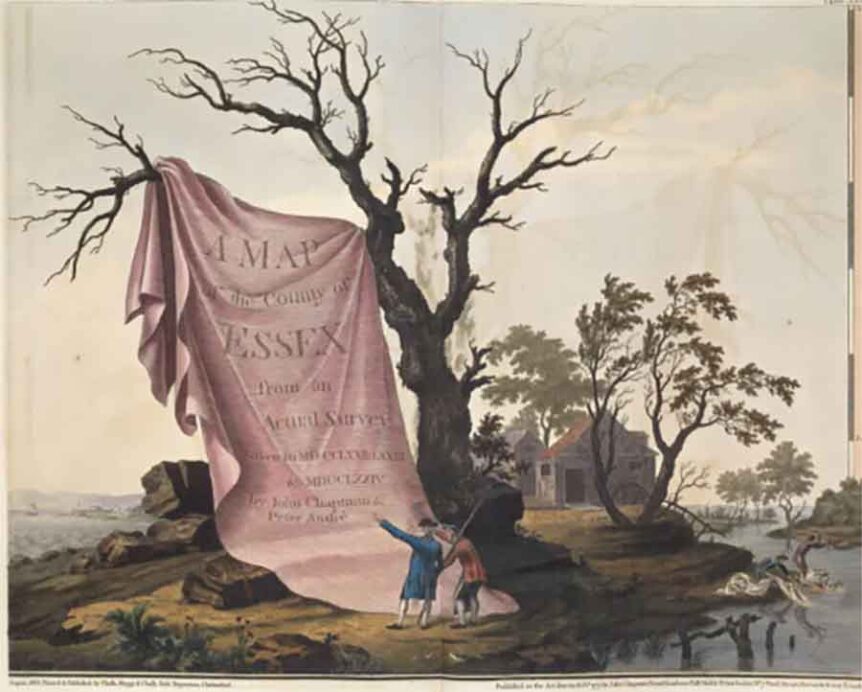
© Laurie Barker 2001
Reprinted from Saffron Walden Historical Journal No 2 (2001)
The official Enclosure Maps2 and the corresponding Awards are well known, original copies being deposited at the time in county courts and parishes. Faced with only the rather bland official Maps and the complicated text found in the rolled Awards, it is not surprising to be put off from examining these archives. There are a number for north-west Essex, ranging over the period 1805-1871.3
The questions which first spring to mind are: what was the ‘before’ situation; and what effects did the Enclosures have? This research could be carried out under a number of headings. Unfortunately very little remains in Essex of any documentation of the process leading to the final Award and Map, and is therefore obscured. Even copies of the Acts are hard to come by.
In a recent book, Enclosure Records for Historians (2000), Dr Steven Hollowell has examined what remains in a number of record offices. From this he details the history and whole process of Enclosures from inception to final completion and gives information on the documentation emanating at each stage. Leaving aside the legal and administrative documentation, surveyors and valuers – very often the same people – compiled the vital ‘pre’ information related to the existing land and ownerships. This was then used as a basis for them to draw up the final allotments after due process of consultation and agreement had been conducted by the Commissioners.
Essex Record Office
In Essex the only remaining records of a ‘before’ situation are the pre- Enclosure maps.3 Even the accompanying books and schedules to these maps were never deposited at the ERO, so that the effects can only be compared in graphic terms without a balance sheet of personal gains and losses.
Perhaps because they were rarely titled, signed or dated, a certain archival muddle and obscurity have prevented the pre-Enclosure maps even being associated with the official Enclosure documents and has contributed to connections not being made for an area of serious research.
Size and fragility has added to the difficulty of access; and photostat reductions of them were carried out at an earlier stage of technology. Photostat copies of some originals do not exist. Muddle is also compounded by the official documents not being entirely complete and photostat copies of these also not available. I have complied a tabulated list of references and availability in the ERO, based on my own researches into the ERO catalogues, which is shown at the end of this article.4
Enclosure Acts
The enabling Acts are a necessary part of the documentation. They set out the reasons for the Enclosure, appoint Commissioners and give instructions as to their powers, methods and scope in arriving at an award and in carrying the Act into execution. Surveyors were to draw up an accurate survey of the areas to be enclosed and the contents to be verified on oath. 5
The parish as existing
Surveyors would have had to record everything that existed that could be subject to the forthcoming consultations and assessments. These would include existing field boundaries and natural features, roads, trackways, accesses, rights of way, watercourses, buildings etc. The names of open fields, shotts and smaller fields would also be added. Although not intended as such by the surveyors, they serve as a valuable map record of that time. These would have been accompanied by field books recording dimensions taken and site information notes.
Schedules of land acreage in terms of arp (acres, roods, perches) for each field and strip, together with their respective owners would have been compiled; and whether the holdings were by copyhold or free and what rights were attached. These would have been keyed to the numbered pieces of land shown on the map. Numbering also avoided the problem of trying to enter personal names on small plots where the scale of the map made this impossible.
An accompanying assessment – carried out by either the surveyor with the added skills or a separate valuer would assess the value, nature and fertility of the land. These too could be drawn up in the form of schedules.
Drawing up the Award and official Map
At this next stage of consultation, the surveyor drew up a scheme of allotments, which would be the outline proposals for the official Map and Award. The pre-maps were already being used as working drawings for the use in discussions in meetings and negotiations out in the field, and were already suffering from continuous rolling/unrolling.
However, rather than producing a separate drawing for the outline proposals, these Essex maps show the draft allotments added to the parish-as existing map, and backed up by the future allottees’ names in red. All this did not add to the already complex record of strips, owner’s names, names of shotts etc.
Would it not have been necessary therefore to produce a separate draft official map for consultation purposes?
Layers: the example of the Chesterfords
The pre-Enclosure maps of north-west Essex, which set the standard of surveyor information, began with those of the Chesterfords.6 The map shows several layers of this information.
Existing field patterns – this layer depicts the legacy of medieval open fields, shotts and strips and small crofts; together with the aggregations evolved over the course of time resulting in smaller and large fields breaking into this pattern. The shotts are demarked by their names being written across the strips and given a roman numeral. However the boundaries of the open fields and the delineation of the shotts are not precisely defined and have to be interpreted. The shotts are numerous and complicated, and there is evidence the surveyor attempted to delineate them. Field names outside the open fields are also named.
The existing ownerships are written on each piece of land including the strips. And the strips for Great Chesterford are numbered, probably keyed to a field book, which gave the arp. However these field books have not survived. Many existing trackways are shown in colour also serving to delineate the shotts. There is another layer, which may represent triangulation and surveying lines. This can be seen in most clearly in the area of Chesterford Common.
A third layer relates to the final official Map and Award. Red coloured lines and personal names have been added which show the setting out in draft form of the allotments on the final map. Not all of these divisions appear on the official map. These are in many cases, straight lines, which bear little resemblance to existing or natural features.
Another layer – and the most perplexing – is a covering of the map in code letters. At first it may be construed that these were the land values. The notebooks of Barnards/ Franklins/ Jennings valuers and auctioneers (ERO D/F 35) show these firms’ individual codes. However, on the maps the same code is used for widely varying values. So what do they represent?
Comparisons with other parishes
The pre-Enclosure maps are drawn to a common scale so it is possible to compare one parish with another.
- Hadstock: much of the same features occur on this pre-Enclosure map.
- Littlebury: this is a boxed set of the map cut up into separate pieces. No photostat exists. The format follows the Chesterfords and Hadstock, although the official surveyor was Rutt of Oxfordshire.
- Wendens Ambo: although much of the field markings are shown, annotations have been reduced and no names of open fields or shotts given.
- Elmdon: this is similar in presentation but with the names of shotts added.
- Newport: this has some open fields and some shotts annotated.
- Ashdon & Bartlow: there are two pre-Enclosure maps here. One map (ERO D/DQy 36) dated and titled 1846 with a revision dated 1850, shows the field divisions in detail. A larger scale map (ERO D/DQy 37) undated and unsigned, shows even more field divisions, and must be earlier. These and the official Map of 1851 can be compared with the Tithe map of 1848.
In some instances the official documents are not in the ERO, making complete comparison impossible. All official documents should be used (Acts, Awards and Maps), as each contains different information. When the pre-Enclosure maps are compared with the official, the dramatic transformation can be seen: all the open fields, shotts and strips have disappeared.
Springboard for serious research
Firstly these maps are a record of the field divisions before being swept aside by the Enclosure. They contain field names, which would be useful to the Essex Place Names Project.
They are a record of natural features of the parish of interest to local historians. On some, farm and village buildings are shown in detail. Small crofts and tenements are also shown which may have subsequently disappeared. For those parishes not subject to the Tithe Commutation Act, they are the only map record of the early 19th century before the 1st edition of the Ordnance Survey.
They raise questions of farming practises and land use before and after the Enclosure. They also contain ownership boundaries which can be related to other historical documents. However in the absence of accompanying documents, which would provide the missing details of the personal names of the smaller pieces of land and the associated arp and holding tenure, the record of land ownership is incomplete. Other documents would have to be consulted to fill in these details.
In those parishes where Lord Braybrooke and the Earl of Bristol were major landowners, their deposited estate records in the ERO do not provide an easy route. And although the official maps clearly show these Lords’ final allotments, the pre-Enclosure maps show they possessed fields and strips intermixed with and dispersed among other landowners: a stage in the evolving pattern of acquisition and aggregation that was rapidly accelerated by the enclosure.
Lastly these maps can be related to the progress of the 19th century Enclosure legislation, to archive collections nationally and as a record of the surveyor’s ‘art and mystery’.
NOTES
- I have used this term rather than draft Enclosure Maps used by W. E. Tate in his book A Domesday of English EnclosureActs andAwards, Turner, M.E. (ed.) 1978 and similarly used by some record offices. The maps referred to, show a pre-Enclosure situation and in some cases the draft allotments for the final official maps have been added or worked on them. A Draft Enclosure Map would be that which shows a preliminary outline of the Official Enclosure only.
- I have used the terminology of the ERO & the PRO in their catalogues. But the words used in the original documents were ‘Inclosure’ & Plan.
- This article is concerned with only those Parishes where there is a pre-Enclosure Map as shown in the tables.
- The ERO’s catalogue descriptions, which are available ‘on-line’ in SEAX, are a very useful preamble to research.
- I have used the Act for Little Chesterford as a model – reference below.
- Mr Ken Kilford has produced two studies based on the Chesterford Enclosures: Great Chesterford in 1801 as revealed in the Enclosure Award (1999) & Little Chesterford in 1801 as revealedintheEnclosureAward(1998), published by the Chesterford & District Local History Society.
PRE –ENCLOSURE MAPS
| parish | ref EROD/DQy….. | scale 1mile= | original | map size & photostat reduction |
| Gt & Lt Chesterford | /26 | 26.6.in | rolled – care reqd. | 94 x 70 ins yes |
| Littlebury | /27 | 26.6 in | boxed set of sections | 96 x 82 ins no |
| Hadstock | /28 | 26.6 in | rolled – care reqd | 48 x 57 ins yes |
| Wendens Ambo | /31 | 26.6 in | rolled – care reqd. | 60 x 54 ins yes |
| Saffron Walden | /32 | ? | fragile not to be produced | ? no |
| Wenden Lofts & Elmdon | /33 1824 -1829 /34 northern ½ | 13.3 in 26.6 in | 57 x 39 ins yes 119 x 74 ins yes | |
| Ashdon & Bartlow | /37 /36 – 1846 & rev 1851 | 26.6 in 13.3 in | 106 x 91 ins yes 76x 60 ins yes | |
| Newport | / 35 – 1840 & rev 1858 | 26.6 in | 76 x 60 ins southern ½ only | |
| Widdington | /38 | 26.6 in | missing from ERO | 76 x 51 ins no |
OFFICIAL ENCLOSURE AWARD (A) & MAPS (B)
| parish | ref ERO Q/RDc… | Act Award | scale of map 1mile= | commissioners | surveyors | mapsize & photostat reduction |
| Gt & Lt Chesterford | /8 & 9 | 1801 private 1804 | 13.3 in 16 in | J Dugmore Edw Hare M Nockolds | J King | 40 x 35 ins 25 x 30 ins both yes |
| Littlebury | /6 | 1801 private Jan 1805 | 13.3 in | R Davis Edw Hare M Nockolds | Wm Rutt | 49 x 41 ins yes |
| Hadstock | /7 | 1801 private Oct 1805 | ? | J Dugmore Edw Hare A P Driver | M Nockolds | ? yes |
| Wendens Ambo & Arkesden | /18 | 1814 private 1819 | no official map at ERO | A Jackson J Josselyn M Nockolds | J King | no |
| Saffron Walden | /25 | 1812 private 1823 | 7.2 in | A Jackson M Nockolds | J King | 39 x 35 ins yes |
| Wenden Lofts & Elmdon | /26 | 1824 private 1829 | 13.3 in | A Jackson M Nockolds | J King | 54 x 39 ins yes |
| Ashdon& Bartlow | /39 | 1836 1851 | 13.3 in | R Franklin M Nockolds | J King | 45 x 36 ins yes |
| Newport | /53 | 1856 prov o 1861 | 26.6 in | Inclosure Commission | C F Adams | 68 x 45 ins yes |
| Widdington | /18 | 1866 prov o 1871 | no official documents at ERO | Inclosure Commission | S J King | award = T/A 724/1 map = TS/M 63/28 |
prov o = provisional order under the General Act of 1845.
D/ DYo 2 is an unofficial Enclosure Map of Arkesden dated 1821
COPIES OF ACTS/ORDERS in the ERO
Lt Chesterford D/DhtE27; Littlebury D/P 9/28/1; Wendens Ambo & Arkesden D/DSs/E3