
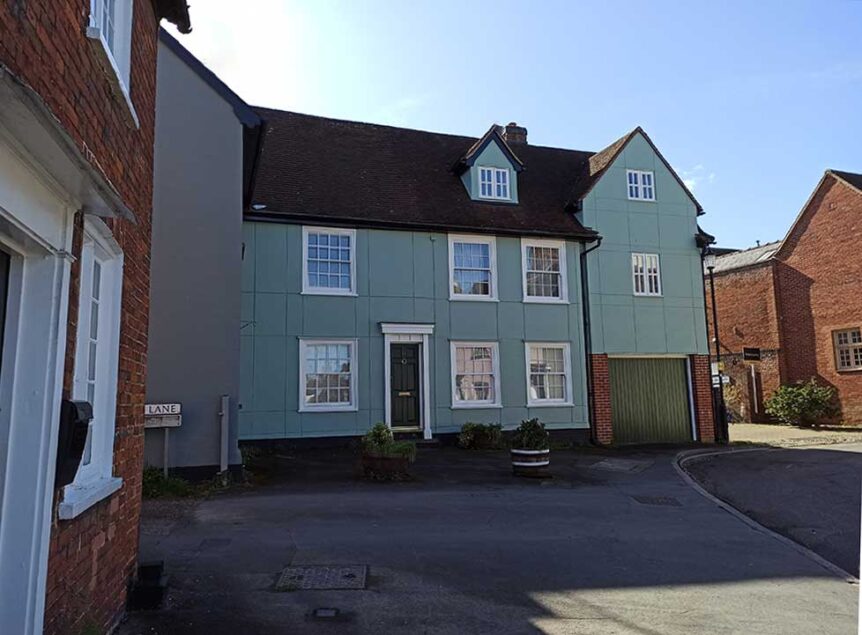
© Malcolm White
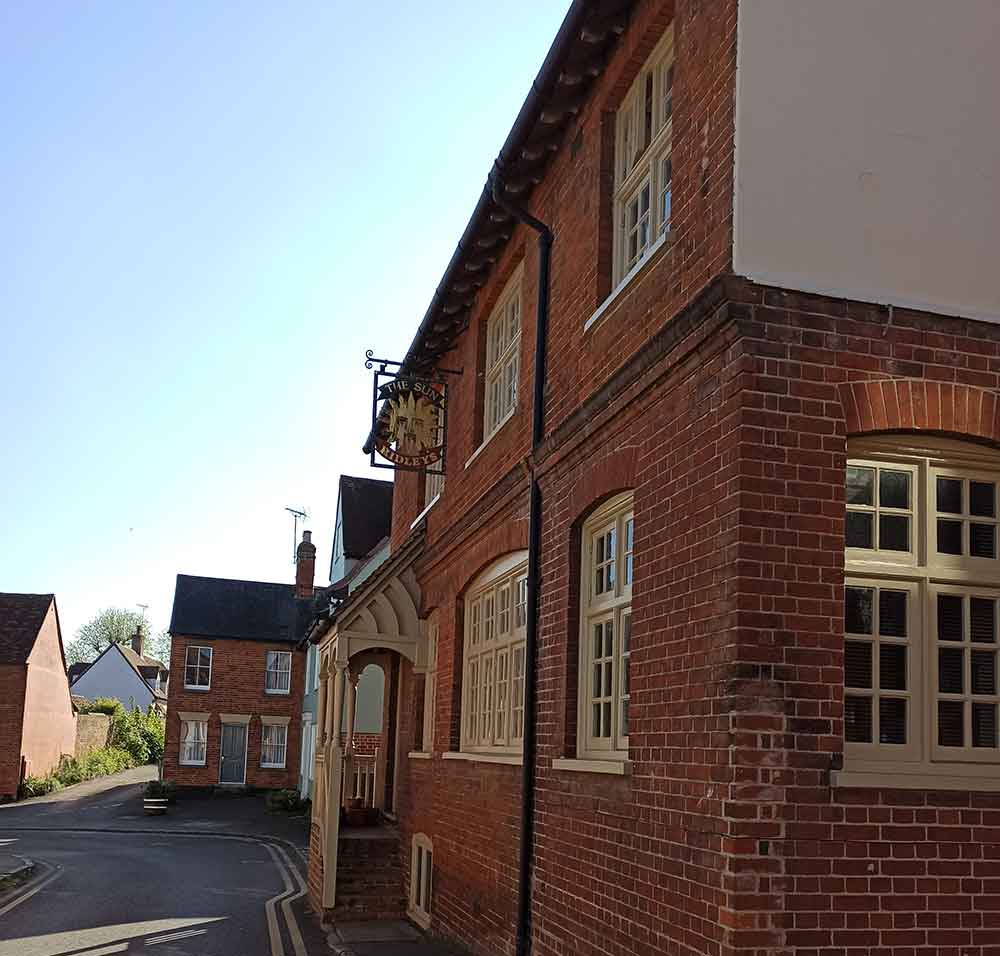
The above featured image is of the top of Gold Street, Saffron Walden in 2026. © Saffron Walden Historical Society
First published in Saffron Walden Historical Journal No. 32 Autumn 2016
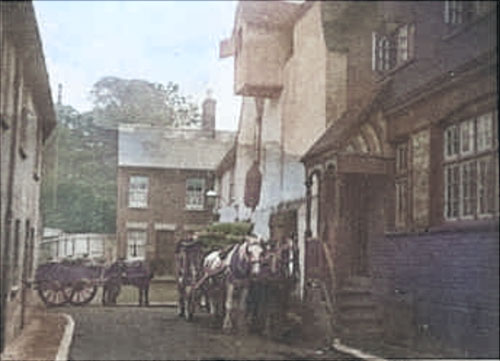
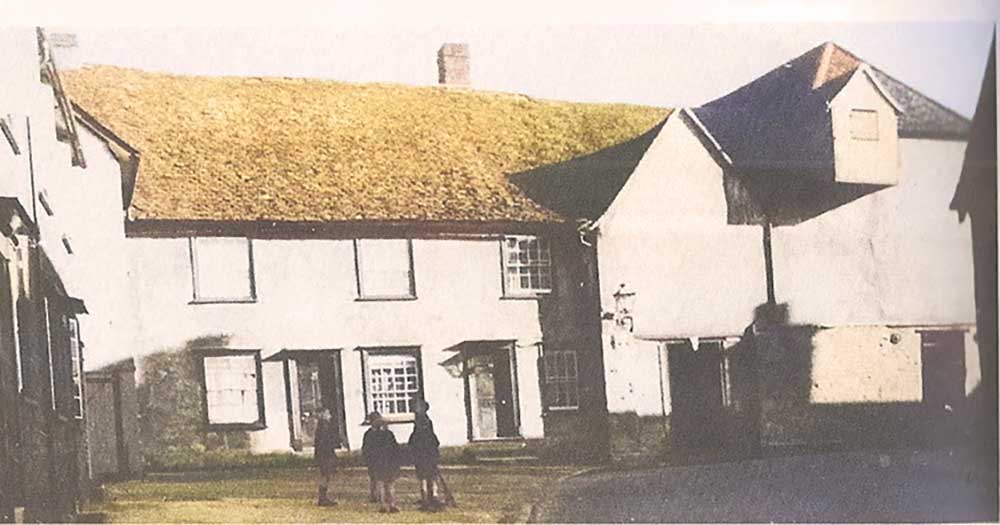
Colourised image: Stacey, H.C., Saffron Walden in Old Photographs (1980), photo 26.
It seems ironic that the biggest fire in the town during the Second World War was not caused by enemy action, but through what was probably an electrical fault. Nevertheless, the fact that it was a simple accident does not detract from its severity. The fire, which occurred on Saturday 12 July 1941, was in a food depot owned by Messrs Sainsbury’s who had moved a number of their grocery warehouses out of London specifically to avoid the dangers of the Blitz.
Before the war, Sainsbury’s main depot was situated in Blackfriars in London, close to and convenient for the London docks. However, once the Blitz started it became obvious that the Blackfriars area was vulnerable to enemy air attack. In addition, the limited supply of fuel, and government restrictions on food movements to no more than 60 miles, meant it was sensible for Sainsbury’s to create a number of depots away from London, and closer to distribution routes. Four new depots were created, three to serve the south-east – Saffron Walden, Bramshott in Hampshire and Woolmer Green in Hertfordshire; and a fourth to serve the Midlands, at Fleckney in Leicestershire.1 The Saffron Walden warehouse was situated at the southern end of Gold Street.
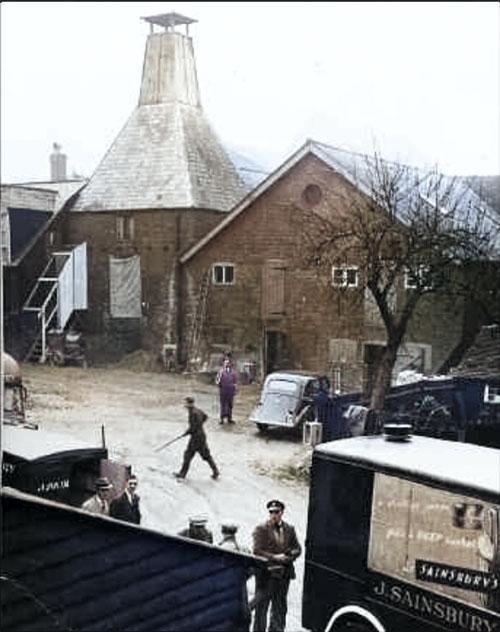
Colourised image by courtesy of Sainsbury’s Archives.
The building itself had been a former maltings and was now disused. 2 On its eastern side it adjoined a pair of cottages, 53 and 55 Gold Street and on its western side, the Sun Inn (Fig. 1). The building also contained a dormitory used by staff.
It was a large site going back as far as the rear of the maltings then in Audley Road. Today, the site is more or less occupied by Oasthouse Court. The warehouse contained a substantial amount of foodstuffs, including perishable goods. Amongst other things, it contained sugar, soap, and ‘thousands of bloater paste jars.‘ 3 It is not now certain how much food was kept there, although contemporary reports talk of ‘many tons of foodstuff’, but as a major supplier for the County and at a time of extreme food shortages, it was clearly an important supply depot (Fig. 2)
The fire probably broke out at about 9pm, when Mrs Elsom, licensee of the Sun Inn, noticed that the wall in the pub adjoining the depot was getting hot. Fire-watchers employed by Sainsbury’s had carried out an inspection earlier, but at 9.15 pm they saw smoke coming out of the dormitory window. A number of staff, who had been evacuated from London to run the depot, slept in the dormitory, but at this time were out in the town. At 9.24 pm, one of the staff, Mrs Lambourne, raised the alarm on her return to the dormitory.
Daphne Cornell, who was later to become Town Mayor, was then a young girl and lived at 53 Gold Street with her sister, parents and grandmother. She remembers seeing smoke in the building at the rear of the Sun Inn and being told to run down to the fire station and alert the Fire Brigade.
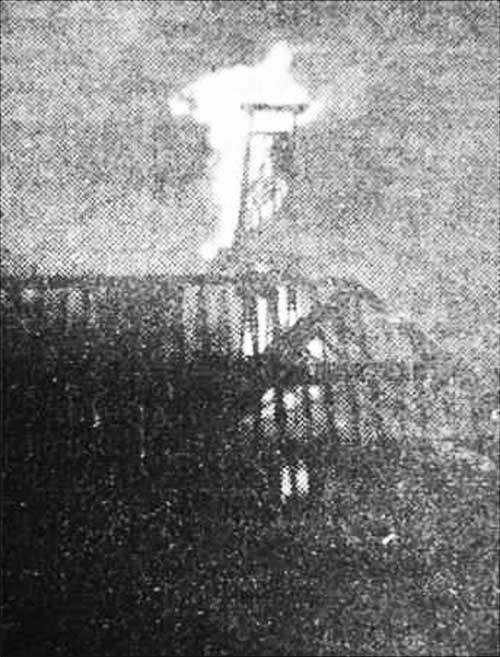
Chief Officer Crickmore set both his men and the AFS to work immediately, but initially, they were hampered by low water pressure. Their first concern was to prevent the fire spreading to the adjoining cottages or the Sun Inn. The low water pressure was a particular problem. A trailer pump was brought in, in addition to the main engine, but the lack of water pressure made efficient handling of the hoses practically impossible. Numerous people tried to help by using stirrup pumps and trying to beat out the flames with a variety of equipment. Some men even tried to help by climbing ladders and scaling beams in an attempt to pull down burning timbers (Fig. 3).4
Meanwhile, local people had arrived, including some soldiers who were billeted at Hill House in the High Street and others camped in Audley Park.5 Together with civilian men and women, the soldiers and airmen formed a human chain to try to salvage as much food as possible. Initially, this was a free-for-all, but once the police arrived, led by Police Supt H. K.Faulkner,6 the crowd was organised so that the food could be brought out quickly. Donald Purkiss remembers that he had just left the Plaza Cinema wearing a new sports jacket when he saw the flames. He rushed to help with removing the food, but his new jacket was completely spoilt by lard, melted by the heat of the fire! Fortunately, through the selfless actions of the public, a considerable quantity of food was saved with, according to the Mayor Ellis Rooke, only ‘a few hundredweights of food being completely destroyed’.7
At this time the fire service was in a state of flux. The town brigade was run by the Borough Council, and the volunteer members were being helped by personnel of the Auxiliary Fire Service (AFS). The AFS had been formed in 1938 as part of the Civil Defence Service. Its role was to supplement the work of brigades at local level and often it could be hampered by the incompatibility of equipment.
However, although there were difficulties in fighting the fire, this does not seem to have been a problem in this case. The Fire Brigade arrived quickly, but the flames were spreading rapidly. There had recently been a spell of hot weather and the old maltings, constructed of dry, dusty timbers and plaster and with numerous draughty areas, quickly caught alight. In addition, the dormitory itself had numerous flammable materials in the form of blankets, linen and clothes, which added to the speed with which the fire spread.
However, the enthusiasm of the large crowds did cause some problems and, according to the Saffron Walden Weekly News, ‘It is possible that a number of casualties would never have occurred had the people concerned been more attentive to instructions issued to them’.8 There were a large number of minor casualties, many treated on the spot by a medical officer from RAF Debden, but five men were kept in hospital overnight suffering from smoke inhalation and five other men were kept in hospital for a number of days, suffering from burns, head injuries and concussion.
Colourised image: Stacey, H.C., Saffron Walden in Old Photographs (1980), photo 27.
At the height of the conflagration, flames reached over 50 feet high, but slowly and gradually the Fire Brigade gained control, such that by 11 pm the fire was under control and was completely out by 2 am. The front of the Old Maltings and 55 Gold Street were almost completely destroyed, but the adjoining cottages were only slightly damaged and, although the roof of the Sun Inn was burnt down, the pub still opened for business the next day!
There was also some collateral damage. Daphne Cornell remembers that because of concerns that both 53 and 55 Gold Street might be badly damaged, volunteers removed the windows of both houses and took all the furniture out.
However, in the midst of the fire it was suddenly realised that there was a lorry full of petrol in the yard. It was quickly driven out, but unfortunately in its haste it drove over the furniture causing considerable damage. The occupants of number 55, Mr and Mrs Ashman, were away, but Daphne and her family were immediately taken in by the Matthews family who lived in number 42 Gold Street. The next morning they returned to their house which was full of water. Daphne remembers her excitement, as a young girl, at being able to jump in the puddles in the house, but she also remembers her mother sobbing quietly. No. 55 Gold Street remained derelict for a number of years until it was made into part of 53 Gold Street in the 1950s (see Figs 4 & featured image above).9
In the aftermath of the fire, there were a number of concerns expressed and the whole question of how the fire was dealt with was considered at the next meeting of the Borough Council, who at that time had responsibility for the Fire Brigade. Whilst the crowd had been helpful, particularly in removing the foodstuffs as quickly as possible, they had also hampered the firemen, even to the point, that at one stage ‘some unauthorised people were struggling with the firemen for possession of the hose’.10 There were also allegations about the way in which the fire was tackled, but the Council dismissed these and, indeed, congratulated the brigade for the way in which they had both handled the fire and prevented damage to other properties. Concern had been expressed, even before the war as to whether there would be sufficient water in the event of a large fire, and static water tanks had been placed around the town.11 In the event the water supply was sufficient.
However, the more serious question was the apparent lack of water pressure. Over 100,000 gallons of water were used in dousing the fire, and the Mayor explained that, although the Fire Brigade were not getting the pressure they needed immediately, within ten minutes the pumps were in full working order. Some problems were also caused by lorries being removed from the yard and driving over the hoses.12 The Council agreed to replace lost equipment, including leggings, blankets and fire axes, and a new tank for one of the trailer pumps.13
This was the last major fire that the Fire Brigade fought under the auspices of the Borough Council, since in August 1941, both the Auxiliary Fire Service and the local brigades were superseded by the National Fire Service.
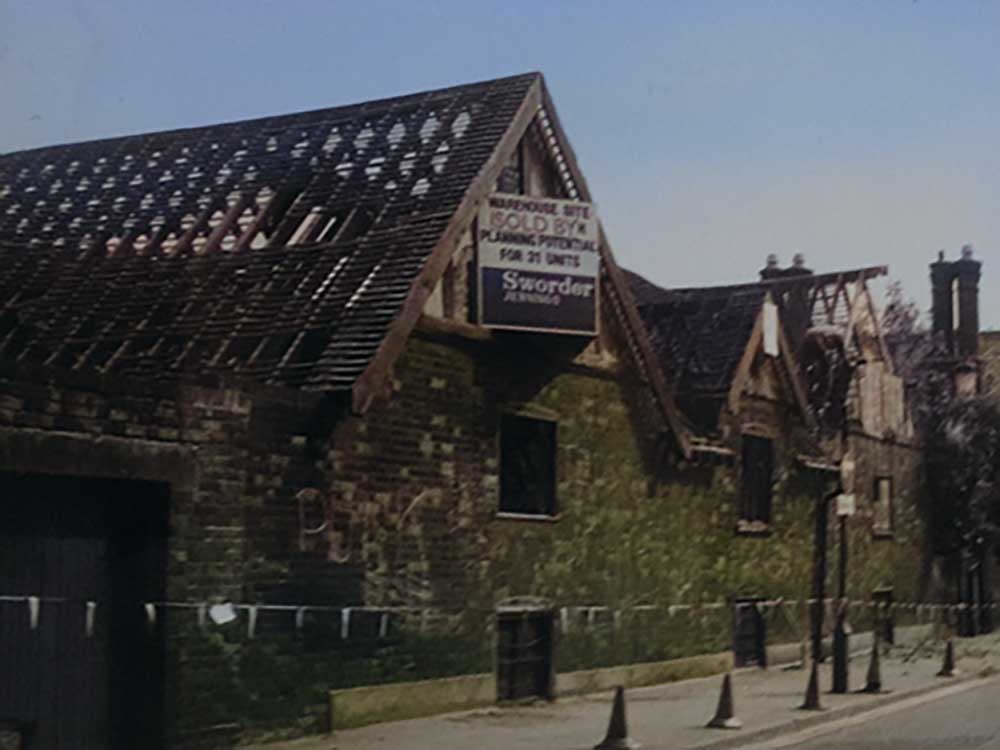
As to the buildings, the frontage onto Gold Street including the hoist overhanging the street was totally destroyed. Once that part of the site had been cleared, it was made into the loading and unloading bay for the warehouse behind.14 These buildings remained in use as a warehouse by Sainsbury until about 1971. They were eventually demolished in 1978 to make way for Oasthouse Court (Featured image above).
Acknowlegements.
The author wishes to thank Sarah Drewery of the Sainsbury Archive for her help, and permitting access to the archive; Daphne Cornell and Donald Purkiss for their reminiscences of the fire; and Kate White for her assistance and help in research.
References
- Sainsbury Archive SA/DEP/7.
- Stacey, H.C., Saffron Walden in Old Photographs (1980).
- Sainsbury Archive SA/DEP/7/3/1.
- Saffron Walden Weekly News (SWWN), 18 July 1941.
- Pers. Comm. Daphne Cornell.
- Herts & Essex Observer, 19 July 1941.
- SWWN,18 July 1941.
- SWWN,18 July 1941.
- Pers. Inf. Daphne Cornell.
- SWWN,18 July 1941.
- Saffron Walden Borough Council minutes, 1939.
- Herts & Essex Observer, 19 July 1941.
- SWWN,15 August 1941.
- Stacey, op.cit., p.26.