
© Zofia Everett
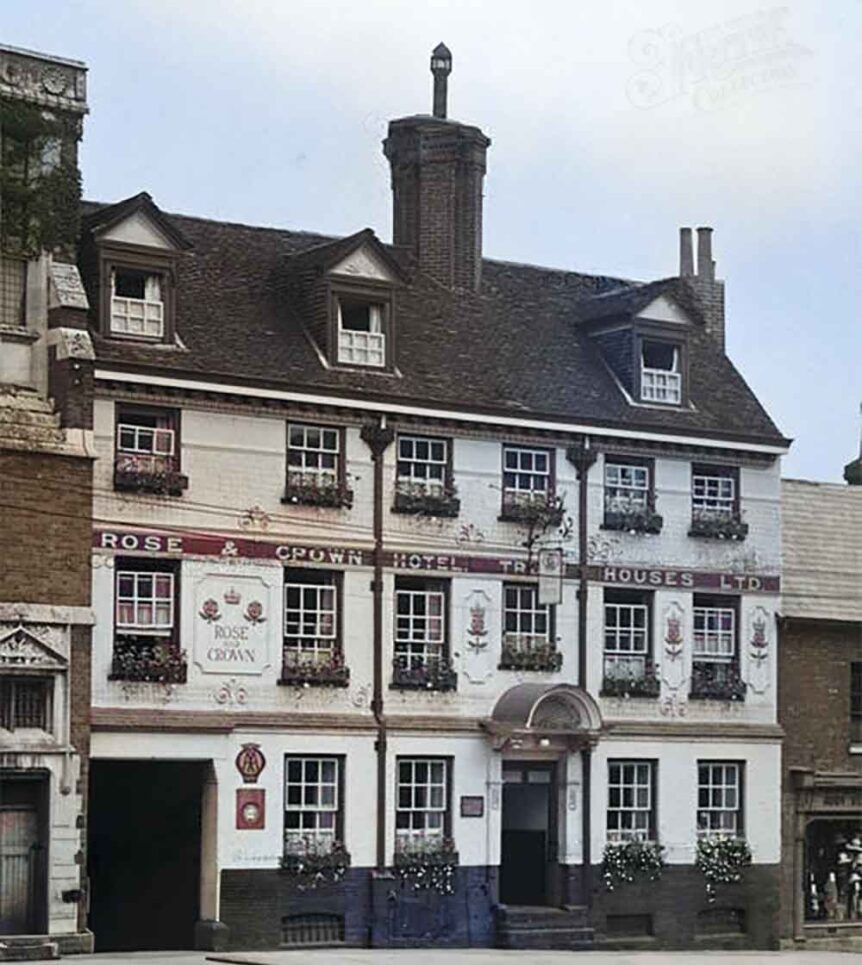
The colourised featured image above is © Francis Frith Collection
Reprinted from: Saffron Walden Historical Journal No 16 Autumn 2008 with recent updates.
The Fire that changed the law in the United Kingdom
December 2009 marked the 40th anniversary of the tragic fire at the Rose & Crown Hotel in Saffron Walden, during which eleven people lost their lives. This was the greatest tragedy to face the town in the 20th century, affecting many lives and permanently changing the appearance and the character of the Market Place, as the Rose & Crown occupied a unique position in the social life and the history of the town.

Prominently situated on the eastern side of the Market Place where Boots the Chemists now stands, it provided a focal point for gatherings, meetings and celebrations for all strata of local society for many centuries, as illustrated by a piece from the Observer 1 April 1911:
‘Saffron Walden During the last half Century’
The Market Dinner Bell
Half a century ago, the Corn Market was a busier place on Market Day than it is to- day. Corn then made a good price and farmers were doing well. At three o’clock a bell was rung and many farmers and merchants who attended the market would then adjourn to the Rose and Crown Hotel for dinner. On some occasions 40 or more would dine Together, and they thought nothing of it costing from 7s 6d to 10s per head. These were the days of port wine and brandy and water after dinner (there was very little whisky drunk then), with the long churchwarden pipe and birdseye tobacco. The old Sun Inn, (famous once as the headquarters of Cromwell and his Ironsides) was open then, and there also a good market dinner for well-to- do farmers was provided. Since then seven of the licensed houses in the town have been closed.1
Half-a-century later this tradition continued. Bruce Munro, local auctioneer and knowledgeable local historian, remembers exactly such events at the Rose & Crown every market day in the 1960s. He remembers:
It was a farming town. Today it has nothing to do with farming, in those days it was 90% to do with farming. It was a real market town. Everything, machinery, dealers, insurance agents, auctioneers, visitors… it all related to farming… through the Corn Exchange you got dealers, porters, farmers and lots of people who came to watch…then the cattle market with butchers, dealers graders… Afterwards they met at Rose and Crown, the White Horse and the Dog and Gun. In those days, pubs closed at 2 or 2.30, but on the market days they were open all afternoon… At the time every market town had a Trust House style market town hotel.
Bruce recalls the appearance of the building:
It had a pargetted front, very handsome – beautiful façade, antiques… In the early 20th century pictures you can see the grapes, they disappeared. When Rooks were doing some work on the hotel in the 1950s they discovered the grapes in the stables at the back… There was a lovely dining room upstairs and when I came, it was Bill Hunt and his wife who ran the hotel.
Bruce remembers some business people who met there regularly such as big farmers, and local businessmen like Mr Stevenson, who owned Walden Dairy, and Ron Hockley, the Building Society manager. After the election, regularly won by ‘Rab’ Butler, the M.P., the election committee would meet for a celebration dinner at the Rose & Crown. The Town Councillors and other committees used the Rose & Crown for business and special occasions.
Shakespeare may have performed at the Rose & Crown in 1606, and William Winstanley, the prolific 17th century writer and pamphleteer who lived in Saffron Walden and at Quendon, started his famous ‘perambulation’ from Saffron Walden to London in 1677 at the Rose & Crown:
I'll show you whence my Journey I did trace:
'Twas from the Rose and Crown, where Mr. Eve Doth keep a House like to an Under-sheriff;
There is good Sack, good French-Wine, and good Beer. And if you'll dine or sup, there is good cheer:
Or does your stomack to a Breakfast stand, There's cold roast Beef, or Pork at your command. For those men who the truth of this deny it,
Let them go there, and do as I did, try it;
There for your money you shall have kind usage, Good words, and reckonings right, without abusage.2
C.B. Rowntree, headmaster of the Friends’ School and prominent local historian, undertook extensive research into the history of the Rose & Crown, examining more than 30 documents, deeds of conveyance and extracts from wills, giving the names of owners of the property from 1604 down to the present time. In 1622 William Holgate purchased The Angel, and in 1623 he also purchased the Rose & Crown which was in the adjoining building. The properties passed on to his daughter Jane and then to his grandson.
In 1681 it was sold to Edward Eve for £250 (the landlord mentioned by Winstanley in his book). In 1695 Richard Reynolds the maltster, and sometime mayor and treasurer of Walden during the reigns of Charles II and James II, purchased The Angel. In 1698 William Patch became the owner and 50 years later William Flower owned both Inns and joined The Angel and The Rose & Crown through the upper floor, creating the long room, a perfect place for special celebrations and big gatherings. He also converted the ground floor of The Angel into two shops, which later became one.
In 1796 William Wiseman, draper and grocer, owned both properties. Wiseman unwisely speculated in malt and ended up bankrupt, and the properties were transferred into the hands of his bankers, the Gibson family. The Gibsons decided to demolish The Angel and built the Gibson & Tuke Bank (now Barclays Bank). Great care was taken in selecting a suitable architect, capable of designing a building for the most prominent location in the town. They chose Eden Nesfield who designed a magnificent Arts and Crafts building.
The Rose & Crown however, is much older than the surviving documents show, and Rowntree provides information giving clues to the times in the life of this Inn before 1623. He points to two clues: the name and the bunch of grapes. It was the only Inn in Saffron Walden with a sign that was different from its name (the plaster work, showing roses and crowns was a modern innovation). The bunch of grapes, three feet high, apparently carved from a single piece of black oak, and gilt coloured, was the ancient sign on the Rose & Crown.
Old deeds are marvellous for details and some give the names of previous owners, generations before, and some give old names of properties. A deed from 1622 records that the Inn was ‘once known as the Rose’. The date when the Inn probably acquired the name of the Rose was in 1359 when John of Gaunt became the new lord of the manor. The third son of Edward III, John was Duke of Lancaster, and the Lancastrian emblem was a red rose. His son Henry succeeded him, later taking the throne from Richard II and becoming King Henry IV. Henry’s emblem as Duke of Lancaster was a rose, and when he became king, his emblem was enriched by the addition of the royal crown. Rowntree suggests that the name of the Inn was changed at the very end of the 14th century from the Rose to Rose & Crown in honour of its new lord of the manor.
However, Rowntree argues that it is probable that the Inn existed long before it changed its name, as the bunch of grapes was the early common sign for all the inns: ‘This was a truly ancient Inn which was the heart of this town for more centuries than we can guess’. Rowntree concludes his account with the Gibsons transferring their business interests from brewing to banking and selling The Rose and Crown to Trust Houses Ltd.3,4
The rest of the tragic history of the Inn is well documented in official reports and newspaper articles. I am going to relate the last hours in the history of this building using information obtained from interviews with people who were caught up in this tragedy.
December 1969
Paul Landsman was 15 at the time, a student at the County High School and the son of Diana and Emil Landsman who were managers at the Rose & Crown Hotel. They worked for Trust House Forte and had been in Saffron Walden only 21 months. The hotel had been losing money at the time, and Trust House Forte decided to appoint experienced managers to reverse this downward trend. Diana Landsman’s family kept pubs and hotels so she had a great deal of knowledge and experience in this type of business. She was very methodical and organised, a trait which proved of great value during the fire. She had a sense of style and could make the most unappealing of places into inviting, welcoming surroundings, all topped with a sprinkle of glamour.
Emil Landsman was Polish, of medium height and a quietly-spoken man, with impeccable manners. He spoke with an unmistakable Eastern European accent and possessed an ability to inspire great loyalty in his staff. During the war, he fought with the RAF and was highly decorated. His personal story deserves an article of its own. When he was discharged from the RAF, he and his wife decided to go into the hotel business. In a short time they transformed the way the hotel looked and operated.

Paul Landsman remembers it well:
I think most people know it from postcards, which are still available, with 18th century white plasterwork, with red roses and gold crowns on it and window boxes – very Georgian looking with a big canopy which is, in fact, still in the yard. It used to be three steps you used to go up the steps… and you went in to the foyer, there was a double door, there was a Rose & Crown, Edwardian, in etched coloured glass… there was a residents’ lounge on the right – which I remember being in red, with a Georgian fireplace, two windows very nicely furnished with – some antique furniture, some modern. There was a William IVth card table in one corner, a William IVth bookcase. When we came, there was a Queen Anne desk under the window and then numerous chairs around… I can remember a very large Chinese plate on the wall, there was the bar and that was half-panelled, painted cream and a big old print of Audley End house… and various maps and things like that round the room. There was also a list of the previous managers of the Rose & Crown… Upstairs – you faced the reception which was on your left as you came in and you went up, straight upstairs, a beautiful 17th century staircase, all turned. Then you doubled back and there was a long corridor with bedrooms, another archway to the right led to other bedrooms… and you went up another three or four steps and you came to a big dining room which was panelled, primarily in oak (see image above). The kitchen was on the right and the Still room was on the left but, before you came to that, the staircase went up to another room, it doubled up again and that took us up to our flat on another floor… And then again, the staircase wound up further and there were bathrooms and other bedrooms higher up. So it was quite a compact building but it went a long way back.
Paul gives a very good description of winding corridors and rooms on many floors, reached by a narrow twisty staircase, it was this layout that later hampered the rescue efforts.
Downstairs, when you went out of the Rose & Crown, in the yard there was what was known as the Tap room but that had been turned into the staff room and, thank heaven, most of the staff used that… Most of the staff were staying there, except for one waiter who was, unfortunately, on the top floor and on the night of the fire, he jumped from the roof and killed himself.
Paul remembers some of the regulars, who were governors from Friends’ School, and local doctors, solicitors. Paul’s school teachers, Mr Maidment and Mr Ferguson came on Saturday nights, and he remembers the crew and actors engaged on the film, The Battle of Britain.
Also there was a big room where you could bring the children and you could bring grandma, who perhaps didn’t want to sit in a bar. They could sit comfortably… And we used to have a lot of students come, and they used to use the lower part because the step was one down… .they were made welcome, they didn’t have to buy pint after pint if they wanted to spend the evening there. Dad said ‘Keep to that area, that’s your area, no problems, leave the other guests’ area – that’s fine, that’ll work.’ And it worked beautifully. We never had any trouble with them…5
Paul remembers that before Christmas:
We decorated traditionally – Christmas tree at the bottom of the stairs and one in the dining room and then we had a small artificial one in the flat. Then mother used to put greenery out, just make it look traditional and rather nice and festive. But not so that it hampered the work of the hotel…Mother would just check the dining room and make sure everything was working, she started that night with the candles and what have you. And very often Chef would put a buffet out, so that looked rather nice. But that was only part of it, he would still cook food. Typical menu would be fruit juice, paté, salmon or something like that, and then an entrecote steak … oh what other things did we have? Curry perhaps, two or three choices like that and then there would be home made pies – apple pies, cherry pies, lemon meringue pie, ice cream, cheeses, coffee … plenty of it. The chef was very good. He was Polish – before he died he won the top award from Trust House Forte… So he was good… Going back to Christmas, we would get dressed, mother expected a certain standard of dress and we’d go down to the bar and say Hello to everybody. We’d have a drink and go into the area, make sure everyone was enjoying themselves…We had a lot of contact with the guests, it was inevitable…We worked round the hotel. People may think it is a glamorous life but it is damned hard work.
The hotel was full that Christmas 1969. The guests were from London, some from Kent, Ipswich, Walthamstow, Canvey Island, Spalding and even America. After a sumptuous lunch and buffet in the evening, the guests retired to bed and Emil Landsman checked all the rooms and locked up for the night. According to the newspaper reports, most of the staff who lived in, went to a party. In total there were 33 people sleeping in the hotel when the fire broke out. About two hours later, Emil Landsman was woken up by people shouting. At first, he thought that it was the late night revellers returning home, but he soon realised something was wrong. Paul Landsman remembers that ‘we were yelling and shouting and Daddy had gone down the corridor’. Inside the flat was the fire alarm which Emil Landsman activated and he also rang the fire brigade. The call was received at 1.47 a.m.
He went to open the flat door and literally it was a sheet of flames. He burnt his hand and it was impossible to get down, then he went down the roof, got down, got the ladder, next door – one down, there was a couple he said ’stay there, I’ll get you when I got the lad out’. He said ‘Climb out and hang on the sill. Diana climb out over Paul and I will catch you’. And that’s what she did, luckily because of the adrenaline, I could hang on. My mother wasn’t heavy but she was quite heavy when it is just you hanging there. So he got mother down, came back for me saying ‘All right, I’ve got your legs and when I say Go – let go’. So I let go and we fell on the roof, rolled and my father caught the gutter and held on so we straightened ourselves up and got down and he said to go down the yard and find mother. Then he went to help the couple that were there, then he went to the front to help whoever he could. There were two men standing there, outside the Town Hall, he said ‘For God’s sake hold on to the ladders’ – they didn’t want to know and he never forgot it… Anyway he went up to help one woman and she said ‘I can’t, I’ve had a hip operation and I can’t get my leg over’ and he said ‘Look, if I hold you, you’ll do it’. She said no and went back, disappeared and died, then I think he helped one or two other people … anyway, just before we got out, my mother picked up a bag of family documents which she always kept from the war and she threw them out, she also threw out the toy poodle, saying it was better she died in the yard rather than in the fire. Luckily, she survived. She landed on her paws and shot up to the far office. When we went up to the store room and gathered everybody there, my mother had a list of all the guests. And she had all the business papers, all the stock room papers, everything, it was a godsend.
Paul recalls that the fire brigade arrived ‘Oh, very quickly considering it was Christmas, I could not praise them enough, absolutely fantastic – there was not a lot they could do, just put it out and stop it spreading to the other buildings – because we were joined to the bank and to the bookshop.’
Chris Phillipson was 20 years old, a retained fire fighter at station 79 in Saffron Walden. He started training when 19 and had served for only nine months when called out on that fatal night. He remembers that the house bell rang (all retained firemen had a special GPO line put in …a box with bells). By the time he got downstairs, his sister Wendy was waiting at the bottom, ready with his fireman’s tunic and helmet.. Riding his moped he came down Usterdale Road, Little Walden Road, Common Hill:
I remember coming on the side of the Common and looking across – you could see this angry looking cloud hanging above the town… Back at the Rose and Crown you could see what it was… Got to the station , there were couple of firemen getting kitted out. Within a minute we were leaving the station with the first appliance with a crew of four, Ron Green, Tom Cook, Dave Vincent and myself. We were the first crew to arrive and the sight which I will never forget was – almost in every window there were people hanging out, shouting for help to be rescued. I remember one gentleman in his pyjamas having hold of Ron Green, saying ‘look my wife is there – get her out – get her out’, At the time we only had one escape ladder… there seemed to be a lot of people milling about – whether evacuated I wasn’t sure… I was sent to the hydrant which is in the corner by Tourist Information – run hose to the appliance and from the appliance to the fire and my claim to fame is that I got first water… To work on the fire in the front room’.
(Later the coroner’s report confirmed that the most probable cause of fire was the television set in the lounge where the fire seemed to be most intense.) Chris remembers that fireman Tom Cook was sent to the back alley to check on the fire exit door that he found locked. On the way he tripped on something and looking up he saw that it was a body, someone who jumped out of the widow. As he ran back to report and was about 20 feet away; ‘This body – it got up and groaned at him- he said – every hair on his body stood on end. He leapt up this corridor as fast as he could’.6 After about 2 hours:
I went round the back – it is like a dog’s leg, as you walk up there, where Gluttons is now… I took over on another jet from a chap there… up on the wall on the bank side was a crew from Bishop’s Stortford – they called ‘stand back – the wall is going to go, and the wall fell out….One of these silly things – if you drop your hose you are always told to run forward, because the hose can fly backwards, if you go forward, you get wet but you don’t get hit by the branch. I thought, there is no way that I am running forward – so, I turned around and started to run forgetting that there was a brick wall there. I went smack into it. All I could hear is this wall falling down behind me…. leading fireman Albert Mummery – he actually did go forward and we saw him disappear in the cloud of dust – and what he has done – there was a door which led to the kitchens and he just stood in this doorway …
Did he calculate this – I asked Chris? ‘No, it’s just if you drop the hose you ran forward and that is what he did, he did what he was trained to do.’ The firemen on the scene faced extreme conditions of smoke and heat, their rescue efforts were further hampered by small sash window openings and window boxes. The first two crews from Saffron Walden were equipped with a 50-foot wheeled extension ladder, first floor ladder and a builders’ ladder from nearby scaffolding. The firemen rescued nine people from the front of the building. The official report by the Officer in charge, Station Officer F.C. Drane (see below) is particularly chilling. In terse statements, he noted minute-by-minute as the charred bodies were recovered from the devastated building, firemen fighting every inch in the suffocating inferno.
Date and time of call:
1.26/12/69 01.47
2.Time of arrival 01.52
3.Make up message from retained station officer 01.59
4.Message at 02.37 states that 6 persons are still trapped
5.Message at 02.56 A range of buildings 150 x 150 feet used as hotel, bank and ancillary buildings, about half wall alight. Persons still being rescued. Make ambulances four, (Note: an ambulance was automatically ordered on the first make up)
STOP.
From Chief fire officer time 04.57
Buildings of 3 and four floors about 60×150 used as a residential hotel severely damaged by fire and half of roof off . 12 jets, 1 turntable ladder monitor & 10 BL sets in use. 18 persons escaped by regular and irregular means 2 persons injured and removed to the hospital by ambulance, 6 bodies recovered, 4 persons still unaccounted for.
Future message time 06.25 A total of 8 bodies have now been recovered.
Further message 10.20 One female body has been recovered. Two persons are still missing.
Further message (from Chief Fire Officer) 11.24 Two bodies have now been recovered. A total of 11 bodies have been recovered. All persons accounted for. Number of calls made 2 at 01.47 & 01.51.
First attendance PE No 79 Station Saffron Walden.
Time left the station 01.51. Time arrived at fire 01.52.7
I watched that fire from my bedroom window. I had come from Poland to study English and worked as an au pair girl for the family of Mr and Mrs Coe, looking after their three children. Frances Coe, was a daughter of a well-known local builder, and she and her husband lived at The Priory overlooking the Common. I was enchanted with the beautiful old house and the location. My bedroom window overlooked the back yard and stable block of The Rose & Crown. I made new friends in the town and on occasion joined them in the part of the hotel used by the youth of the town. I remember the well-used brown leather settees and armchairs, the old prints on the walls and enticing open fire.
On that night I was woken up by a strange glow in my bedroom, and thought that it must be caused by the sun rising. The windowpanes were unusually warm and looking out to the stables I could see a huge fire raging over the hotel. I ran to wake up my employers. There was a knock on the back door. On the doorstep stood an ashen-faced man in a suit worn over his pyjamas. Behind him huddled a small group of half-awake people in their dressing gowns. He asked if we could look after them for a while, as he was trying to find alternative accommodation for them. As soon as he spoke, I knew that he was Polish.
We brought the visitors into the kitchen, at the back of the house, and started to make pots of hot tea. Amongst the group of guests was a middle-aged couple. They were constantly asking about their daughter who, with her friend was sleeping on the top floor of the hotel. They were being reassured that the girls must have been taken to the Kings Arms where the second group of rescued guests was being cared for. Emil Landsman asked to use our phone and called the Saffron Hotel asking them to take in the survivors of the fire. They said no, as the hotel was closed for Christmas. However, a few minutes later the Saffron Hotel called back and took the guests in.
Later that night, we learned that some of the guests died in the fire, including two young women in the rooms at the top. One was not much younger than myself, and I found this very difficult to cope with. It was her parents that I was reassuring only a short time before in our kitchen. Many local people knew nothing about the fire until later in the day.
On 27 December dramatic headlines alerted the nation to the Christmas tragedy in Saffron Walden: ‘Wall of Flame kills 11’, was the headline in the Daily Mail, followed by ‘Blaze Disaster at Party Hotel – 11 Die’ in the Daily Mirror: ‘Horror at the Holiday Hotel’ Weekly News. However, reporting events of such tragic proportions was not enough excitement for the tabloids. On 27 December 1969 the Daily Sketch started controversy, by reporting that Jack de Lee, at the time the landlord at the Kings Arms in Market Hill had said: ‘I was amazed that the local firemen who were wonderful and worked like slaves – did not arrive until about 30 minutes later. They were short staffed and short laddered.’ The other papers followed suit with similar allegations, on the principle of never allowing facts to interfere in making up a good story. Such treatment by the press deeply angered the local firemen and many of them threatened to quit. Every day, they risk their own lives to save others. In the case of retained firemen, they are paid only a small remuneration or expenses, in this case it was a paltry £2 15s.
The survivors and witnesses to the fire did not allow this false allegation to continue and by the beginning of January the headlines read: ‘Weekly News ‘Firemen Praised’, Cambridge Evening News 7 January 1969 ‘1,000 say: We are proud of hotel blaze firemen’, Observer ‘Tribute to firemen goes on record’. The coroner’s report and the official report of fire officer in charge revealed that the first call was received at 1.47 a,m. and the first crew arrived at the scene at 1.52. This is nothing short of a miracle. The headline from Cambridge Evening News (1 January 1970) reads: ‘M.P. seeks new law on safety after tragedy’. Saffron Walden M.P. Peter Kirk did achieve his goal, as the Fire Precautions Act came into operation in 1971. To this day the Fire Service Training College at Moreton-in-Marsh uses the example of the Rose & Crown fire as a course study in their fire prevention course.8
Although the interior of the building was severely gutted, the magnificent façade and the medieval cobbled yard and stables were still standing, and could have been saved, thus preserving the unique appearance of the square. At the time, the local council wanted to have the site cleared as soon as possible and Trust House Forte did not want to spend money on preserving it. However, there was strong opposition to demolishing the building and a preservation order was applied for from the Secretary of State.

Before it could be approved the owners demolished the façade on 19 January and the town lost one of its most beautiful buildings. All that remains is the bunch of grapes.
In January 1980 Shaun Noble wrote in the Saffron Walden Weekly News:
On a local level, the character of the town centre was changed forever. ‘The Rose and Crown was a focal point for meetings and socialising. The decision of Trust Houses not to rebuild the hotel and its replacement with Boots new store, which opened in 1973, has helped to create an increasingly bland town centre dominated by banks and estate agents.9
Post Scriptum
I am most grateful to Paul Landsman for providing such a lucid personal account of the events that took place that Christmas night. His family’s tragedy did not end there. Trust House Forte offered them a new position at the Royal Clarence Hotel in Bridgewater. Paul remembers it as a beautiful Georgian house designed by Robert Adam. Tragically, Diana Landsman suffered a series of nervous breakdowns. The couple decided to retire and the family moved to a cottage in Great Chesterford. In the 1970s not only fire regulations regarding public buildings were inadequate, but neither was there a counselling service to support victims of tragedies. Mrs. Landsman witnessed the death of 11 people and injuries to others, she lost all her possessions and all that she and her husband worked for, and she had had enough. She committed suicide.
Emil Landsman after many decades found his displaced Polish family and started regular trips to Poland. On his last visit he was taken ill and died in Poland where his ashes were scattered.
Chris Phillipson became a professional fire fighter at Stansted Airport, a job from which he retired in 1997. He has served the public for 28 years. He has left the town of his birth and now lives in Lakenheath in Norfolk, but frequently visits Walden. The tragedy at the Rose & Crown deeply affected him and since that day he has been collecting newspaper cuttings, photographs and documents relating to the fire. He has donated this material to the Town Library.
References
- The Observer 1 April 1911, ‘The Market Dinner Bell’.
- Winstanley, W. Poor Robin’s Perambulation from Saffron Walden to London (1678).
- Rowntree, C.B. ‘The Angel and the Rose and Crown’ Essex Countryside Vol 2, No 5, Autumn 1953, p.36.
- Shakespeare’s Richard II. The King’s Players are said to have performed at Audley End and also for the town’s people at the Rose & Crown in 1606: ‘item given to the Kinges plaeirs 6s 8d’, quoted in Malcolm White Saffron Walden’s History: a chronological compilation (1991), p.49.
- i.e. students from the Teacher Training College.
- Fire doors in hotels and boarding houses were often kept locked, with a key kept on the inside next to the door. This was the case in the Rose & Crown.
- Information from Operational Log in Chris Phillipson’s scrap books on The Rose & Crown Fire in the Town Library.
- Newspaper cuttings in Saffron Walden Town Library, newspapers on microfilm at ERO Archive Access (1969, 1979, 1980).
- Shaun Noble ‘A Christmas tragedy that changed the whole town’, Saffron Walden Weekly News 3 Jan 1980.
Oral history interviews with: Paul Landsman 18 November 2007; Chris Phillipson 27 February 2008; Bruce Munro 12 and 26 March 2008.
Additional notes 2025: This tragedy resulted in the government passing the Fire Precautions Act 1971. However the strict enforcement and inspection attracted criticism by some business leaders and an agenda grew under successive governments to “cut red-tape”, including the deregulation of fire safety. On 1st October 2006, the government rolled-up nearly all the preceding pieces of UK Fire Safety legislation into the Regulatory Reform (Fire Safety) Order and in so doing repealed the Fire Precautions Act 1971 and revoked the Fire Precautions (workplace) Regulation 1997.
See also the reports from The Fire Brigades Union and Saffron Walden Reporter