
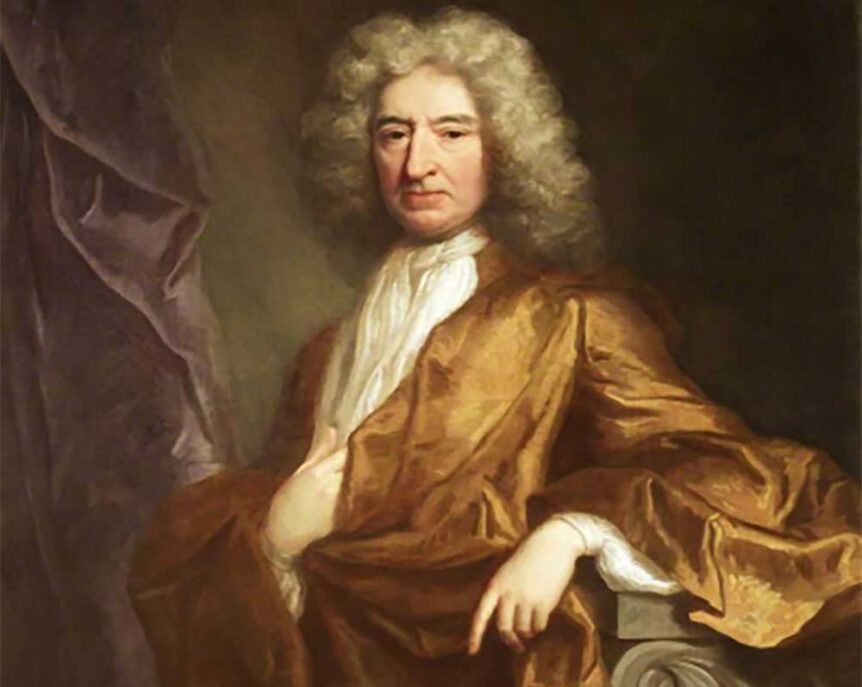
© Martin Rose
The above image of Edward Colston is by Jonathan Richardson. Bristol City Council Collection.
Reprinted from: Saffron Walden Historical Journal No 40 Autumn 2020
Until Edward Colston’s statue was pulled from its pedestal and thrown into Bristol harbour in June 2020, most of Britain had no idea who he was. As we all now know, he made a great deal of money from the slave trade in the late seventeenth century and, as is often the way of hard-nosed, rich profiteers, he invested heavily in charitable donations, both during his lifetime and after his death in 1721. Much of Bristol’s public architecture and charitable endowment is owed to Colston (though he only actually lived there briefly in the 1680s, despite serving as its MP in 1710-13) and the statue was put up 170 years after his death in recognition of his munificence.
He had, in other words, succeeded in buying posterity’s good opinion: the inscription on the plinth calls him “One of the most virtuous and wise sons of [the] city”, and as for his prospects of heaven, his funeral sermon announced that “surely as far as man is able to judge, we may, without presumption, believe that he is found acceptable in the sight of God”. Only in our own day has the virtue of Edward Colston been seriously questioned; and we may perhaps feel a little less certain than his eulogist of his acceptability in the sight of God.
He was born in Bristol in 1636, apprenticed in the Mercers Company of London in 1654 and enrolled in the Company in 1673. His own business interests were wide, trading with Spain, Portugal, Italy and Africa in fruit, wine and sugar; but he is most closely associated with the slave trade. In 1680 he became a shareholder in the Royal African Company, at this time the single largest shipper of slaves across the Atlantic, and for the rest of the decade he “took a leading role in the Company, serving on several committees, and becoming Deputy Governor in 1689”. Its Governor was the Duke of York, latterly King James II, so that Colston’s role in the Company was more senior than it sounds, he and the Sub-governor guiding it through the crisis that followed the Glorious Revolution, which saw it lose its monopoly of the African trade. Colston presented a portion of his own shareholding to King William III in a bid to keep it afloat.
His philanthropy was far from unconditional, an embodiment of his High Anglican churchmanship. Any beneficiary of the many schools and other institutions he endowed who failed to live up to his rigid High Church Tory principles was unceremoniously bundled out of the door onto the street; and any school that made the slightest concession to nonconformist or Whig views was deprived of his funding. But the sheer scale of his charity was impressive: £64,000 of charitable gifts in his lifetime and £71,000 more in his will.
As well as his primary business of trade, Colston was a money-lender, buying and selling mortgages and other tradeable paper. Amongst his many acquisitions were the manor and the advowson of Strethall, four miles from Saffron Walden. From the vantage point of the early twenty-first century he is by quite a long chalk Strethall’s most controversial lord of the manor and patron of its little Saxon church of St Mary the Virgin – but to begin with he probably had no interest in the place beyond its value.
*
The previous lord of the manor, Leonard Newport, an impoverished royalist gentleman, inherited the debt-laden manor in about 1681. Strethall never, according to Philip Morant, “recovered its plunder and confiscations” after the Civil War, and Newport was obliged almost at once to raise money by mortgaging it for £600, along with the appendant advowson of Strethall church, to a syndicate of London money-lenders. The 500-year mortgage was simply a paper investment and it changed hands fast – three times in the following year – before ending up in November 1684 in Colston’s hands. Leonard Newport continued to own and run the manor for another quarter of a century, holding his last court baron in 1709, but he also used his property to raise a good deal more money, borrowing another £1,650 from Colston in 1700.
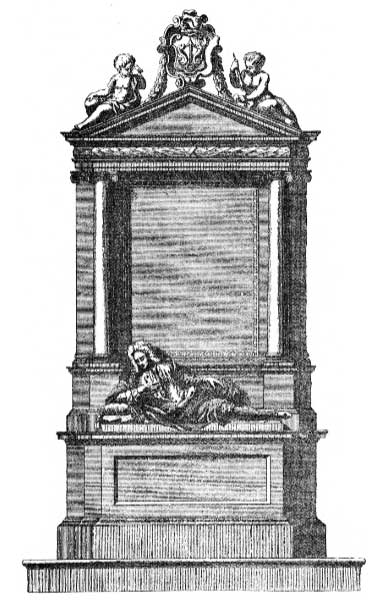
There may have been some trouble over the advowson. If an appendant advowson – one which, like Strethall’s, was firmly attached to the manor – was mortgaged, it neither remained wholly with the mortgagor (in this case Leonard Newport) nor did it pass wholly to the mortgagee (Edward Colston). When a vacancy or ‘avoidance’ occurred, Colston had the right to ‘present’ a clergyman to the bishop for institution; but Newport retained the right to ‘nominate’ to Colston the clergyman whom he was to present. In other words Colston, the mortgagee, might own the mortgaged advowson, but he couldn’t use it without agreeing to the candidate put up by Newport, the mortgagor. A pair of cases concerning mortgaged advowsons, confirming this uncomfortable division of rights, bracketed Colston’s tenure at Strethall: Amhurst vs Dowling (1700) and Gardiner vs Griffiths (1726) are the cornerstones of precedent on mortgaged advowsons. 1
This situation first arose at Strethall in 1701, when the rector Robert Dickman died: Newport and Colston seem to have agreed on William Coe who was duly presented and instituted. But when Coe died in 1706, his successor, Charles Lancaster, is recorded both by Philip Morant in his History of Essex and on the Strethall Rectors’ Board as having as patron (which is to say, in this case, appointed by) ‘The Bishop’, Henry Compton of London. Since nothing else had changed, we must assume that Newport and Colston failed to agree on the candidate whom Newport nominated, and Colston refused to present him. The Bishop of London was obliged, we may infer, to declare a lapse, and after six months to ‘collate’ Lancaster to the living himself. It seems likely that Lancaster was Newport’s candidate and therefore that his politics or his churchmanship (or both) failed to meet the exactingly starchy standards of Edward Colston.
Newport found it more and more difficult to service his mortgage, and in 1711 he sold the manor to Colston for quittance of the by then outstanding £2,207. By 1711 therefore Colston was in full possession of the manor, holding regular courts presided over by his steward, the last of which took place in 1720. It seems to have formed part of a wider assembly of land in north-west Essex: his 1721 will bequeathed to a young man called Robert Carr “my Mannor of Steathall in the County of Essex and all other my lands, tenements and hereditaments in the same County”.
Colston decided early on that his Essex property would be a suitable legacy to the Carr family. Either Robert Carr the elder (1679-1740) or his wife Elizabeth was a cousin of Colston’s, and in the absence of any children of his own the Carrs were one of a small number of more distantly related families who filled that place in the old bachelor’s affections. The elder Robert Carr was a fellow mercer, a fellow High Church Tory and a trusted confidant. He was also one of the five executors of Colston’s will, and for this very weighty and demanding service, he received £200.

But that wasn’t all he received. Colston clearly also took a liking to Carr’s son, the younger Robert Carr (1705-1755), and in his 1721 will bequeathed him “ffive hundred pounds over and above my estate at Streethill in Essex”. 2 Young Carr was sixteen at the time of Colston’s death and may have been steered towards the cloth by Colston, who seems to have been feathering a nest at Strethall rectory, as well as at the manor, for his young protégé. It is not clear how enthusiastic Carr was about a clerical career. He was thirty-two when he took Holy Orders in 1737, a year after his marriage to the widowed Elizabeth Saville (née Baldwin).3 Strethall formed part of her marriage settlement. The minimum age for ordination was 23 and a half, and this might suggest that his seeking it at this point had as much to do with succession-planning in anticipation of Charles Lancaster’s death as it did with a vocation. This suspicion seems to be corroborated by the fact that he apparently never exercised any clerical function at Isleworth in Middlesex where he spent his whole life, either before or after his brief spell as rector of Strethall.
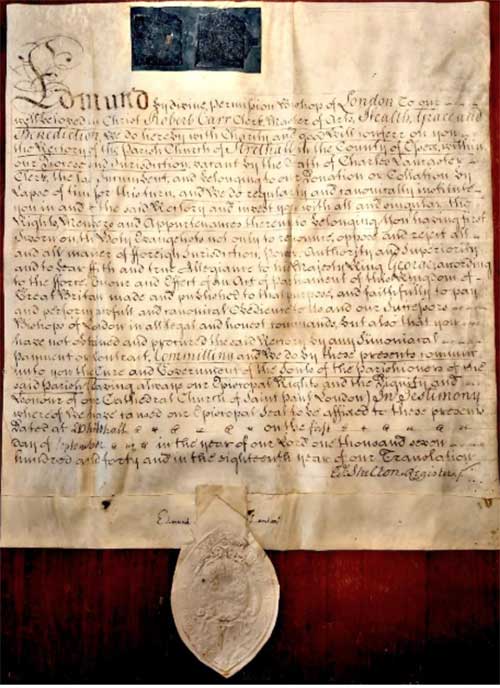
Photo Lizzie Sanders.
The advowson of Strethall is not mentioned specifically in Colston’s will, because being an ‘appendant’ advowson, attached to the manor, this did not need spelling out. Carr may have expected a vacancy much sooner than it actually occurred: in the event, Lancaster lived until February 1740, having perhaps spent 34 years as a thorn in the side of his successive patrons. He was also the Rector of Wenden Lofts, to which he was presented in 1707 by a Matthew Lancaster, who was presumably an uncle or other relative. When he eventually died he left a mess. He had lost all the Strethall parish registers, which have never been recovered, and this may be symptomatic of wider failures at his two livings.
At very much the same time as Lancaster, the elder Robert Carr also died, aged 61, describing himself in his will as a “clothworker of Isleworth”. The younger Robert Carr now faced a rather tricky problem. This was the first vacancy (or ‘avoidance’, as the ecclesiastical lawyers called it) in 34 years, the last having been in Edward Colston’s time; and Carr could not present himself to a living using an advowson which he had acquired since the last vacancy. To do so would have constituted the sin (and ecclesiastical crime) of simony and probably resulted in his expulsion from the rectory, as rector, and his loss of the advowson, as patron. So he turned to his bishop, Edmund Gibson of London, who had ordained him three years earlier. Bishop Gibson, a stickler for clerical correctness, must have been sympathetic to Carr’s problem, especially if Lancaster had left the parish in administrative and perhaps doctrinal disorder. He let the vacancy run for six months after Lancaster’s death and then declared a lapse.4 This allowed him to take matters into his own hands and ‘collate’, as the arcane vocabulary of the Church of England has it, Robert Carr the younger to the rectory, just as he had in the case of Lancaster. A collation is a direct appointment by the ordinary (usually the bishop) without the involvement of the patron, so Carr did not have to present himself to Strethall and propriety was preserved. He was safely instituted at St Mary the Virgin, and the advowson was securely his for future use. 5
Curiously, the rectors’ board at St Mary’s Strethall shows Robert Carr presented by Robert Carr, which was certainly the underlying transaction, but very much not the legal position. Since the splendid letter of collation remains amongst the church’s possessions, the wording on the board may have been a deliberate, and slightly tart, comment on the propriety of these proceedings by Charles Griffinhoofe, himself a former rector of Strethall, who gave the rectors’ board to the church in the 1920s. Or it may simply be that the complexity of the transaction was no longer understood, almost two centuries later. 6
Robert Carr did not linger as rector, perhaps in fulfilment of an agreement with his bishop, or more likely because he simply didn’t relish the idea of being an absentee country parson and didn’t need the income the living provided. He may have been quite happy to withdraw, having cleared up some of the muddle that Charles Lancaster had left behind him and put in his place a sound Tory parson who knew how to run a parish properly. At any rate, after a short incumbency as ‘squarson,’ he resigned the living in 1743 and himself presented his successor William Hopkins, the vicar of Elmdon since 1720. Mr Hopkins naturally felt himself under no obligation to resign from Elmdon (most rectors of Strethall held at least one other living), where he remained vicar for another 36 years in tandem with Strethall.
*
Edward Colston’s munificence to Strethall went further than simply making a gift of it to his friend’s son. He was a large-scale exploiter of ‘Queen Anne’s Bounty’, the fund established personally by the queen in 1704 to augment the incomes of poorer livings in the Church of England. Queen Anne assigned to the fund the remaining income from First Fruits and Tenths (the ‘skim’ that first the papacy and then the Crown had taken from ecclesiastical incomes since time immemorial) and devoted it to augmenting the income of chosen poor livings. It would eventually, the theory went, raise all clergy to a decent living standard, though as one writer rather archly put it, “it will yet be the work of Ages”. Although he was not yet an MP in 1704, as a High Tory, Colston was probably uncomfortable with the Queen Anne’s Bounty Act which was the Queen’s successful, if oblique, parry to the viciously partisan Occasional Conformity Bills pushed repeatedly by the Tories; but he then used the Bounty to the utmost to leverage his equally partisan charity.
The mechanism was complicated. Two-thirds of the Bounty’s income went in outright grants, though there were many poor parishes and relatively little money; and there was also, for up to a third of its budget, a provision whereby the Bounty would match, pound-for-pound up to £200, the gifts of private donors. This allowed benefactors to move parishes they favoured to the front of a queue that was otherwise likely to be centuries long. The money that was granted to a parish had to be invested, at this date usually in land, to yield a regular income.
The Thesaurus Rerum Ecclesiasticarum records a benefaction of £200 to Strethall in 1723, more than a year after Colston’s death, by “Edw. Colston Esq. and Mr Robert Carr”. The delay was presumably caused by his death and the execution of his large and complicated will, which delayed payments already agreed but not yet made. This donation was matched by the Bounty, putting the income from a healthy £400 capital in the rector’s hands. The parish of Strethall was eligible for the Bounty “by reason of the Smallness of [its] income”, which is given by Ecton’s handbook, the Liber Valorum, as £40 at a time when “a Competency would”, it was asserted, “amount to … Sixty or Eighty pounds per annum”.
But Colston did not leave it at that. In his will, he left £6,000 to be used for sixty donations of £100 each to specified poor parishes, on condition that the parishioners themselves raised another £100, which would in turn elicit the Bounty’s maximum grant of £200. He listed the parishes, mostly in Oxfordshire and the West Country. One of the few exceptions was Strethall, which was to benefit again, the only parish to receive two such gifts from Colston. He gave £200 to Strethall on this second occasion, brushing aside the obligation he laid on the parishioners of all the other parishes, of funding half that sum.
This second endowment was possible because between 1718 and 1736 the Bounty’s rules were relaxed to allow multiple applications from the same parish, as long as they were in different years; and to allow the proportion of match-funded grants to rise from a third to two-thirds of the total budget. In 1725 Colston’s executors (including of course Robert Carr senior) made a second payment of £200 to Strethall, which once again the Bounty Commissioners dutifully matched.
The rector of Strethall, at this stage Charles Lancaster, now had the prospect of the income from £800 capital, though we can assume that the patron of the living, Robert Carr the younger, took an active and directive interest; and that his father did the same. The normal procedure was to buy land to yield a regular income, and they began to look about. The problem of course was that Strethall itself is a very small parish (of 629 acres – even Catmere End was only added to it in the 1880s) and there wasn’t land available for purchase. So after some investigation, 52 acres of land were identified in Great Chesterford and purchased as an addition to the Strethall glebe.
This was rented out and provided a no doubt very welcome addition to the income of Mr Lancaster, Mr Hopkins and his successor Mr Tillotson for the next 75 years, until the Great Chesterford Inclosure Act of 1801 forced Tillotson to address the question of glebe land once again. The average annual return per acre of agricultural land in eastern England at this time was around 10 shillings, so the income of Strethall rectory was increased by about £26 a year, or rather more than half. It is no surprise that Charles Lancaster held on until death snatched him away from Strethall. Like most Strethall rectors, he was a pluralist, and the rectory of Wendon Lofts gave him £45 a year: his income from Strethall, now some £66, allowed him a comfortable life, and there was nothing anyone could do to induce him to give up the sixty per cent of his income that Strethall provided.

In the meanwhile, the gratitude of the now well-endowed Robert Carr the younger to Edward Colston was made quite clear when he came to christen his children: his son and heir was another Robert, but the second boy, born in 1744, was named Colston Carr (1744-1822), for the family’s benefactor. The Revd Mr Hopkins was obliged to substantiate his own gratitude to the Carrs twenty years later by taking on young Colston Carr as Assistant Curate at Strethall. He paid him £20 a year from his own living for several years in the 1760s – though there is no particular reason to suppose that Colston Carr saw the inside of Strethall church.
Robert Carr the younger remained lord of the manor of Strethall until his death in 1755, after which his widow Elizabeth continued to enjoy her life estate in the manor, which she managed vigorously from a distance until her own death in 1797: they held six courts between 1731 and 1791. She sold off the advowson, so that Tillotson was presented in 1780 not by her but by the purchaser, Frances Hindley. 7
The Carrs’ two elder sons were as different as chalk and cheese. Richard Carr, the heir, was the Captain of an East Indiaman, the Barwell, and amassed a large paper fortune in India. Sadly, paper is what much of it was, at least in his lifetime – 32,508 pagodas, 11 fauams and 74 cash (£13,005.6s.3d) in debts to him guaranteed by bonds from the Nabob Omdut ul Umarah whose Carnatic state had since been annexed by the East India Company. These debts were unpaid at the captain’s death in 1786 and his clergyman brother Colston was still pursuing them, as his ‘receiver’, in court and at the hearings of the Carnatic Commission decades later. His claim was eventually accepted in 1816.
This was, however, too late for Captain Robert. His will was a tissue of wishful thinking, revolving around his determination to redeem the manor of Strethall which was once again in the hands of money-lenders. It had been mortgaged again in 1779, with his mother as a party to the transaction: Captain Robert no doubt had a large share of the proceeds. His mother lived 42 years a widow, which may have tried Captain Robert’s patience a little; but it is clear that regaining Strethall with the fairy gold of his Indian debts was a constant preoccupation for the rest of his life. In the event neither he nor his executors could realise the £1,000 necessary to pay off the mortgage, and Strethall remained a piece of tradeable paper, the Carr family interest finally extinguished in the first years of the nineteenth century.

As for the glebe land in Great Chesterford which Edward Colston had so munificently funded, it came to the fore once again with the private Great Chesterford Inclosure Act of 1801, which allowed the Earl of Bristol, the vicar of Chesterford and the parish’s other landholders to push through consolidation and redistribution. The Revd Mr Tillotson of Strethall was clearly alarmed by the prospect of meeting his share of the costs of enclosure, particularly fencing, and petitioned for the right to sell five acres of his redistributed land to meet these costs. This was granted, and the land was sold; and with the fencing of the 47 acres of new glebe Edward Colston’s direct legacy to Strethall slumbered once again, until in 1978 the Endowments and Glebe Measure (1976) came into effect, transferring the ownership and management of glebe land from incumbents to the Diocesan Boards of Finance. And with that, Edward Colston’s legacy to Strethall passed finally into history, 257 years after the old slaver “like a lamb, or saint of God, fell asleep” in 1721.
Notes:
- Topped off by Mackenzie vs Robinson (1758-59), well after the death of Edward Colston and both Robert Carrs.
- In the event a codicil to the will diverted the income from the £500 to young Robert Carr’s mother, Elizabeth, and his sister, Anne James, until the second of their deaths, when the capital would revert to young Robert Carr.
- Strethall and its advowson formed part of Elizabeth’s 1736 marriage settlement.
- Lancaster’s death was in late February 1739 and the letter of collation is dated 1st September 1740: until 1752, when the year end was moved by parliament from 24th March to 31st December, these dates were six months apart. Cripps on Church and Clergy tells us that ‘The term or space within which the title to present by lapse accrues from the one to the other successively is six months; and as the computation of time concerns the church, it is made according to the rules of the canon law, that is, by the calendar, for one half-year, not counting twenty-eight days to the month: and the day on which the church becomes void is not to be reckoned in the account.’
- Bishop Gibson’s letter states clearly that the collation is “for this turn”, a translation of pro hac vice, the Latin term normally used, indicating that the bishop’s intervention is a one-off and extraordinary act, establishing no precedent.
- I am informed by Dr David Melford that he believes the letter to have been presented to the church between 1920 and 1956. I can’t verify this, but clearly it would favour the second explanation over the first.
- The advowson returned to the lord of the manor when the manor was sold: no lord could alienate an ‘appendant’ advowson (an advowson attached to a manor) in perpetuity, so that the sale of the manor triggered the reversion of the advowson to the new lord.
References:
G F A Best, Temporal Pillars, Cambridge, 1964; John Ecton, Thesaurus Rerum Ecclesiasticarum, 2nd ed. London 1763; W R Le Fanu, Queen Anne’s Bounty: A Short Account of its History, London: Macmillan, 1921; Wills of Edward Colston, Richard Carr the Elder, the Revd Colston Carr and Captain Robert Carr (National Archives); Church of England Clergy Database; M Deacon, Great Chesterford: A Common Field Parish in Essex, Saffron Walden 1983; David Melford, A History of the Manor and Parish of Strethall, 2nd ed. 2019; Gregory Clark, Land Rental Values and the Agrarian Economy: England and Wales 1500-1912, U of C, Davis 2001; Britishlistedbuildings.co.uk: Statue of Edward Colston; Kenneth Morgan, Edward Colston and Bristol, Bristol: Historical Association, 1999, Essex Record Office document series D/Db 400.