
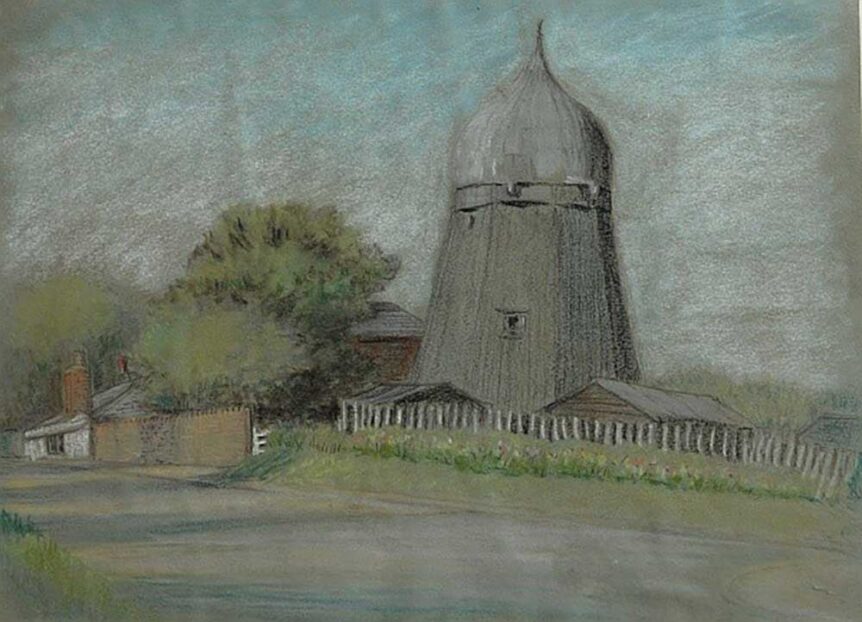
A Millwright’s Tool from Saffron Walden
© Bari Hooper. First published in Saffron Walden Historical Journal No. 31, Spring 2016
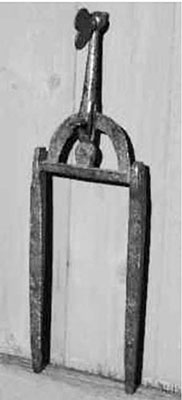
Some years ago while perusing the stock in a well-known Saffron Walden antique shop, I chanced upon an unusual, and at the time unidentified iron object (Fig. 1). It appeared to be a tool of some kind, and tied to it was part of an old paper label bearing the pencilled inscription ‘Rus . . / munt Ple’ (at this point the label had been torn away and with it the remainder of the words). The proprietor of the shop told me that the item was part of a collection of blacksmithing tools his late father had cleared from a ‘long-defunct smithy’ in one of the villages just over the border in Cambridgeshire. Unfortunately, he could not remember the name of the village.
My curiosity aroused, I purchased the item with the intention of trying to identify it in the back catalogues of an auction house specialising in antique craft tools. I put the mystery item in a toolbox in my cellar, intending to research it later, but it rested forgotten for many years until I recently rediscovered it.
With my interest reawakened in the object, I cleaned it of rust and applied easing oil to its one moving part. Having completed this operation, I re-examined it in the hope that in doing so I might discover its function. The device, which is made of wrought iron, consists of two flat-sectioned 190 mm (7. 5 in) tapering prongs joined at the top by an 83 mm (3.25 in) flat-sectioned bar into which is fixed a quadrant. At the centre of the bar is a pivot point from which projects a moveable 102 mm (4 in) arm, through which the aforementioned quadrant passes. At the base of the arm is an integral screw-thread in which is inserted a thumb-screw enabling it to be moved and fixed at any desired point on the quadrant. At the top of the arm is another internal-screw thread set at an angle of about 60 degrees, holding a large thumb-screw the thread of which tapers to a point.
The cleaning and measuring of the item unfortunately provided no hint as to its purpose, but in Raphael Salaman’s comprehensive work, Dictionary of Tools c. 1700–1970 (1989), I found (p. 275) an illustration of an almost identical example to that in my possession. This identified it as a millwright’s scriber, a tool colloquially known in Kent and perhaps elsewhere, as a ‘cuckoo’, as Salaman explains: [it] is used for marking the pitch circle on gear wheels, and also for marking the length of the cogs, i.e., the face line on the diameter of the wheel. (The pitch circle is the imaginary line along which two gear wheels in mesh make a rolling contact, and from which measurements essential to the form and spacing are taken.)
Now that I knew the name and function of the tool my next obvious move was to look again at the damaged label that came with it. Perhaps it would reveal the name of the village just over the border in Cambridgeshire from whence it was said to have come? But before doing so I decided to try to find a bit more information on how the tool was actually used. Salamans’ explanation of its function is I am sure perfectly understandable to an engineer, but as a layman I was (and still am) unable to visualise it in use. In Kenneth G. Farries’ five-volume opus Essex Windmills, Millers & Millwrights (1988), the most comprehensive work on the subject in English, there is an extensive technical glossary of milling terms in which the pitch-circle is listed, but surprisingly there is no mention of the scriber used in marking it out.
However, the author describes the five mills known in Saffron Walden, and to my surprise and delight the description of the first of these reads: ‘Smock mill. Known particularly as Ruse’s Mill. Stood in the garden of Old Mill House, 21 Mount Pleasant Road, at the junction with South Road’ (Fig 2 & featured image above). The words ‘Ruse’ and ‘Mount Pleasant’ immediately stood out. I looked at the label again: ‘Rus . . / Munt Ple’. Apart from the misspelling of ‘Mount’ (perhaps a reflection of the writer’s local pronunciation of the word?), the remaining words complied with the Essex miller’s name and beginning of his address: ‘Rus[e] M[o]unt Ple[asant]’. The mill, which was built in the 18th century, was held by the Ruse family for many years, the first recorded being Stephen Ruse in 1830. Several other millers subsequently worked the mill up until about 1900, during which time it was always known as Ruse’s Mill. It was demolished in 1955.
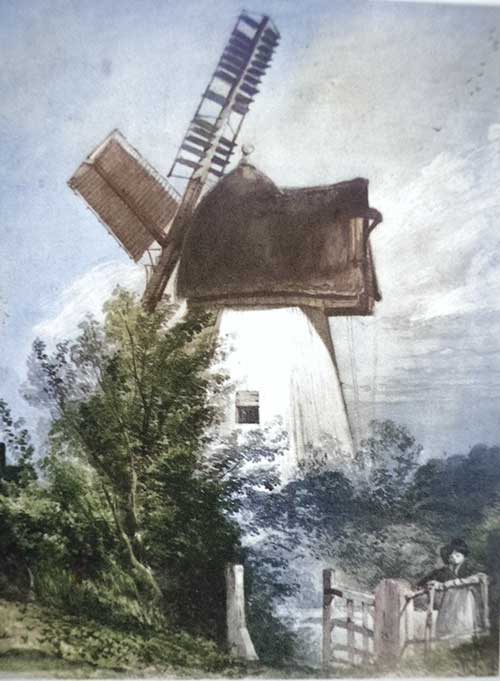
There are still many unanswered questions: in which of the dozen Cambridgeshire villages ‘just over’ the Essex border, was the smithy located? However, I set out (belatedly) to identify a mystery tool said to have come from Cambridgeshire, and discovered that rarest of birds, the Walden cuckoo.
Notes
1.The author is a retired archaeologist who lives in Newport.
2. Raphael Salaman (1906- 1993), a Cambridge graduate in engineering, was born only eleven miles or so from Saffron Walden in the Hertfordshire village of Barley. His interest in the history of tools came about as a boy through watching craftsmen at work there.
3. The featured image above is © Saffron Walden Museum
4. See also Bari’s article Wicken Bonhunt-Holed stones and sharp iron: equine folklore and the article ‘Windmills of Walden’