
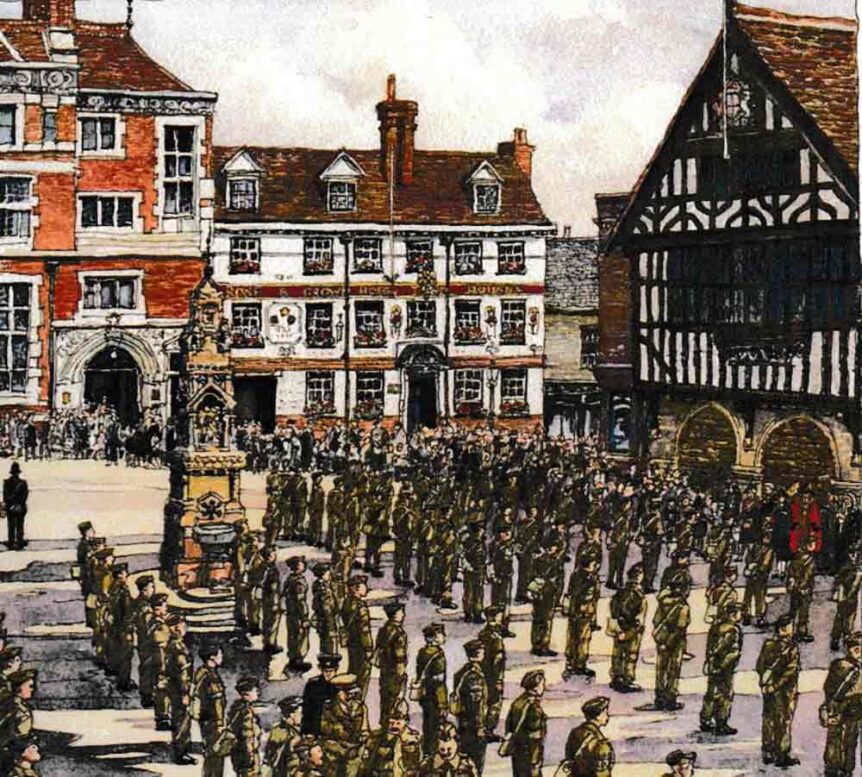
(No.1 Platoon, “D” Company, 12th Battalion, Essex Home Guard)
The above illustration ‘Saffron Walden Home Guard Parade’ in the Market Square 1940 is © Brian Sanders 2012.
© Malcolm White
Reprinted (with 2026 updates) from Saffron Walden Historical Journal No 24 (Autumn 2012)
Like many small rural towns, Saffron Walden had always supported its country’s defence.
In 1800, with the threat of invasion from Napoleon, a volunteer force was formed which became the 2nd Battalion of the 1st Essex Legion of Volunteers; in 1887 the Colours were handed over to the Saffron Walden (‘I’) Company of the 3rd Cambs Volunteer Battalion of the Suffolk Regiment; from which men went to the Boer War. In 1914 men from ‘D’ Company, 8th Essex (Cyclist) Battalion, another volunteer force, marched off to the trenches; and in 1924 the town raised a company of the 7th Battalion of the Essex Regiment (Territorial) Army.1
When, in May 1940, the German Army quickly invaded France, Holland and Belgium, there was a real fear throughout the country that Britain would be next. Locally, Ernest Tennant, owner of The Vineyard in Windmill Hill, wrote in his diary ‘Looking out of the window… all looks peace and beauty, but pheasants keep calling as they hear distant gun fire and bombs dropping and we all sleep with guns beside us in case of parachutists dropping from the sky.’2
In a broadcast to the nation on 14 May, Anthony Eden, the Secretary of State for War, said:
Since the war began, the Government have received countless inquiries from all over the Kingdom from men of all ages who are for one reason or another not at present engaged in military service, and who wish to do something for the defence of the country. Well, now is your opportunity. We want large numbers of such men in Great Britain, who are British subjects, between the ages of 17 and 65 to come forward now and offer their services…The name of the new Force …will be the Local Defence Volunteers.3
Given its history, therefore, it came as no surprise that Saffron Walden and the local villages immediately responded. Indeed it was reported that one volunteer was registering at Walden Police Station before the broadcast had even ended, and within 24 hours of the broadcast about 300 volunteers had registered at Walden, Stansted and Newport and about another 120 at Dunmow. The men came from all occupations including local councillors, schoolmasters, British Legion members and farmers and farm workers.4 Within the week the number of volunteers had reached over 800 and Capt H.T.Myhill, O.B.E. had been appointed as Group Commander for Saffron Walden.5
A command structure was quickly set up. In East Anglia, Sir Arthur Mills was appointed the Eastern (No.4 Region) Regional Commander and Colonel Sir Edward Ruggles-Brise, a much-decorated veteran of the Great War, was appointed as the Essex County LDV Commander.6
Essex was divided into a total of 12 Battalions (this was later extended to 18 battalions as the LDV expanded). The towns and villages of N.W. Essex were formed into No. 12 Battalion under the command of Brig-General C.G. Charlton and four companies were created: ‘A’ (Dunmow), ‘B’ (Stansted), ‘C’ (Newport) and ‘D’ (Saffron Walden). ‘D’ Company was placed under the command of Capt H.T. Myhill. (Various reorganisations took place during the life of the Essex Home Guard, but these four companies remained, unchanged, as part of the 12th Battalion for the remainder of the war.) By the end of 1940, these four companies could boast 1,182 men, an impressive total for a large rural area.
The Companies, in turn, were organised into platoons and sections.7 In ‘D’ Company (Saffron Walden), No. 1 Platoon comprised of sections at Saffron Walden and Sewards End and was under the command of Lt A.J. Cook; No.2 Platoon comprised of sections at Hadstock, Ashdon and Radwinter under the command of Lt E.B. Lamb and No. 3 Platoon comprising sections at Wimbish, Debden and Debden Green, was under the command of Lt G.E. Frost. No. 1 Platoon was divided up into six sections. Later, as we shall see, a seventh section known as the Special Services or SS section, was formed.
Clearly there was a glamour attached to the LDV. So many men had volunteered in Walden that at a council meeting, the Mayor, Alderman Ellis Rooke, had to appeal for volunteers for both the Air Raid Precautions and the Auxiliary Fire Service, as men had left these in favour of the LDV. But there was also a word of warning with one Councillor pointing out ‘that there were a number of people in the Borough who were not yet doing anything towards the national effort’.8
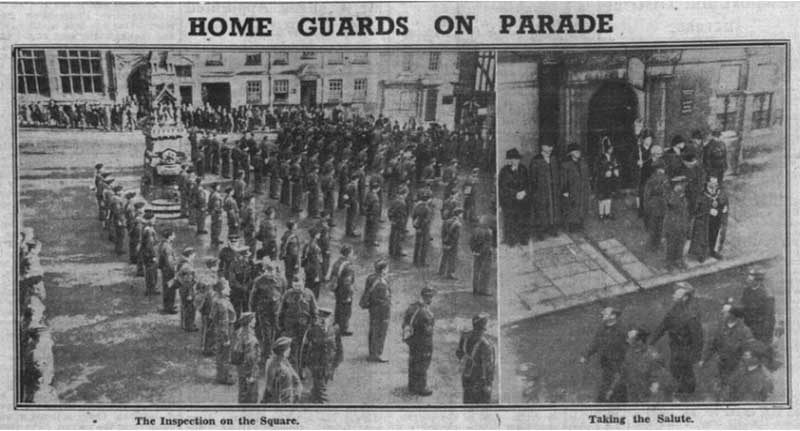
Such was the success of the appeal for the LDV (or the Home Guard as it was renamed in July), that nationally recruitment was suspended by the end of July, and by the end of the year ‘D’ Company (Saffron Walden) was at full strength with 265 recruits. The first ceremonial appearance of the local Home Guard took place on 19 November 1940 during the British Legion Remembrance Service which concluded with an inspection in the Market Square.
The Saffron Walden and Sewards End Section were joined by No 2 and No 3 platoons. Although they came in for some criticism about their dress, the Saffron Walden Weekly News was quick to defend them, pointing out: ‘It is how they shoot that matters… the International Brigade which caused General Franco a good few sleepless nights… would not have cut much of a figure on the parade ground’.9
The following week the Mayor entertained the Saffron Walden and Sewards End Section at the Rose & Crown where they were addressed by Brig.- Gen. Charlton, Commanding Officer of the Battalion.10 Perhaps conscious of the criticism of their dress, he said he was pleased to announce that very shortly all Essex Home Guard would be issued with serge battle dress, although Capt Myhill was rather cynical about this, saying, ‘If it fits you like mine fits me, it will not fit at all’.
Initially the role of the Home Guard was intended to counter the threat of German parachutists. Glider and parachute assaults during the invasion of Belgium, along with German propaganda, had led to the belief that large numbers of parachutists would be used at the start of an invasion, and the Home Guard became known as ‘Parashots’, a name reflecting their perceived role.11
In 1933 a Drill Hall had been built in Station Street for the Territorials, comprising of a large hall, a billiards room, a restaurant, a lecture hall and various administrative offices. At the rear of the building a covered rifle range was provided.12 At the time it was built the Battalion was under the command of Capt Myhill, and as he was now the Commanding Officer of the Home Guard, the Hall was quickly taken over for ‘D’ company training.
The men were trained in everything of a military nature including drill, weapon usage, fieldcraft, mapwork and signalling, observation, obstruction and demolition, and particularly village defence and street fighting. Mapwork, signalling and use of the compass were sometimes taught from the top of the Water Tower in Debden Road, because of the extensive views it offered, recalls Don Purkiss.13 Officers were trained at Battalion Headquarters – a notebook kept by 2nd Lt. G.T. Barnard gives extensive details of, for example, how to clear a town through street to street fighting.14 Barnard (later in 1966 to be Mayor of Saffron Walden) was second in command of No. 1 Platoon.
To start with, the Government had difficulties in providing any arms for the Home Guard. Following the evacuation at Dunkirk, it was a priority to re-arm the Regular Army, and so improvised weapons were all that could be provided. Locally, being in a rural area, numerous shotguns were available and agricultural tools were quickly turned into more deadly implements. Rifles were eventually obtained from USA and Canada but with little ammunition – often as little as 10 rounds per rifle.15 Sadly, however, even this led to a number of tragic accidents as untrained men were let loose with potentially lethal force. In Walden, Ethel Parry, the wife of Home Guard member, Lewis Parry, was fatally shot by accident, when he was practising loading and unloading his rifle.16
Full-scale military weapons were rarely available to the Home Guard because of the requirements of the Regular Army, so like many Home Guard companies, the Walden men improvised producing all sorts of weapons. A return made to Essex Home Guard HQ, in June 1942, showed that the Walden Company had 96 self-igniting phosphorous grenades, 12 home-made Molotov cocktails (simply comprising of petrol in a bottle), and 12 home-made bombs in its store.17
Bizarre weapons were made. Don Purkiss tells of an explosive oil drum which was devised and designed to blow up a tank. It was tested in the old chalk pit (now the site of St Mary’s View) and created a large explosion. In 1941 the Government made available to the Home Guard the no.74 grenade, better known as the sticky bomb. It consisted of a cylinder covered in a very sticky substance and had a short handle. The idea was to plant it on the side of a tank where it would stick and then explode after a minute or so. But it was a dangerous weapon to use and not always very successful. Don Purkiss relates the experiences of the Walden Home Guard with this weapon:
For the demonstration all the Home Guard companies in the district were assembled at an advantage point on Roos farm and a large metal bucket once used in a gravel pit represented the tank. The officer in charge was Geoffrey Barnard and after suitable explanations he went to a box of grenades, took one out and removed the outer metal leaves revealing the sticky bomb, rather like peeling a banana. He went to the substitute tank and planted it firmly on the side. He walked away briskly for about 50 yards and lay down with his hands behind his head, all according to the book, but nothing happened. Three times he repeated this, but in the end the bombs had to be exploded with a charge of TNT. It was the last we saw of the sticky bomb.18
In 1942, ‘D’ Company received two weapons specifically mass-produced for the Home Guard, the Smith Gun and the Blacker Bombard Spigot Mortar. The Smith Gun was unorthodox in its appearance. It had a 3-inch smooth bore barrel and was mounted on a contraption which looked like a small two-wheeled pram. This would be tipped on its side and one of the wheels used as a base plate. It was not an easy or particularly safe instrument to use. Lt Barnard had to produce detailed instructions for its use – four men were required for its operation.19 It was called ‘a brute of a weapon, very heavy and awkward to handle’, and gained a terrifying reputation for killing its crew!20
The Spigot Mortar was more effective, being cheap and reasonably simple to install. The mortar was mounted on a stainless steel point installed in concrete and could be quickly assembled and dismounted. Two steel points are still visible today in the grounds of the District Council offices and another in Catons Lane.
There was a continual emphasis on exercise and route marches. The Home Guard often took part in exercises with the military and simulations of possible invasions were practised. A major exercise, which involved all four companies of the 12th Battalion, took place in late April 1941, and the Saffron Walden Company were commended for their high standards of fitness.21
Some people thought that too much time was being spent on drill and routine. Stanley Wilson, Town Mayor from 1942 to 1944, wrote to the Weekly News saying that there should be less emphasis on marches and more on learning how to snipe, throw bombs and ambush the enemy.22 However, even these routines had their purpose, as Sir Winston Churchill wrote: ‘I am anxious that the enemy should have a vivid impression of the strength of our Home Guard. This will no doubt be conveyed to him, by photographs of reviews and will act as a deterrent on paratroop descents’.23
Numbers in the local Home Guard fluctuated wildly. It has always been a bit of a misconception that the majority of the Home Guard were elderly. By 1943 the average age of the Home Guard, nationally, was under 30.24 The oldest member of Saffron Walden Company, Pte Alfred Sutton, well- known as a guard on the railway, was only 62. In fact many of the Home Guard were teenagers, or people in jobs which were initially classified as essential, but subsequently reclassified. As a result, as younger men were called up, the ranks of the Saffron Walden platoon began to suffer severely. Lt. Cook appealed through the newspaper for more volunteers in the hope ‘that they will come forward in the true spirit which characterises this voluntary system of defending Britain.’25
Further appeals for members had to be made. In January 1942 the Home Guard arranged a social event in the form of a New Year’s party, which was well attended, and the Mayor, Alderman Ellis Rooke was invited to present the prizes. But he chose the occasion to also issue a warning against complacency. He pointed out that the country was still in great peril and it was the duty of every man to do his bit to preserve freedom. But, he said ‘I can walk about the town and see at least 100 men who should be members of the local Home Guard. They are slackers, but I warn them that if they do not come forward voluntarily, they will be compelled to join.’26
It should not be thought that this need to keep up numbers was unique to the town. In March 1942 the Government announced that compulsory enlistment would be introduced for the Home Guard in 20 counties including Essex, Hertfordshire and Cambridgeshire.27 New Defence Regulations made provision for conscientious objectors, but despite this at least one man appeared before the local bench for refusing to join the Home Guard. Thomas Waite of Littlebury was summonsed for refusing to comply with a direction given by a National Service Officer to enrol in the local Home Guard. His defence was that he was unfit for active service, having been wounded in the Great War. After much debate he agreed to join the Home Guard, on the proviso that he would only be given light duties and would not march.28
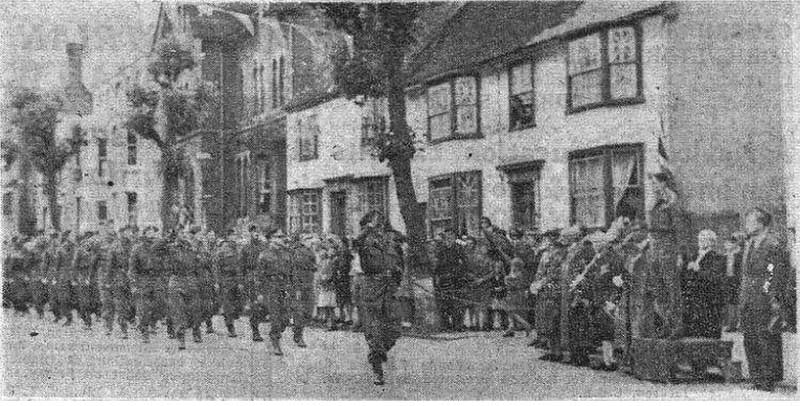
Those who joined up certainly did their bit, with several, sadly, making the ultimate sacrifice. John Palmer of Middle Square, off Castle Street, was one of the first members of the Home Guard, joining in June 1940 when he was just 17. The following year he was called up joining the Regular Army, but was killed in the Middle East on his 20th birthday in 1943.29 Another young man who had originally enrolled in the Home Guard, Raymond Holroyd, went on to join the Royal Marines, and having served in Africa saw active service in Sicily, where he was seriously wounded. Invalided home he was privileged to take the salute in July 1944, as his former colleagues paraded down the High Street.30
A typical week of training is shown in Lt Barnard’s notebook.31 On Monday 29 June, Sections 1-4 were given detailed instructions on the use of the machine gun. Sections 5 and 6 were on patrol. On Tuesday, sections 1-4 went on a night patrol, whilst Sections 5 and 6 practised firing with the machine gun (probably at the firing butts situated at Beechy Ride). Wednesday saw a Full Dress and Arms parade, and Thursday and Friday involved more nightly patrols for all six sections. On Sunday there was a compulsory church parade. It should be remembered that all of this would take place after many of the men had carried out a full day’s work.
Regular shooting took place at Beechy Ride. Practice was with the standard .303 rifle and the aim was to put all bullets within a two-inch ring at a distance of 100 yards. Those who could do this regularly were earmarked as snipers.32
The nightly patrols were detailed to look after essential services and to look out for paratroops. Don Purkiss gave details of nightly patrols near Howe Wood on Debden Road. Usually men would go in pairs and would get wet when it rained. Don would always try to go on patrol with a friend who owned a car as they could shelter in this if bad weather occurred!33 Typically patrols would be defending vital services. These included the Post Office, the electricity substation in West Road, the petrol dump in Victoria Avenue and the railway tunnels between Audley End and Great Chesterford. In addition patrols would take place in the countryside and would also guard large open spaces such as the golf course and the Common, as it was believed these might have been objectives for parachutists or even glider landings.
The 12th Battalion as a whole also had responsibility for defending the GHQ Line, the national defence line which in NW Essex ran from Debden through to Great Chesterford.34 In 1941, Saffron Walden was designated as a Category ‘B’ nodal point and a patrol from the 12th Battalion were detailed from the town for the specific purpose of guarding the mined crossings of the River Cam at Audley End.35
A number of road blocks had been established in Walden and another of the roles of the Home Guard was to prepare and defend these.36 The road blocks consisted of holes in the road, in which in the event of invasion, iron posts would be installed. The major junctions going both east-west and north-south were protected and the Home Guard practised both inserting the iron posts and defending the road blocks.37
By 1942, with a number of servicemen returning to undertake essential work and with a large number of fit youngsters, it was decided to set up a Special Services section in which volunteers were trained in the art of undercover warfare. Their role was offensive rather than defensive. To be selected for this one had to be young and fit and be able to consistently shoot a two- inch group at 100 yards on the rifle range. Don Purkiss recalls:
We wore plimsolls instead of boots and had to do everything at the double including route marches. We had more parades than the others and these included tree climbing and swimming parades. We had night exercises when we blackened our faces and plimsolls and pitted ourselves against the home guard defences. On one occasion we had a night exercise which involved the whole of the home guard. We were to attack and capture all the vital services in Saffron Walden – the police station, the post office the fire station and of course the home guard HQ’s. Our SS section was split into groups of threes and fours and each group had its own target. Each group started separately from differing directions a mile or so outside of town, but were forbidden to start before an agreed time. We were told that we could commandeer bicycles if we wished but in the event nobody did. The group I was in were to attack the Post Office and we started from up the road to Ashdon. We started on time which was a mistake because it was still twilight. Later it became pitch black. It is difficult to understand in the present day just how dark nights can be in a complete black out. All our group were soon captured and had to make our way to the drill hall for debriefing. The rules were that when captured a large “C” was chalked on the prisoners steel helmet and they had to make their own way to HQ. The only target that was captured was the police station, where the Police were locked into their own cells.38
Numerous exercises took place. One typical exercise was “Operation Snapper” a full scale exercise involving all of “D” company as well as units of the regular army and which took place in July 1942. Lt Barnard’s notes 39 record that the Home Guard were to man the road blocks at Lt Walden Road, Ashdon Road, Radwinter Road and Thaxted Road and communications networks were set up to the various petrol depots. The battle lasted for four hours and included thunder flashes, blocked roads and traffic diversions.
The Weekly News of 31 July 1942 reported on the exercise which was treated as though it was the invasion of the town: ‘During the exercises actual war gas was released on the Market Square and about noon, a roar overhead was the signal for waves of aeroplanes to dive-bomb the town.’40 A ubiquitous ‘Fifth Columnist’ was, inevitably, present and, disguised in Army uniform, succeeded in getting past the guard into the Headquarters and dropping a bomb, ‘killing’ the Mayor. As he was the Chairman of the Invasion Committee, it was a less than happy conclusion!
Other exercises were undertaken with the Poles stationed at Audley End House. The Poles were undergoing extensive and detailed training as many of them were to be parachuted back into their occupied homeland and so they usually proved more than a match for the Home Guard, many of whom finished up with extensive bruising and occasional broken limbs.
Not all exercises were necessarily successful. Lt. Barnard gave details of a night exercise which took place on 7 October, 1942 and the lessons that could be learnt. His notebook reads like a school report. He said that discipline had been bad, orders ignored, and that there had been too much talking. But he also stressed some less obvious points. It was essential that the men should know the local countryside well and they should try to keep off the stubble which could cause coughing and was how one of the patrols had been caught.41 Don Purkiss gave details of one night time exercise where, crawling through grass, their presence was given away by curious cows, who wandered over to see what was going on thus arising the suspicion of a sentry.
Much Home Guard activity inevitably consisted of marches and parades. Every Sunday saw a compulsory church parade and other parades were held for various reasons. In May 1943 the Walden ‘C’ and ‘D’ companies paraded through the town to commemorate the third anniversary of the Home Guard.42 A salute was taken on the Common, followed by a demonstration of field exercises where the Home Guard showed their prowess with weapons, such as the Spigot Mortar and the machine gun.
The Home Guard carried out other functions in addition to their nightly patrols. During Warship Week in February 1942, an exhibition of models and weapons was arranged in the Corn Exchange. Volunteers were required to both guard and man the exhibition and many of the Home Guard put in an extra guard for various evenings, often entailing an eight-hour shift after a day’s work.
The Saffron Walden Company also fund-raised for a comforts fund, designed to provide such things as bunks and trestle beds in isolated locations which men were required to guard overnight.43 The fund was also used to enable relatives of injured Regular Army personnel to visit them in hospital. The Home Guard also did its bit in National Savings. In 1944 the ‘Salute the Soldier’ week was held and ‘D’ company with, by then, a strength of 461 men, raised over £10,300. an average of £23 per head, a phenomenal total given the low wages of the time.44
It was inevitable in this rural area that, come harvest time, there would be a conflict between the requirements of the Home Guard and local farmers. This became more pronounced as the war progressed and it was becoming obvious that invasion was very unlikely. By June 1944, farmers were being advised to approach the Platoon Commander of the worker concerned to see if their employees could be released for essential work.45 If the Home Guard authorities would not comply then the farmer could appeal to the Essex War Agricultural Committee.
D-Day on 6 June 1944 brought much excitement to the Home Guard. Ernest Tennant wrote in his diary: ‘Last night I was orderly officer at the Drill Hall. The Home Guard were disappointed that the Germans dropped no parachutists on Saffron Walden in retaliation as we knew we would have dealt gloriously with them’.46
In July 1944 the Home Guard carried out a realistic battle scene in the Deer Park at Audley End. This was destined to be their last major exercise, and so the public were invited to attend. The demonstration was held to show how the Home Guard would deal with an attack on the town by about 20 paratroops. According to the Weekly News: ‘The town almost shook with the reverberation of exploding shells, with the …. rat-tat of machine gun fire, the ‘ping’ of snipers bullets and a smoke screen’.47
With the success of D-Day and the remorseless drive towards Germany, the need for the Home Guard began to be questioned. There was considerable support for the continuation of the force and so the stand down was phased with the announcement that all parades would be voluntary from 6 September, 1944 and a national stand-down parade would take place on 3 December 1944.48
Locally the last of the compulsory Sunday church parades took place on 11 September 1944. The Weekly News paid tribute to the Home Guard pointing out the vital work that they had undertaken. However, whatever may have been decided nationally, the local Home Guard still felt they had a role to play. In September 1944 over 130 officers, N.C.O’s and men asked for voluntary parades to be held as they wished to carry on until the war in Europe was over.49
This perhaps showed some foresight, for a role clearly still existed for the Saffron Walden men. In September two V1 rockets hit the town. The first on 16 September landed at the rear of the Friends’ School, causing extensive damage to both the School and the Training College.50 A second rocket landed near The Vineyard on 22 September, breaking windows in the house and damaging the staircase at the adjoining cottage. Ernest Tennant, on returning from his Home Guard duties, was unable to get into the cottage because of the debris.51
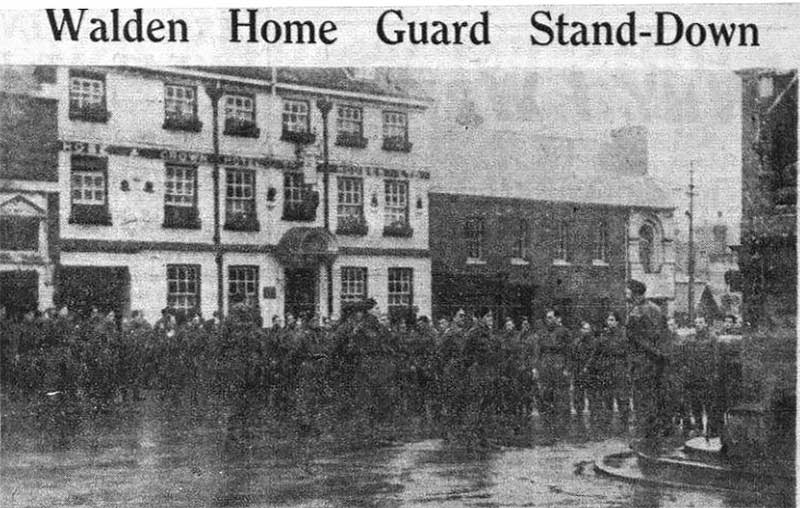
In November the Home Guard were formally stood down. In Walden the Mayor, Stanley Wilson, entertained the men and their families in the Walden Cinema. His speech summed up the role of the Home Guard: ‘For four and a half years they had done a fine job of work… although they had not to shoot Germans, they had played a part in the winning of the war. Had Britain not organised and had not men trained in the Home Guard, Hitler would have invaded this country. The Home Guard did a grand job in backing up our regular armed forces’.52
Later in the month, a service was held in Chelmsford Cathedral to commemorate the stand-down of the Essex Home Guard, at which a detachment from the town took part. Then on 3 December 1944 Walden ‘D’ Company held their Stand-Down Parade in front of Brig. Charlton and led by Lt. Col. Thomas Slingsby, Commanding Officer of the 12th Battalion. The final salute was taken in the Market Place and was addressed by the Brigadier, who reviewed the work of ‘D’ Company and congratulated the men.53
Capt. Tennant (a prominent industrialist who had held informal meetings on behalf of the Foreign Office with Von Ribbentrop, the German Foreign Minister, before the war) reported:
Today I attended a ‘Stand Down’ parade of the Home Guard. We marched around Saffron Walden… several hundred strong and quite smart we were, after nearly four and a half years training. We used to growl and grumble at every-Sunday parades and exercises and the many all-nights on duty, guarding the golf course (a possible landing ground for paratroops), the post office, the railway tunnels etc, but it has been worthwhile and I have made many friends’.54
It was not quite the end of Walden Home Guard. On 8 April 1945 a special parade was held at the Plaza Cinema in Station Street, where members of the Saffron Walden Company of the Home Guard received the King’s Certificate of Thanks from Mr William Adams, the Deputy Lieutenant of Essex (and the town’s former Town Clerk), and a picture of the whole company was taken. And then following VE Day the Town Council passed a resolution of thanks at its meeting on 11 May 1945, at which they thanked the Home Guard and other Civil Defences for ‘the devotion to duty shown by them during the tragic years covered by the period of danger by enemy action’.55
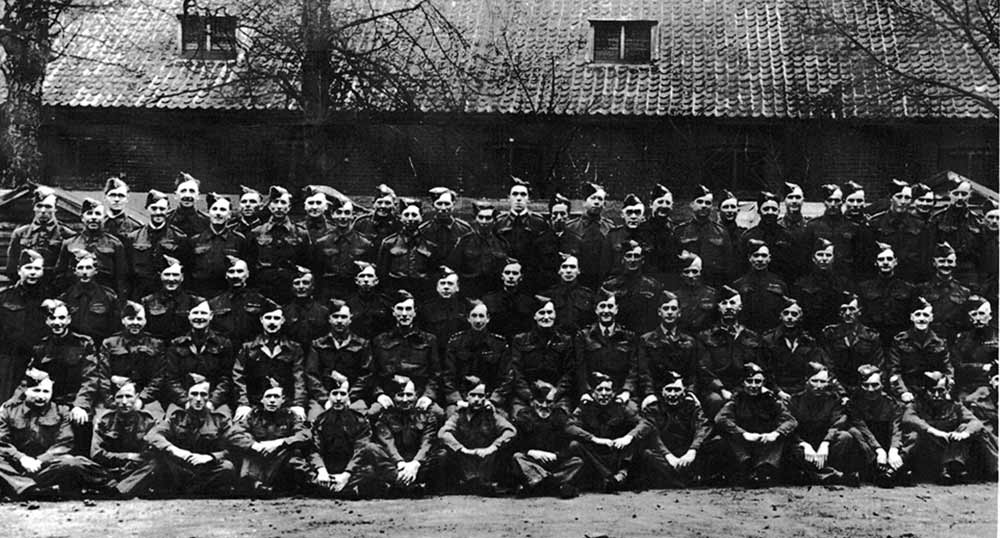
The author thanks those who responded to a Walden Local appeal for names of those in the photograph and would be pleased to obtain information on the others. The known names in correct order can be found with a copy deposited in Saffron Walden Town Library.
A note on the artist Brian Sanders: Brian has been a professional artist for over five decades, during which time he has worked in every area of the illustrative arts. He was born in London in 1937 and was evacuated to Saffron Walden during World War Two. In 2010, he was inspired to write the book ‘Evacuee: A Wartime Childhood’ about his evacuation and his memories of life & times in and around the Town at that time. During the 1980’s he embarked on some extraordinary illustrations for more than 50 sets of stamps. Notable amongst these are the five sets of stamps representing the U.K. Police force, the Scout and Guiding movements and the history of World War II.
References
- White, M., Saffron Walden’s History (1991), pp. 93, 178.
- Tennant, E.W.D., True Account (1957), p.231.
- Eden, A., Freedom and Order (1946), p.71.
- Saffron Walden Weekly News (hereafter SWWN), 17 May 1940.
- SWWN, 24 May 1940.
- Burgess, R., ‘Thaxted Home Guard’, The Thaxted Bulletin (Winter 2010).
- This article is only concerned with the Saffron Walden Company. For details of the platoons and sections of Dunmow, Stansted and Newport companies, see: Finch, P., Warmen Courageous: the story of the Essex Home Guard (1951).
- SWWN, 21 June 1940.
- SWWN , 22 November 1940.
- SWWN, 6 December 1940.
- Mackenzie, S.P., The Home Guard (1996), p.21.
- White, op.cit., p.210.
- In conversations with the author, Donald Purkiss, who has lived in Saffron Walden all his life, recalls that he and his father joined the Home Guard in 1940. His father being a crack shot, he was put in charge of the rifle range. In 1943 Don volunteered to join the Royal Engineers and duly received his calling-up papers. However, as an architect he was recalled to work at Acrow on the secret designs for the artificial harbours used during D-Day. He rejoined the Home Guard and, having military experience, was placed in the Special Section whose meeting place was the Railway Arms. Eventually Don served in the Far East. After the war, Don started his own architect’s business in the town, the practice still being run today by his son, Peter.
- Notebook of Lt. G.T. Barnard of 1942, kindly loaned to the author by his granddaughter.
- Mackenzie, op.cit., p.45.
- SWWN, 4 October 1940.
- Barnard, op.cit.
- Purkiss. op cit.
- Barnard, op.cit.
- Mackenzie, op.cit. p.120.
- SWWN, 1 May 1941.
- SWWN, 7 Feb 1941.
- Churchill, W.S., The Second World War, Vol.4 (1951), p.843.
- Graves, H.G., The Home Guard of Britain (1943) p.168.
- SWWN, 21 Nov !940.
- SWWN, 23 January 1942.
- SWWN, 13 March 1942.
- SWWN, 15 October 1943.
- SWWN, 11 February 1943.
- SWWN, 14 July 1944.
- Barnard,, op.cit.
- Purkiss, op.cit.
- Purkiss, op.cit.
- Barton, M., The Demolition Line – WW2 Defences, Saffron Walden Historical Journal (Autumn 2011).
- The National Archives, WO166/1281 & 166/6738.
- For further details of these see White, M., ‘1938: Walden Prepares for War’, Saffron Walden Historical Journal (Autumn 2008).
- Barnard, op.cit.
- Purkiss, op.cit.
- Barnard, op.cit
- SWWN, 31 July 1942.
- Barnard, op.cit.
- SWWN, 14 May 1943.
- SWWN, 13 March 1942.
- SWWN, 21 July 1944.
- SWWN, 23 June 1944.
- Tennant, op.cit. p.238.
- SWWN, 21 July 1944.
- Mackenzie, op.cit. p. 152.
- SWWN, 16 September 1944.
- White, op.cit. p.244.
- Tennant, op.cit.p.240.
- SWWN, 3 November 1944.
- SWWN, 8 December 1944.
- Tennant, op.cit.p.241.
- Saffron Walden Borough Council Minutes, 11 May 1945.