
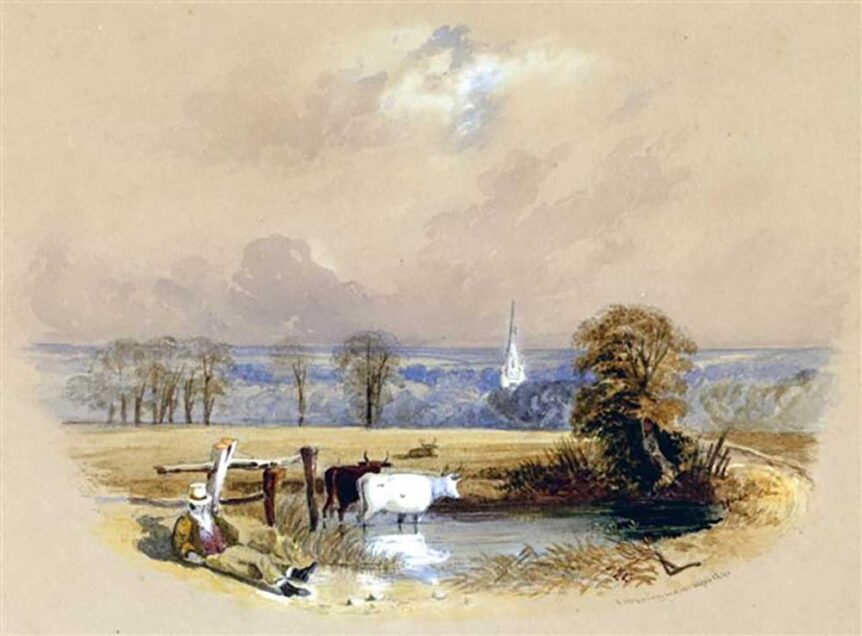
The above image is of Buckenhoe Pond, looking approximately South West
© Geoffrey Ball.
Reprinted [with 2026 updates] from Saffron Walden Historical Journal No. 2- November 2001
The long history of Saffron Walden as a marketing centre arises from its inseparable contact with the land of the surrounding country. Industries that thrived were nearly all closely connected with marketing and processing agricultural products.
A few examples that come to mind are saffron, wool, barley and malt, wheat and flour, livestock and meat, dairy products especially cheese and butter, hides and leather, and so on. What was the farming like that produced this range of products, how was it organised, and who held the land in the centuries before the nineteenth century when enclosure finally brought about the demise of a centuries-old way of life? What follows will, I hope, provide some answers to these questions.
To cast some light on the subject of who held the land and its use in former times, it is necessary to look back to the Middle Ages when in principle all land belonged to the Crown. Manorial lords held land directly from the King in return for services, and these lords in turn had people holding land from them, again in return for services. The types of services varied and were defined by the tenure under which the land was held. Most land today is subject to private property rights, but this was not so in the Middle Ages when much land was subject to common property rights and customary law whereby the right of ownership did not give exclusive right of use. Though an individual owned land, other people living in the community had the right to use that land in various ways, for example arable farming, grazing, fuel and settlement. Most of those using the land in these ways were customary tenants and subject to customary law administered by their manor court.
In the immediate vicinity of Saffron Walden there were two manors, Brook Walden and Chipping Walden. A Steward of the Manor was the senior figure, and he would have been largely responsible for agrarian matters.¹ The manor court was the body through which the lord administered his responsibilities for agrarian management and control. An example of the sort of control exercised would be a tenant who held land ‘at the will of the lord’ and therefore, according to the custom of the manor, was thereby subject to customary law. If he wished to transfer his holding of land to another person, for example, father to son, the transaction had to be recorded in the manor court roll. The tenant received a copy of the entry which in time became known as copyhold. While this was not a free tenure, it was heritable and gave a significant measure of security. However, if the copyholder wished to transfer his land, as suggested above, the manor court could demand an entry fine from the incoming tenant. A similar fine could be applied if the holder of the land died and his heirs wished to sell the copyhold. This was, in effect, a fee charged to enter the property. Not all tenants held land by ‘copy’ but only ‘at will’. This tenure was of lower status and gave little security. Most of the services required from these ‘unfree’ customary tenants were largely commuted to money payments as time went on.
The tenants of the manor lived in crofts and farmed in the ‘open fields’ ― a term used by modern historians ― which were located locally to the north and south of Saffron Walden and, to a lesser extent, to the east of the town. Predominantly, but not exclusively, they farmed the lighter chalky soils which were in the areas of earliest settlement. To the west of Walden there was demesne land which by 1561 was the property of the 1st Earl of Suffolk, owner of the Audley End Estate. In earlier times some of this land had been open fields, part of Walden Abbey. These tenant farmers were first and foremost subsistence cultivators who sold produce, mainly grain, if it was surplus to family requirements. The family grain requirements were obtained from about 2¼ acres of land per person on a three-field system so a family of five would require a minimum of 11¼ acres for subsistence alone.² It has been estimated that about 80% of farmers in England were probably living at subsistence level at the start of the 16th century and a high percentage of holdings in North-west Essex were less than 20 acres in extent. However, locally the percentage of subsistence farmers may well have been less as this was an area well suited to cereal growing where yields would have been higher than the national average and could have produced more frequently a surplus for the market. Unfortunately, peasant farmers kept no records.
The next point to consider is their method of farming – the cows and ploughs part. Firstly, it was essentially a cooperative system where the fields in which they farmed contained land held by many tenant farmers. These open fields were divided into shotts and each farmer had his own strips of land within the shott that had been allocated to him by the manor for his use. The strips were sometimes 220 yards long, the distance a team of oxen was said to be able to plough without a rest and known as a furlong. The width of the strip could be 22 yards, making an acre in total. These strips often became an elongated ‘S’ shape as the oxen used for ploughing started to turn before the end of the furrow. Four oxen and a plough were roughly 40 feet in length, so a large turning circle was necessary. The teams of oxen were usually owned jointly by several co-operating farmers, and the plough may also have been jointly owned by the same group.
A rotation of crops was followed by all the farmers having land in any one field, wheat being sown in the autumn and barley in the spring, these being the two cereal crops everyone grew. In addition to the two fields being cropped, there was a third – ‘the three-field system’ mentioned earlier – which was fallowed or rested for a year from cropping. This field was used from harvest onwards for grazing, thus benefiting from the replacement of some plant nutrients by the grazing animal, until the time arrived to plough for the next crop when the rotation would begin again. Wheat was the first crop after fallow. All farmers had land in at least three fields, but many had similar strips in yet more fields, often far distant from their homestead.
The problems arising from small fragmented arable strips were a serious impediment to progressive farming and resulted in much lost time at critical periods. Field drainage was hindered by multiple occupation and a mass of field paths. Significant increases in yields were almost impossible to achieve for many reasons and compared unfavourably with enclosed land, about which more later. Average grain yields in the medieval period are always difficult to gauge, but 10 to 11 bushels of barley per acre can be used for an average crop, with rather less for wheat and oats. Of this gross yield, two to three bushels would have to be retained for tithe and seed for the following year. Cereal yields were slow to advance, but by the mid-16th century the average was about 13 to 14 bushels per acre. According to some figures from Norfolk, significant increases in yield only came about after 1750 and then continued to rise quite steeply into the 19th century. By 1850 barley yields had advanced to about 40 bushels per acre by which time soil fertility levels were much higher than they had been in the era of the open fields.
While numerically the largest group of farmers were these customary tenants holding open field land, there were also seven large leasehold farms within the two manors. These seven were what we would recognise today as farms complete with a farmhouse, set of buildings and fields – known as ‘closes’—which were demarcated by hedges in contrast to the open fields outside their boundaries. All seven were part of the Audley End Estate and leased by individual tenants able to farm large acreages. These farms ranged in size from 56 acres to over 300 acres and as time went on incorporated additional land gained from purchases and exchanges of open field strips. The farm maps of 1758 show these farms together with contiguous areas of open fields.³
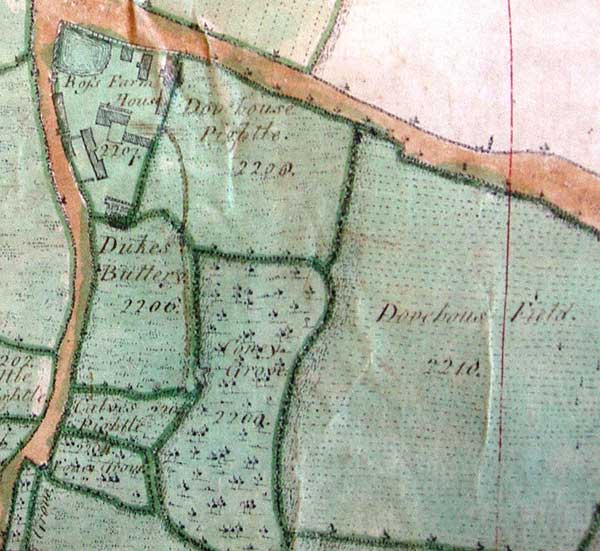
Their names were St Aylotts, Butlers, Westley, Ross (Roos), Pounce Hall, Monks Hall and Audley End Farm. Apart from Pounce Hall, all the others remain as working farms to this day. Nearly all are located near the 300 foot contour at which level the soils generally become heavier and naturally less free-draining than the soils at lower levels, but have greater potential for higher yields and were thus favoured by those able to undertake the extra cost of farming heavy land.
Rentals reflected the difference in value between open field lands in NW Essex at 7s to 10s per acre whereas enclosed land was valued at 15s to 20s per acre according to Arthur Young, writing in 1807.4 Most of the original farmhouses had been replaced in the 16th and 17th centuries by the structures which stand today but often with alterations and additions. Apart from the houses, a range of conveniently located buildings would have been provided for the farmer, which were maintained jointly by landlord and tenant.
In 1747, just prior to the partition of the Audley End Estate, a survey was carried out of these seven leasehold farms in Brook and Chipping Walden, as well as other farms in the manors which were subsequently granted to Lord Hervey under the terms of the partition of 1753. At that time, several of the farms were in a poor state and concern was expressed about retaining tenants or finding replacements. One of the greatest problems for landlords in managing these large commercial farms was finding and retaining enterprising tenants who were capable of making sufficient profit not only to pay the rent, but to have access to the capital to finance their farming operations. An example of the concern expressed is as follows: ‘paling, hedges, ditches, gates, bridges, stiles in the worst condition I ever saw. It is absolutely necessary therefore to put it in tolerable order that some profit might arise and that whoever came to look on it might not be frightened or give it an ill character’.5 Again ‘Rent had been raised a few years since nine pounds yearly which is abated to the New Tenant and his bargain is dear enough. The house is ready to fall, ye roof must be taken off and thorough repaired this spring’ etc. etc.6 Generally the farms in the outlying manors were in poorer condition than those in Brook or Chipping Walden.
Arthur Young detailed the costs involved in setting up a farm, presumably of 100 acres, as he began with a requirement of five horses at £30 each. At the time it was considered usual that five or six horses were required per 100 acres. What he terms as the ‘Principal Items’ amounted to £1,548, a considerable sum which only a very few could be expected to raise. The list includes the livestock, necessary not only for the market, but also to maintain the fertility of the fields. The grazing animal and farm-yard manure were realistically the only available sources of plant nutrients apart from legumes such as clover, beans or sainfoin. Mixed farming was essential if soil fertility was to be maintained. Most of these farms had both sheep and cattle.
In order to ensure that soil fertility was not put at risk, strict compliance by the tenant was required, who had to agree to a limit on the number of cereal crops in the rotation. Normally on the heavier land, where turnips were not grown for fodder, the rotation would still include a bare fallow to clean the ground. At most, two cereal crops in four years separated by a legume such as peas or beans were grown. On the lighter land turnips were grown which were either fed off in the field, or carried off for yarded stock and were regarded as a cleaning crop, when grown in rows that could be hoed.
Before leaving the subject of those who held land, reference should be made to the freehold farms, several of which became part of Audley End estate as a result of purchases during the second half of the 18th century, but by no means all. A number remained as freehold properties into the 20th century. The Saffron Walden Enclosure Award of 1823 finally terminated open field agriculture in the parish and the land was allocated to various landowners. A few new farms were set up, on former open field land, and the pattern set for a totally commercial agriculture capable of producing the additional food for a rising population, but not without social disturbance and hardship for many people.
NOTES
- The Steward of the Manors in 1758 was a John Craster, and his deputy was Thomas Butler (information from L. Barker).
- J.Z. Titow, English Rural Society 1200-1350, p9.
- Audley End Farm Maps 1758 at ERO: St Aylotts D/DQy 13 (Grid Ref 569399); Butlers D/DQy 12 (GR 560407); Westley D/DU 120 (GR 532402); Ross D/Dby D/Dqy 11 (548361); Pounce Hall T/M 124 (GR 563383); Monks Hall D/DQy 14 (GR 559431); Audley End T/M 123 (GR 525377).
- Arthur Young, Secretary of the Board of Agriculture from 1793, died 1820: Agriculture of Essex, 1807.
- ERO D/Dby 9, 1 January 1747: Little Walden Park
- ERO D/Dby 9, 1 January 1747: Catmer Hall, Littlebury
Note: Geoffrey Ball, who lived in Saffron Walden, was a retired agriculturalist and company director who worked both in this country and Africa.