
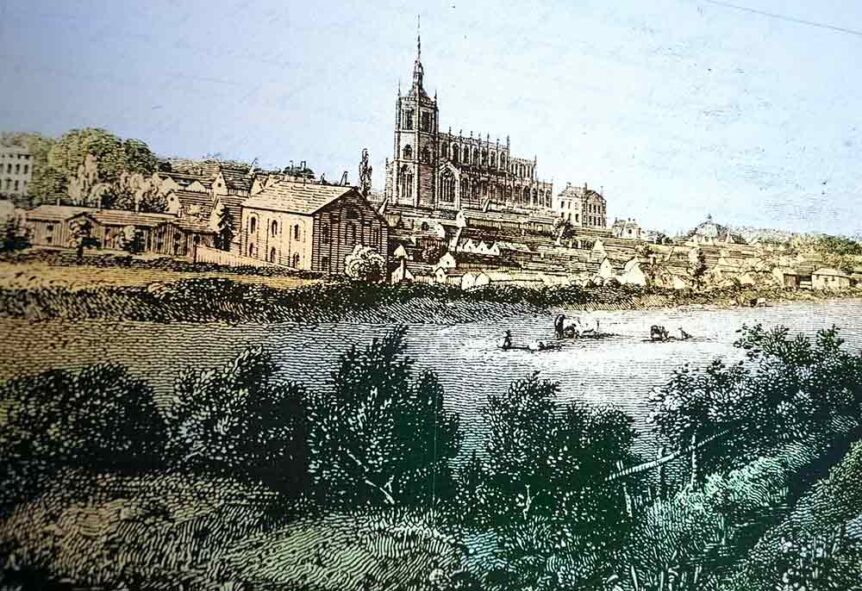
Note: The featured image above shows St. Mary’s Church from the Battle Ditches
© SWHS Archives.
© Elizabeth Allan. First Published in Saffron Walden Historical Journal No. 33- Spring 2017
In medieval Walden the parish church was physically dominant from its location near the castle on the ‘acropolis’ above the market. It also played a focal role in the cultural life of the town. Ritual activities included processions: banners were carried on St. Mark’s Day, the date of the dedication of Walden Abbey church, as well as at Rogationtide and around the town, predictably, at Corpus Christi. Celebrations at Candlemas involved dancing, for which skins were bought to make shoes, and a drama featuring an ‘Abbot’. Secular festivities included bonfires and probable games and merrymaking around the midsummer feast of the Nativity of St. John the Baptist, with their potential for reinforcing corporate identity, and perhaps generating the many court prosecutions for assault and general disorder then. Church ales, alternatively called ‘Mays’ were held, especially at the feast of Pentecost. Ritual fires, essential to the Vigil of Easter, were lit also at the feast of the Dedication, and the secular rites of Hock Monday contributed to church funds. For a social high-point around the feast of Pentecost in 1456, bread and cake, ‘the Pentecost tart’, using saffron, pepper, cloves, mace and butter, were baked and two quarters of barley brewed.
Varied rich accoutrements and ornaments sustained ritual and much effort went into maintaining its requisites: missals were bound, a grail book written, a breviary and other service books mended. The churchwardens frequently acquired candles and oil: in 1439 a barrel of lamp oil for the year; while the choir was supplied with tallow candles, wax ones were used at the altars and for ‘the harrow in Tenebris’. The church contained many images, some three-dimensional, some painted on banners and other surfaces. In 1463 a ‘large tree’ was bought for making an image of the ‘Blessed Mary’, while other known images are of St. Anne, St. George, St. Mary Magdalene, St. Catherine, St. John and St. Christopher. There were also lights of The Salutation and of St. Etheldreda. The visual was further elaborated: a painted tabernacle was made at Norwich and fine textiles included a white silk chasuble for an altar and a velvet cope with gold leopards. Vicar John Clynt left items including a bible, sold by the churchwardens for the considerable sum of £4 14s 4d. The Mass of Recorder was written on parchment, the liturgy of The Visitation on vellum and among items painted were a figure of Christ, the pulpit, crosses, the high altar frontal, a pax, banners and even a chest for storing surplices.
Fraternities (Gilds) will have had an important role in the town’s social and religious life. In 1389, gilds of Corpus Christi, Holy Trinity and All Saints were recorded and may have continued to function but generate no surviving documents of the 15th century. However, the Holy Trinity Gild was cited by a testator in 1481 and any extant Corpus Christi Gild would be involved in the processions recorded in 1444 as happening at the commemoration of Corpus Christi when seven banners and the hearse were carried, bells rung and drinkings took place in the cemetery. The three gilds of 1389 each had a chaplain, appointed to celebrate mass annually for their members.
The additional Gild of Our Lady of Pity was newly founded in 1400 to provide care for destitute men, with an almshouse, to be served by a priest. John and Eleanor Butler provided for a house to be built in the churchyard to accommodate him. Two additional priests were to live with him without charge and receive sixpence each per quarter to assist with the weekly Lady mass. In 1501 John Chapman left £1 for a purple cover for the image of Our Lady of Pity. The gild had both female and male members and the priest was to say Requiem Masses, as well as a weekly Mass in the almshouse and, on Saturdays, the day traditionally associated with the worship of Mary, Mass of Our Lady in the parish church, For the latter, the priest was to assemble three women: one from the parish church, one a gild member and one of ‘a general type’. It is unclear whether this is because women were more biddable, more available to attend, or more appropriate to a Lady Mass. Almshouse inmates were to be encouraged to come to church, to pray for inmates, benefactors and friends. The annual feast, following sung Mass and sermon, saw rituals of social reversal merge with doctrines of ‘the first shall be last’, in that the poor were to be served first, by the most worshipful present. It was in fact through the Gild of Our Lady of Pity that the elite seem to have exercised power until the foundation of the new Holy Trinity Gild of 1514.
Overall, the town may have been well endowed with priests, perhaps fifteen in the early 15th century. The extant churchwardens’ accounts, recording parish income and expenditure, list very numerous gifts and bequests, some specifically, and many more, surely, associated with requests for commemoration. These, incidentally, name many, mostly women, whose lives are otherwise unrepresented in the records. The prosperous Katherine Semer’s final will, of 1514, is noteworthy because her endowments for commemoration included the perpetual chantry in Walden church, basic to the Holy Trinity Gild’s foundation, still maintained after 1546. The laity’s establishing gilds, and chantries providing extra priests, may show a commitment to the local church. Extra priests surely brought benefit to the church but it is difficult to be precise about testators’ commitment. However, a particular devotion is hinted at occasionally: in 1477 Robert Mayhew left a red silk cope, worth £5 6s 8d, so that the church could reserve existing special ones for use on the greater feasts. Donations display a considerable variety, which partially reflect variety in Walden’s social and spatial context.
Money was raised also by street collections and by the ‘ales’, which were evidently associated with major feast days. Mention should be made of plays as also providing income for the parish, and making a distinctive contribution to social/cultural life. Three are recorded by the churchwardens in the period 1438-90. They seem to have been performed in the streets, in the market and in Little Walden.
Note:
For further information, see Allan, E. Chepyng Walden: a late medieval small town, Saffron Walden 1438-1490 (2015). SWHS Publications