
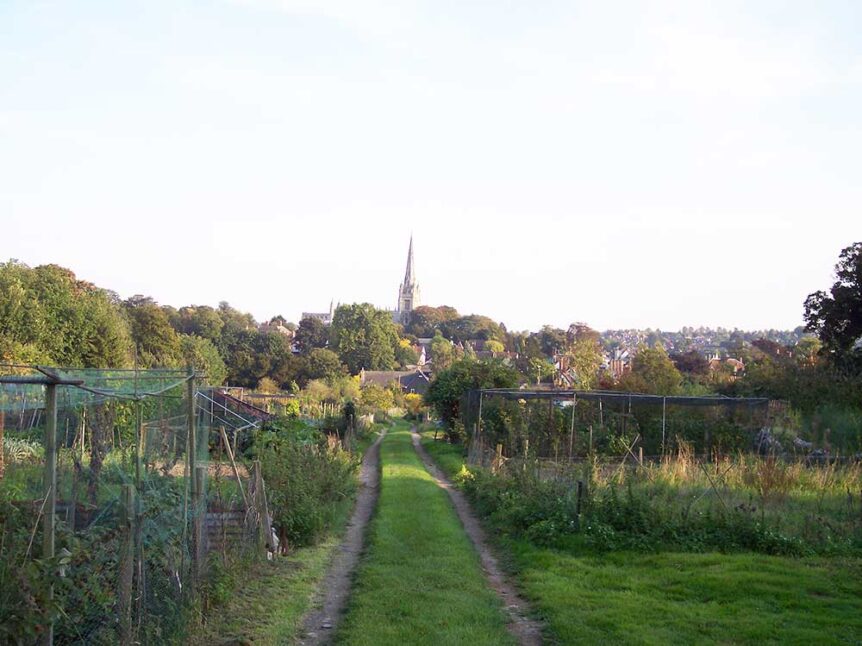
© Jacqueline Cooper.
Reprinted, with 2026 updates from Saffron Walden Historical Journal No. 20- Autumn 2010
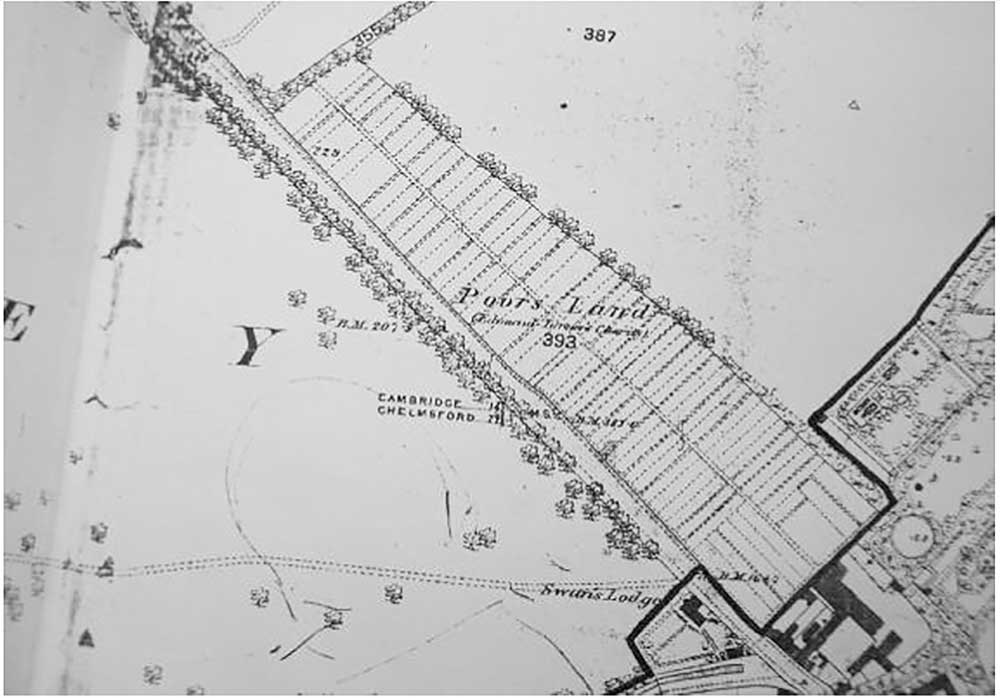
On 24 January 2026, it was 195 years since 25 men drew lots to decide which plot they would have on the newly-provided five or six acres of land at Windmill Hill laid out as allotments for the poor by the worthies of Saffron Walden (Fig. 1).
Among the list of 25 men on the earliest tenants’ list was 40-year-old Thomas Westwood of Castle Street. This surname can still be found among the plot holders today, and indeed the late Ernie Westwood had inherited his highly productive 30-rood plot from his father Ernest, who himself took it over from his father, George Westwood. Altogether five generations of Westwoods have had a plot here since the 1830s. Today Ernie’s widow Sheila cultivates it still.
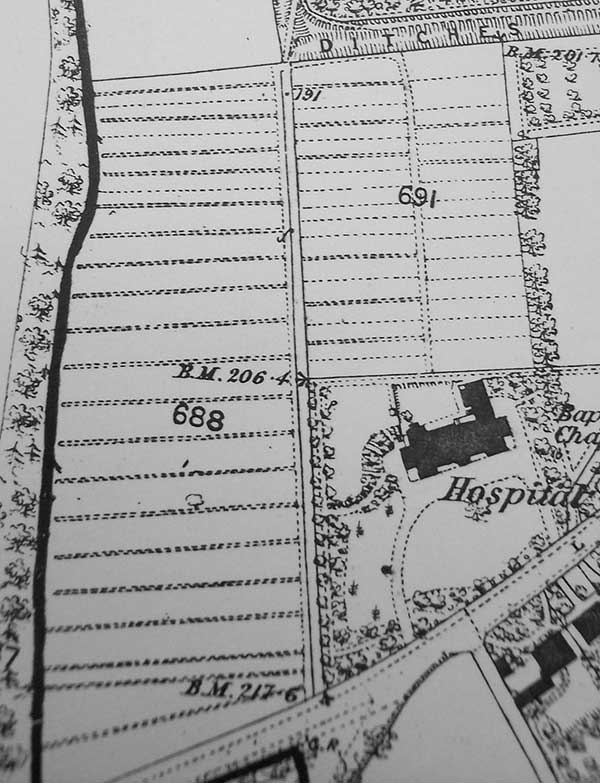
That these plots are still being cultivated today, let alone in some cases by the same family, represents a remarkable milestone, as it is very unusual for an allotment scheme to operate on the same piece of land for so long. Known originally as Turner’s field, Windmill Hill allotments appear to be the earliest survivor in situ of the 1829-31 Spade Husbandry scheme which originally comprised eight allotment sites. There were two sites earlier than this but one of them, Limekiln in Little Walden Road, has been moved to another piece of land at Byrds Farm Lane; and the other, known as Parkwall, has been built on and now lies beneath Saxon Way (Fig. 2). The other sites were known in 1830 as Railey field (now Railey Road), Nicholls field (at Thaxted Road), Copthall (near Ashdon Road), part of Warners field (near Turners) and Holmer Cross (now part of Goddard Way).
The Windmill Hill allotment site is particularly significant, not only because it is original, but also because of the date when it was first announced: December 1830. This date coincided with the time of the ‘Captain Swing’ riots, which were causing huge concern all over England, including NW Essex. As described in detail in my book, The Well-Ordered Town (2000), the Saffron Walden Spade Husbandry scheme as a whole actually began the year before the Swing unrest; but did not really take off in a noticeable way until minds were concentrated by the threat of riot breaking out in the town. This led to a flurry of activity and the appointment of special constables.
The Spade Husbandry Scheme
The sequence of events that led to the allotments scheme began, as did so many initiatives of the period, in the mind of ‘Gentleman’ John Player, a leading worthy of the town. As early as 1828, he had realised that allotments represented a potential amelioration to the desperate poverty of the times. But the accolade has gone to the actual providers of the land following the formation of the Spade Husbandry committee in 1829 – the 3rd Lord Braybrooke and the Gibson family. It was Braybrooke who first of all experimented with the idea on his Littlebury estate, and Jabez and Wyatt George Gibson who offered the first Walden plots – 4½ acres on Lime Kiln field off the Little Walden road, ready to cultivate by the spring of 1830.
The scheme was an immediate success, with far more men wanting plots than could be accommodated, hence the search for additional fields that could be converted to allotments. Three wealthy men of the town – John Emson, Thomas A. Catlin and John Archer – did not respond to direct appeals for fields to be used as allotments, so Lord Braybrooke offered seven acres of land next to the wall of Audley Park, hence known as the Parkwall allotments. In spite of the high rents, 38 men were happy to take the 30-40 rod plots. This was soon followed by the Gibsons offering more plots at Railey field. That made three allotment sites so that by the summer of 1830, there were potentially 450 adults and children benefiting from the produce of 78 plots. The townsfolk found the streets of Walden awash with cheap vegetables. It was a huge success, and even more people wanted plots for themselves, but where was the land to come from?
This question acquired a sudden urgency when labourers in nearby villages, Clavering, Arkesden, Elmdon and elsewhere joined in the ‘Swing riots’ – an unprecedented mass movement of protest which spread right across southern England and beyond, and put tremendous worry into the hearts of the ruling class, fearing that Britain might be on the brink of revolution. At all costs this revolt must not reach Walden, and the answer to keeping the town labourers happy was perceived to lie in the provision of more allotments. A series of urgent meetings took place and suddenly more land was forthcoming.
The Saffron Walden Corporation and the charitable trusts agreed to the use of charity land for allotments. Mr Nicholls, tenant of five acres of Erswells Charity land in Thaxted Road, was compensated to give up his tenancy at once, and Wyatt George Gibson hired the Turners Charity land at Windmill Hill to be sub-let as allotments too. In addition, the Gibsons also offered land in Warners field, and the Catlins land in Copthall field. All this frantic activity took place from 7-17 December 1830, precisely the period when the Swing riots were at their peak locally.
In the course of time, most of the original sites have disappeared but, perhaps because of its private ownership,Turner’s Field survives from the original Spade Husbandry scheme. It is an interesting thought that this important amenity was a response to protest which never actually happened, whereas the bread riots in 18th-century Walden achieved little for the ordinary people in the long term.
New research
During the past decade, much new research on allotment history has appeared, notably a classic study by Jeremy Burchardt, The Allotment Movement in England 1793-1873 (Boydell & Brewer, 2002). This confirmed the dramatic rise in allotment provision in the 1830s all over England, and concluded it was set in train by the Swing riots, afterwards acquiring a momentum of its own, aided in many areas by campaigners and societies. Dr Burchardt saw allotments as a modernising factor in rural society. He also appealed for historians to carry out more primary research using local allotment archives. This was a challenge I took up by organising a nation-wide allotments project under the umbrella of the Family & Community Historical Research Society (FACHRS), with Dr Burchardt as academic adviser (see Burchardt www.fachrs.com ). A network of 30-40 researchers from all over the country investigated local record office allotment records in almost every county. As the data on 19th-century allotments began to flood in, it became clear that allotments were not simply marginal benefits for a few poor labourers, but were integral to rural life and culture in the 19th century. This project, together with Dr Burchardt’s earlier findings, has transformed our understanding of allotments, and has resulted in a book and CD database summarising the results: Breaking New Ground: nineteenth century allotments from local sources (FACHRS Publications, 2010).
These two new volumes (which were not published at the time I wrote The Well-Ordered Town), give greater context to the Walden allotments. It is now clear that they were not, as so often claimed, the earliest in the country: numerous plots already existed elsewhere by 1829, as far back as the 1790s in Gloucestershire and Wiltshire. It could still be that Walden had the earliest town allotments, since one omission from both the new books is any deep research into urban allotment provision; however, Sheffield had something very similar by themid-18th century.
What is certain is that there were many more allotments existing before Walden had them – a total of 87 sites are known, and there were probably more awaiting discovery. In Essex, earlier schemes existed by 1820 at Loughton, Chesterford, Brightlingsea and Walthamstow. The author’s own research on Cambridgeshire allotments found that two sites appeared in the early 1800s, and this county had as many as 45 allotment sites by December 1830, a large proportion of those known for the whole of England. Indeed, it was one of these, the well-publicised scheme at Waterbeach, which Lord Braybrooke visited during his research on the subject and which influenced his initial scheme at Littlebury
The Windmill Hill site is rare insofar as the FACHRS Allotment Project found only three other places which had allotments still in existence today on the same site dating from this early period. The Free Gardens at Great Somerford in Wiltshire were established by 1809 and still exist today; the Poor Potato Ground at Loughton in Essex, set up in 1819 is still an allotment site in 2010; and Poor’s Plot at Stretton on Dunsmore, Warwickshire. dates back to 1825. There are probably others but many sites still in use today have no early documentation surviving. The beginnings of the Windmill Hill allotments, thanks to the clerical efficiency of John Player, are well documented and therefore it is reasonable to claim that they are the fourth oldest allotment site known to have existed before the 1830 surge, and to be still in use today on the same land.
The organisation of the allotments went downhill somewhat, following John Player’s resignation as secretary in 1841, and his death five years later. The allotment archives during his time are meticulous, but after this information is sparse. Sporadic minutes suggest that the allotments were in a mess in the 1840s, full of weeds and arguments about boundaries and unpaid rents. The committee gradually improved standards but interest tailed off in 1858, and only occasional meetings were recorded over the years. Then, on 25 September 1906, the committee decided to disband, as it was easier for tenants to hire their plots directly from the landlords: Lord Braybrooke, the executors of the Gibson estate, Lewis Fry and the Saffron Walden Amalgamated Charities. This decision took effect at Michaelmas 1907 – it may be coincidental that this was also the time when the Allotments Act of 1907 consolidated earlier laws forcing councils to provide allotments on demand. At a final meeting on 24 April 1909, the committee decided to spend £100 of its remaining funds on prizes for allotment holders entering town flower and vegetable shows, presumably those organised by the Saffron Walden Horticultural Society, which still flourishes today.
Windmill Hill Allotments
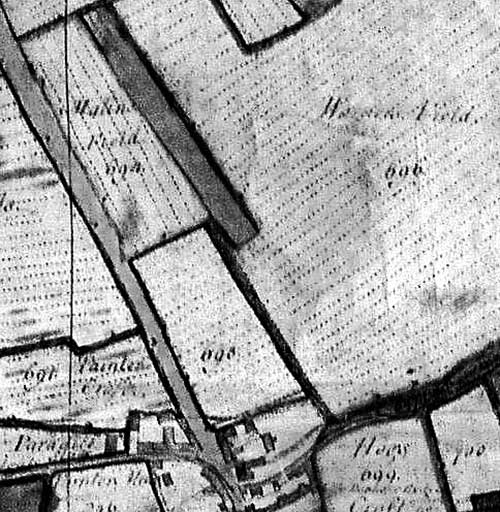
The land to the east of Windmill Hill in Saxon times was part of Coppid Bush open field, but is shown as separate crofts on the map of 1758 (Fig. 3). They became known as Turners field, associated with the Edmund Turner Charity, which in 1700 bequeathed valuable sums annually to the poor of Audley End and Walden. Early OS maps of the town show the layout, and still name it as Poors Land since the rent money went to the poor.
After Turners was allocated as allotments in December 1830, a hedge between the two fields was removed and the 25 holders drew lots for plots in the new year. Eight of them were old tenants from Parkwall field, while others lived nearby in Bridge End, Horn Lane and Castle Street. Most plots were 20, 30 or 40 rods, but Henry and Samuel Marshall from Bridge End had 80 rods each at the bottom of the hill, and William Byatt had 60 rods. The other surnames on the list of early tenants are Cox, Palmer, Wren, Freeman, Barker, Davis, Cornell, Finton, Butterfield, Bird, Warner, Augur, Brand, Archer, Hodson, Brown, Goodwin, Bacon, Watson and, of course, Westwood.
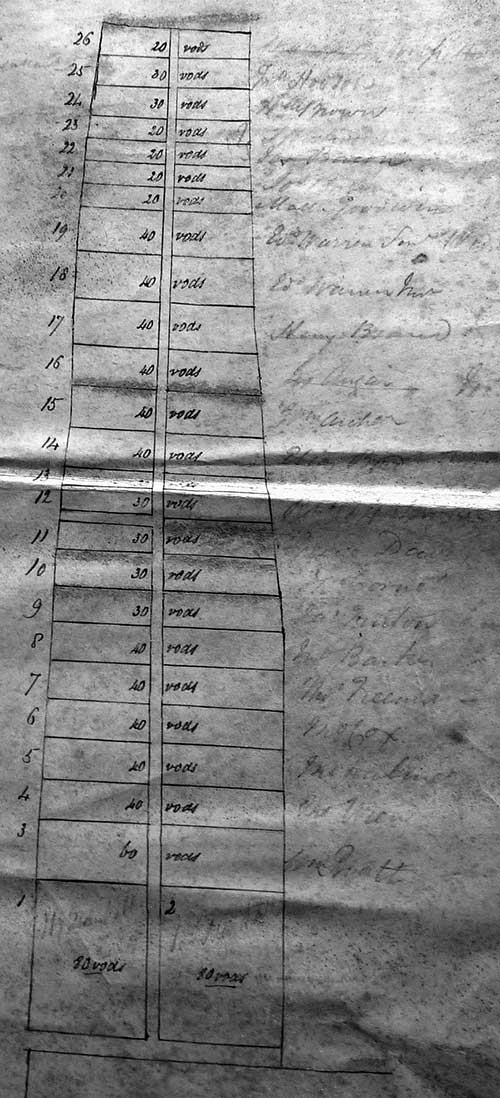
It was probably John Player who drew up an undated plot plan which survives in the town archives (Fig. 4). The tenants’ names are pencilled in next to their plots, but many are too faint to read. However, those which are readable match the tenants’ list as do the plot sizes given, so it is reasonable to conclude that this drawing shows those who first cultivated these plots in the 1830s.
Later on, the Gibsons were allowed to exchange Turner’s charity land with land elsewhere in the town, but promised to keep the old land as allotments. Thus the Windmill Hill site remains privately-run, unlike others in the town which are provided by local authorities. Uttlesford District Council has five sites. including Birdbush Avenue, Radwinter Road and Rowntree Way, a total of 46 plots, whose history is mostly associated with the building of nearby housing. Saffron Walden Town Council provides two statutory allotment sites, at Byrds Farm Lane (a replacement for the old Limekiln allotments) and Little Walden Road, a total of 66 plots, but is under great pressure to provide more as there is a long waiting list.
There is also a waiting list, presently of 30 applicants, for the Windmill Hill allotments, owned by the heirs to the Gibson estates, the Fry Family Trust, who also own Bridge End Gardens and the Fry Art Gallery. The allotments are administered by Watsons estate agents, who took over from Cheffins in the 1950s.
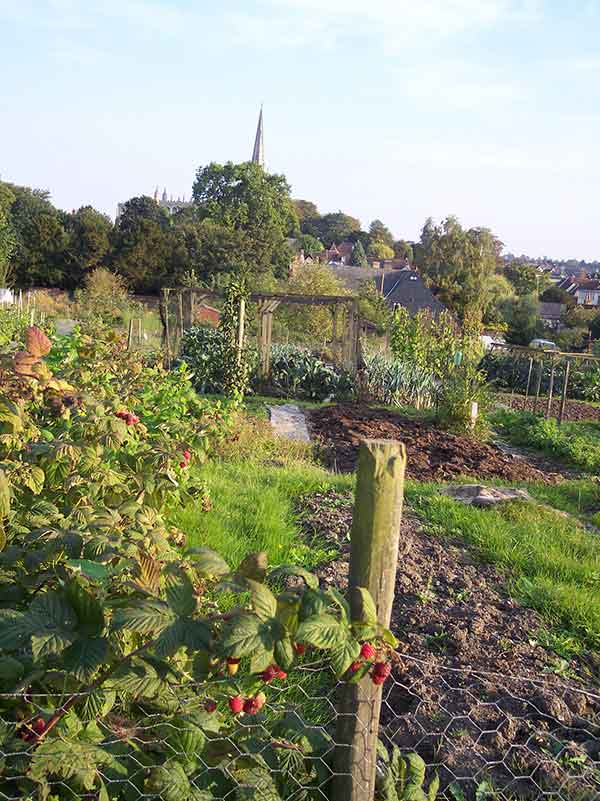
The 25 large plots of 1830 are today 50 smaller plots of ten rods, which must surely be the most desirable allotments in Saffron Walden. Resting from their labours, allotmenteers can enjoy one of the best views in town, encompassing the spire of the parish church (erected soon after the allotments appeared), and the varied rooflines of the old town, interspersed with tall treetops (Figs 5 & the featured image above).
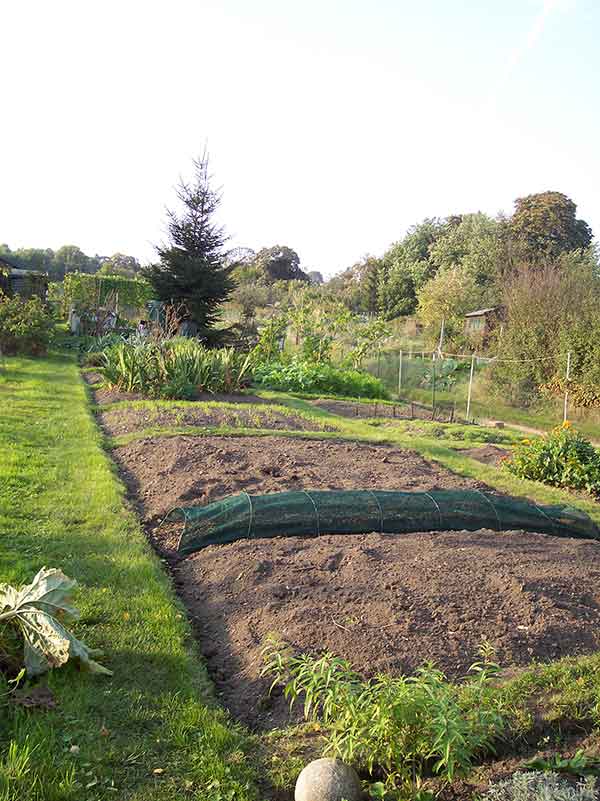
The soil is good and, even after 195 years, the land remains productive thanks to careful husbandry and constant soil improvement. It is a remarkable achievement that these allotments, which came into existence before Victoria came to the throne, have produced thousands of tons of good, fresh food for so many generations of townsfolk, and continue to do so today. But the allotments sadly have lost one important fixture – Ernie Westwood, former bus driver and postman, who died in March 2010 after devoting much of his life to the allotments that had been rented by his family for at least a century. He is remembered by plot holder, Martyn Everett:
It was very unusual to go to the allotments and not see him. Even when he became very ill, he would still go out and work very slowly and methodically, stringing his beans or digging another small plot. He always had a story to tell, or a joke about something. He kept a small tin in the trench he was digging into which he would put all the things like wireworms, and blackbirds would come and take them from the tin. Ernie saved a lot of his own seed, so that they gradually became adapted to the soil and the micro-climate of the allotments – he always had the biggest leeks, broad beans and best runner beans for this reason – he didn’t necessarily do it by the ‘book’ but by what he had learnt from his father and from his own experience. He had a very old spade, which had broken down one side of the blade, so it was like half a blade, and this had then been worn smooth with use.
Martyn’s wife Zofia, who recorded an interview on tape with Ernie for the Essex Sound Archive, adds:
When working as a postman, Ernie would do his rounds from dawn onwards, and then spend the rest of the day working on his plot. His soil was fine with no stones and well-manured and rich. He was great with giving advice and help to novices such as us. His two plots were beautifully planned and arranged and he worked systematically, and slowly from one end of the allotment to another. Each day another little piece dug over and raked ready for the next year’s crop. It was a pleasure to see his work. He worked slowly, methodically and took great pride in his allotment. In the summer he was always there an hour or so before lunch, getting beans or new potatoes or fresh little cabbages for lunch. It requires stamina, dedication and a love of growing things.
Stamina, dedication and a love of growing things – yes indeed, this is the essence of allotment life. As an allotment holder in Clavering for over 25 years, the author is full of admiration for the continued commitment of the Fry family to the Gibsons’ desire to provide these allotments; and the achievement of Saffron Walden gardeners like Ernie Westwood who have kept these excellent plots in good heart for so long, when so many others have gone. In the case of Windmill Hill, there is an additional significance, since they lie on the northern edge of town, an area that has never been developed and where the built-up boundary is in the same position as it was in earlier times. With the golf course on the other side of Windmill Hill, it means that this end of Walden has been saved from the extensive development that continues to take place elsewhere – even the Catons Lane boundary will now be compromised with the new housing development planned there.
Long may this end of town remain inviolable for it is certain that, if the townsfolk did not protest in 1830, they would certainly do so now if anyone ever suggests developing beyond this historic boundary and losing these precious allotments!
Note:
Breaking New Ground, is available at Saffron Walden TIC. See also Cambridge University Press.
Sources:
Saffron Walden Museum 40477;
Spade Husbandry records (ERO D/B2 PAR9/5);
1758 Saffron Walden map;
19th century OS maps.
The author would like to thank Martyn and Zofia Everett, Malcolm White, Colin Bazley and Sheila Westwood for additional information.