
© Mike Hibbs. Reprinted (with 2026 additions) from Saffron Walden Historical Journal No. 35 Spring 2018
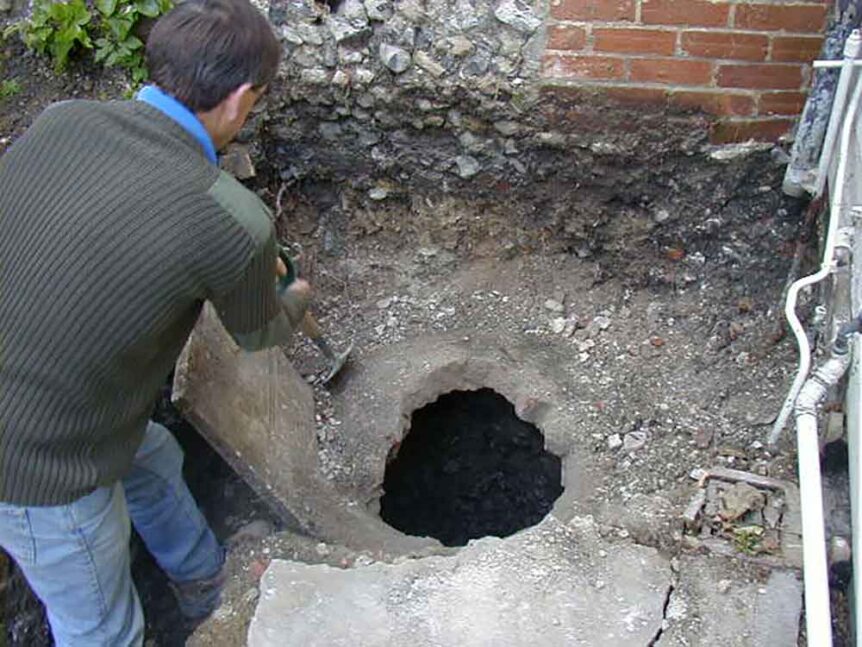
Note: the above featured image is of Gerald Mummery uncovering a well in Castle Street.
Quite apart from the archaeology of Saffron Walden, there are a number of underground phenomena, mainly man-made. Here are some I have come across in my work as an architect in the town.
The Slades
Many people will be aware of the Madgate, Fulfen and Kings Slade streams, seasonal watercourses that run through or near Saffron Walden, about which I have written before (SWHJ Spring 2013). The Kings Slade, in particular, runs through the centre of Saffron Walden, flowing from east to west under Foulslow Bridge at the bottom of Chaters Hill, and then along the bottom of the Common (Fig. 1).
It then enters a culvert before re-emerging at the Bowls Club in Abbey Lane. For many years the Fire Service used to go through the culvert as part of their training. I recall entering it, aged about 13, from the Common and going about half-way along.
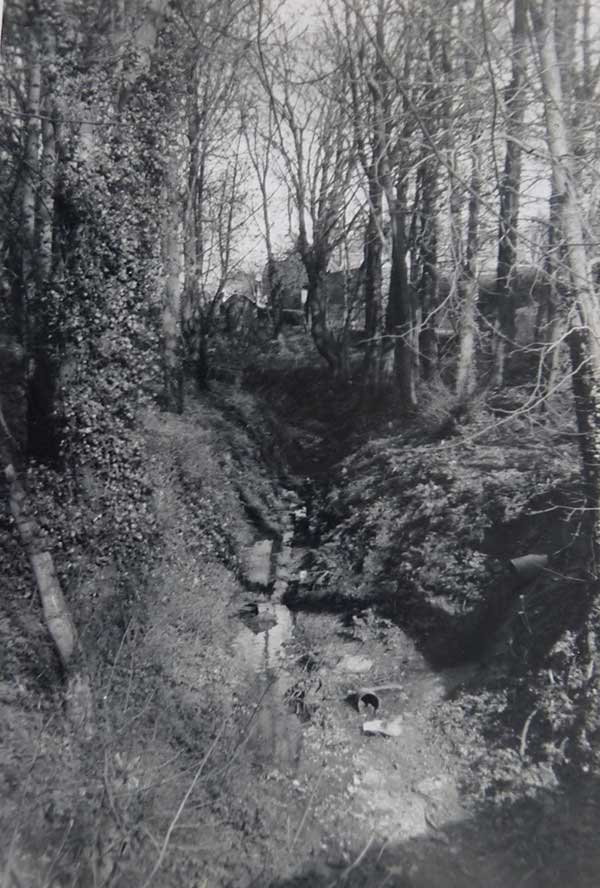
The culvert has a bend about half-way through, and when our unsupervised expedition lost sight of the little silhouette of light forming the entrance we lost confidence and turned back. Fortunately, there is now a grille to stop unauthorised access.
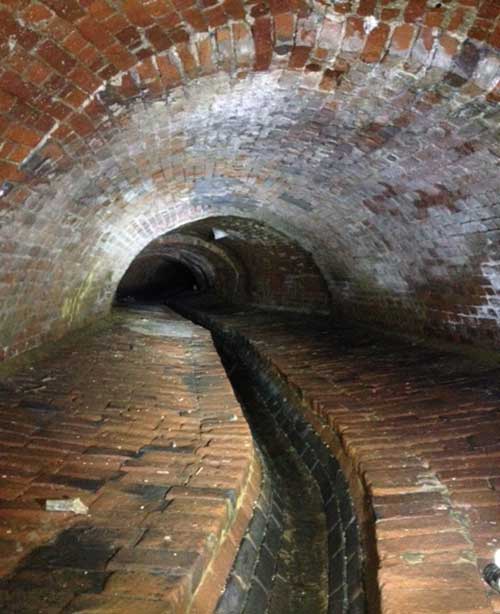
The Kings Slade culvert is a fine construction, made from the local soft red brick, with an arch over a wide bed (Fig. 2). Some parts of the construction may be older, as they are made from flint. It is interesting to track the route of the Slade on old maps, before it was culverted. It must have been a very smelly open sewer, carrying as it did both sewage and the waste from the tannery in the old Police Station car park at the bottom of the Common right through the Town Centre. You can still see evidence of it in the form of access hatches set in the floors of shops, or in the pavement.
The top of the Kings Slade culvert is surprisingly close to the surface – sometimes only a foot below the tarmac. It is high enough to stand up in parts of the culvert. The Environment Agency is currently planning to repair it, at considerable cost. There are many stories of tunnels linking the Church to the Castle, or the Town Hall to the Church. It is likely that these stories arose because of the surface water drains constructed in the Victorian period. These still exist, running down each side of the High Street for example, and connecting to the Kings Slade culvert. Only about 18 inches high, the drains are made from brick forming an arch. One in particular used to run from Church Street down the hill behind the shops on the West of Market Hill, but is now long gone.
The Slades only carry significant amounts of water when the aquifer is full – which happens about once every 15 years. This is because the land surrounding Saffron Walden is clay but the town itself sits on chalk.
Wells
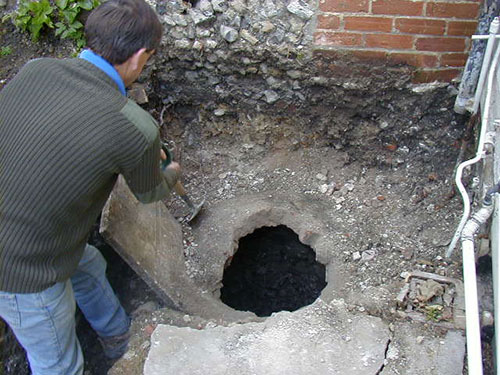
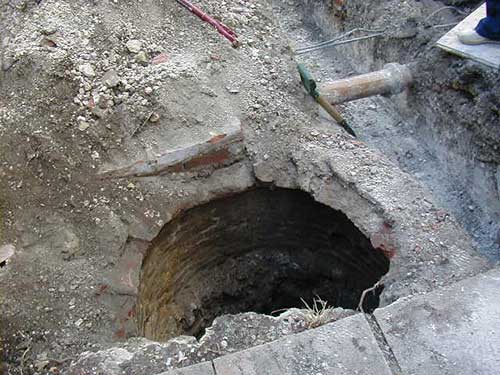
Before the Gibson family provided a regular water supply from the fountain in the Market Square, the only source of water was from private wells. Most 18th and 19th century houses in the older part of Saffron Walden had wells, and in Castle Street, where every other house appears to have been a brewery, the wells were large and deep. Many had cast iron pumps attached to them, to pump up the water, and early versions had hollowed out logs to bring the water to the pump. However, in the absence of a proper drainage system, the water supply was often polluted, as the Gibsons found when they dug the Town’s first public well in Hill Street.
Wells were dug by professional welldiggers. A circular wooden form was laid on the ground, and bricks set on it to form a circle. The ground was then dug out from underneath the wood, and as the circular form went down more bricks were added. There was no need to include mortar as ground water entering the well was welcome, and the circular shape meant that if the structure was compressed by the surrounding ground it was all the stronger. Once water was reached the well-digger was hauled out on a rope, and a brick dome constructed, this time with mortar, to cap off the well (Figs 3 & 4). In the absence of water for a well, 19th century buildings often had a tank in the backyard to collect rainwater running off the house, with a pump to take the water up to a tank in the roof. This was no doubt a modern version of older methods of collecting water for home use.
Cellars
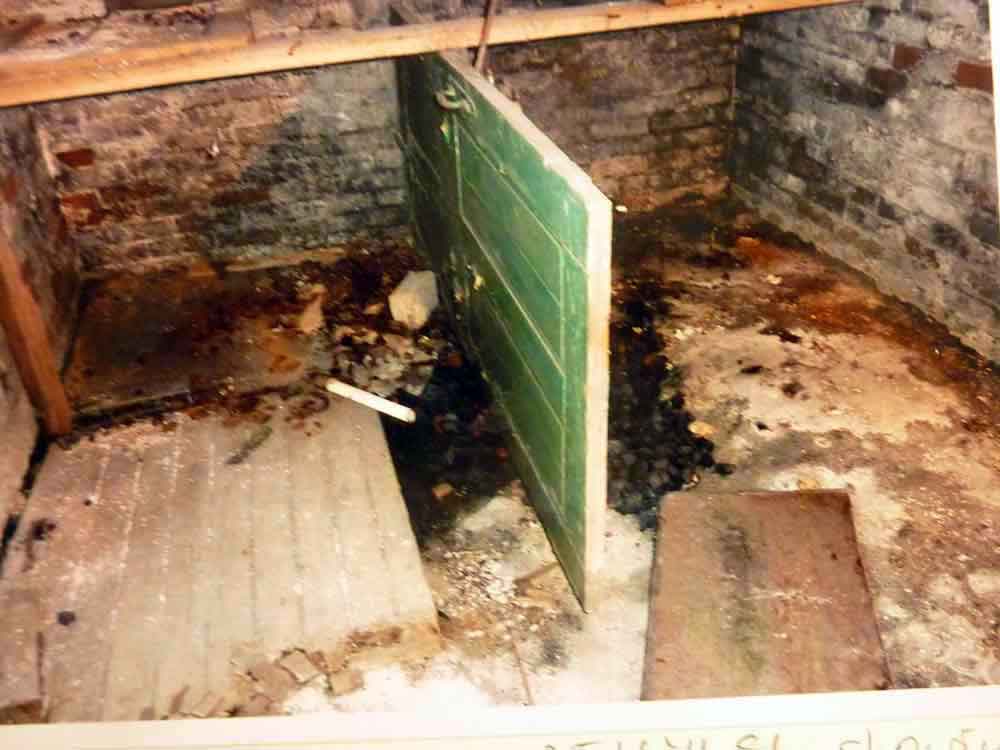
Wells are sometimes found inside houses. If a glass plate is placed over them and a light inserted, ferns grow within weeks. This is a botanic oddity, given that ferns do not grow well in the chalky soil of Saffron Walden. However, even stranger is finding a well in the cellar. This phenomenon can be found in several properties in the town, and in at least one case the water level is immediately below the floor of the cellar. Given that the cellar was often the site of the kitchen range, it will have saved the servants considerable labour to have the water supply so close. But the damp and dark conditions in which they were expected to work are still disturbing.
Saffron Walden’s cellars are seldom the same size or shape as the building above them. Often, they are older. In the case of The Cross Keys, the 14th century building in King Street has a timber frame, and one of the main posts sits unsupported, immediately over one of the two cellars. Neither cellar fits the plan of the pub above, suggesting they were dug to suit earlier buildings. In Castle Street almost every building has a cellar, but frequently this is a small room at the front of the property, lit by a pavement light, and usually damp. Most have evidence of being used to store coal in the 19th and 20th centuries, when heating depended on open fires.
In the town centre cellars had a different role, providing safe storage for businesses and the town’s authorities. These cellars are mostly 19th century, with brick vaults, and are often very large. The cellars under the former White Horse pub in Market Street are deeper than the level of the culvert of the Slade, and the top of the brick arch of the culvert can be seen running through them (Figs 5 & 6).
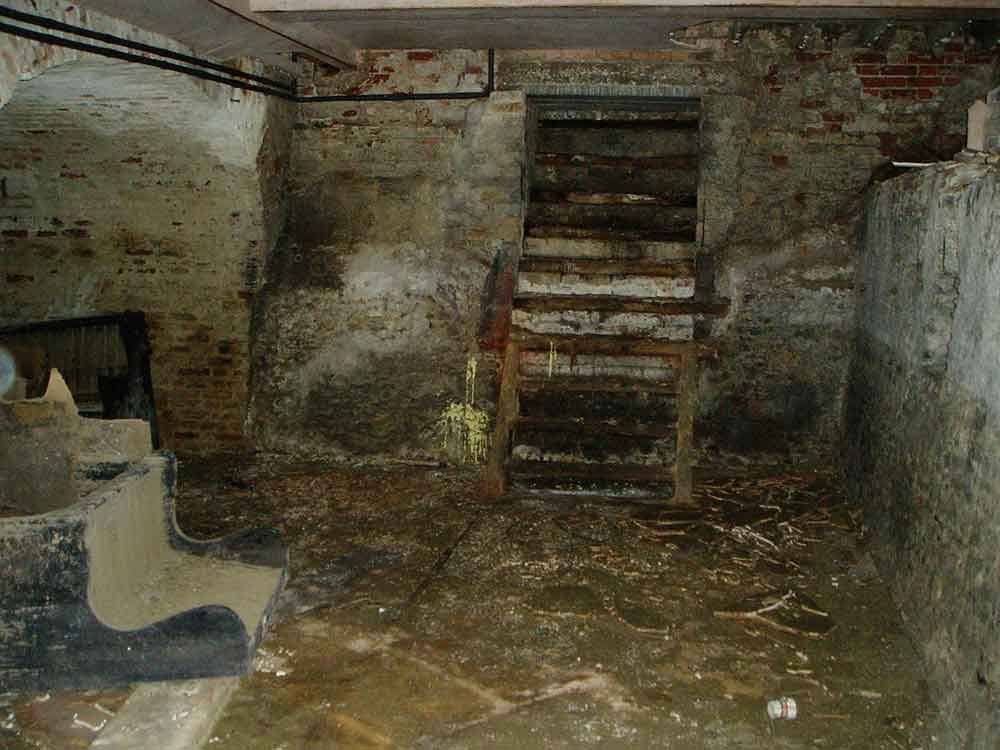
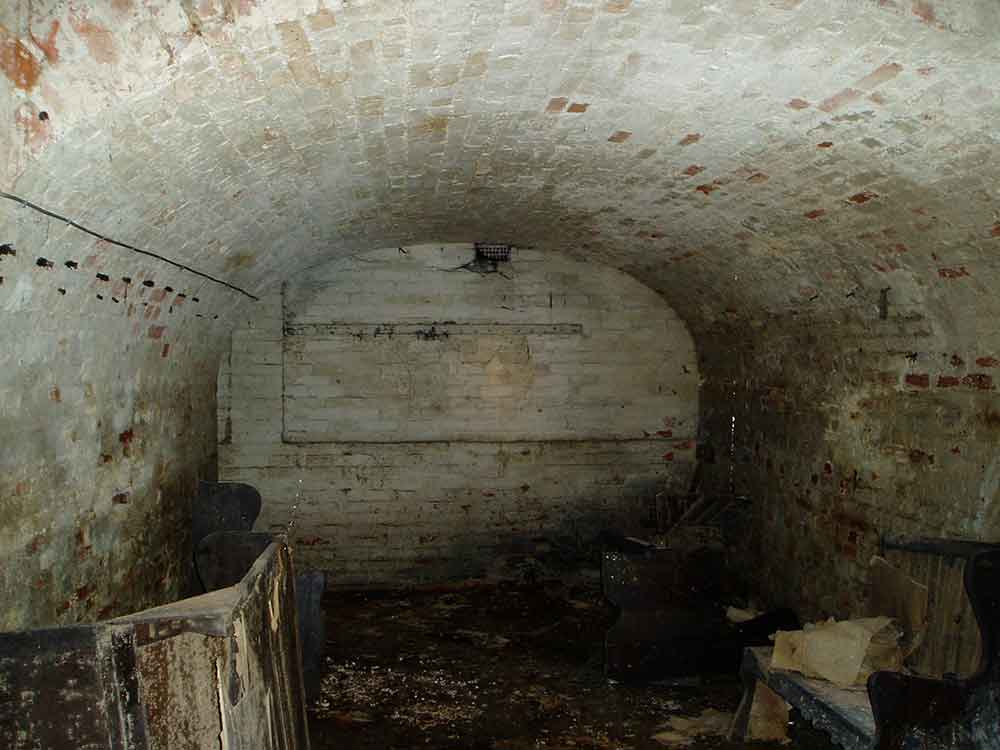
The cellars slope gently down to the bank of the slade, and may reflect the original ground level before the river was culverted. These cellars played an important role in Saffron Walden’s history when they were used to store grain during the food riots. Cellars in the town centre often run under other buildings or connect to other cellars, in some cases forming a network of underground routes. In one case a particularly steep street is a consequence of a cellar extending under the paved surface from the adjacent shop, north of the Buttermarket.
Most cellars in the town were constructed by excavating the bedrock chalk, which does not require any retaining walls or reinforcement. However, chalk is friable, and tends to get trodden everywhere. Later cellars are lined with flint set in lime mortar, and 19th and 20th century cellars, usually brick, have solid floors and walls. The entrance is often through a low door, with a brick stair running down beneath the main stair. The treads were usually oak, set in the wall on either side and making a nosing for the otherwise hard brick stair.
Cellars are reluctant to give up their secrets. A cellar in Cross Street was found with a Purbeck stone floor possibly dating to the 13th century, and in another property in the same street there is a Victorian china headed doll laid beneath the floor, surrounded by bunches of herbs. In yet another building elsewhere in the town, reputedly once used as a Baptist Church, is a cellar containing a font suitable for full immersion.
What lies beneath our feet is always a source of mystery. The stories of tunnels connecting prominent buildings probably suggest an innate human desire for another world beyond the immediately understood environment. Cellars are found, and unexplained bricked-up openings are exposed. This may be the origin of apocryphal stories, about skeletons supposedly bricked up in cellars. Settlement cracks appear and are blamed on mysterious old ‘workings’ below. There is one property in Saffron Walden where the builders, constructing a new porch, found a small area of blue clay in the ground, a geological impossibility but suggestive of an artificial pond. Old natural ponds are sometimes filled in and built over, with disastrous consequences. I was once told of a vast water-filled cave beneath the village of Littlebury – but that is outside the Parish of Saffron Walden and beyond the scope of this article.
Images
Fig. 1 from R. Maidment 1960s thesis on Saffron Walden, by courtesy Saffron Walden Town Library; Fig. 2 by courtesy of the Environment Agency, Figs 3, 4, 5, 6 by the author; Fig. 7 Martyn Everett.