
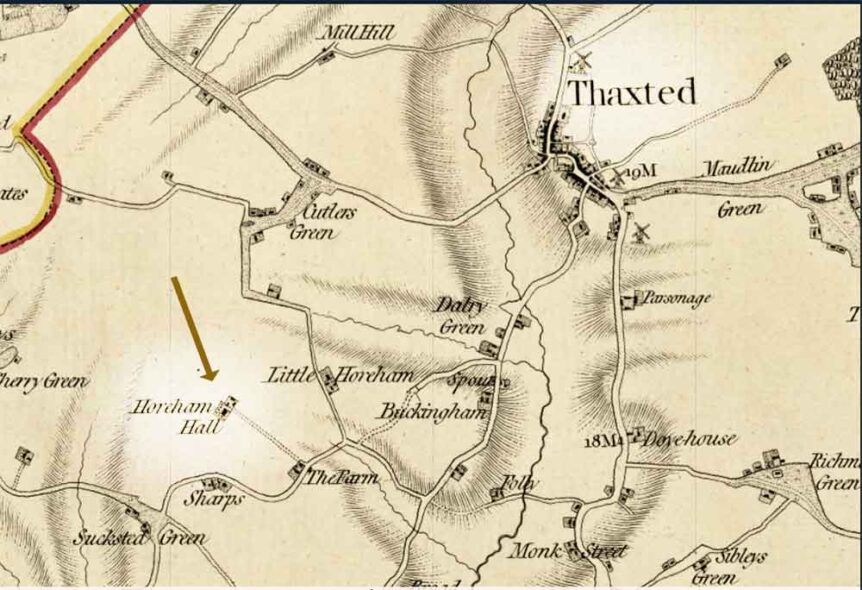
Featured image above : Extract from Chapman & André map of Essex, 1777, showing Thaxted and Horham Hall. The parish boundary between Thaxted and Broxted parishes runs through the hall. Reproduced by permission of the Essex Record Office
© Geoffrey Ball. First published in Saffron Walden Historical Journal No. 4 Autumn 2002 (with 2026 update).
Update in 2026. For the purpose of modern valuations some figures have been inserted thus […] having been assessed using the CPI inflation calculator. Amounts may vary through time and should be used for guidance only.
About one and a half miles out of Thaxted on the Broxted- Elsenham road (B1051) near Armigers Farm, there is a private road leading to Horham Hall, which is shown on the map (image above).
In 1807, the Hall was the centre of an estate of some 900 acres containing six farms, a water mill and some woodland, all located in the parishes of Thaxted and Broxted.
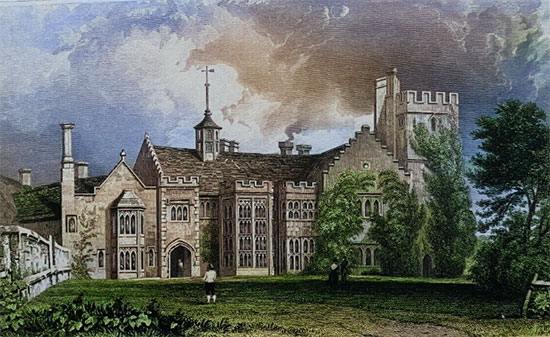
The estate had passed in 1617 into the possession of Sir William Smyth, nephew and heir of the Learned Sir Thomas Smyth, Secretary of State who had built Hill Hall (now English Heritage) at Theydon Garnon, Essex. The estate remained in the ownership of this family until 1854 but some 320 acres were offered for sale by auction in July 1824.1
The farm at Horham Hall was the subject of an inventory and valuation on 14-15 September 1807 undertaken by John Barnard, a valuer based at Tilty, the small parish adjoining Thaxted and Broxted. Mary Buttle – sometimes spelt with only one ‘t’ – the farm tenant had recently died and had been buried at Broxted on 26 August 1807.2 She left a will dated 2 March 1802 which had been proved on 8 September 1807.3 More of this later.
The record of the actual inventory and valuation is in itself of local historical interest because it is contained in one of the 45 notebooks covering the day-to-day work of John Barnard, Valuer and Appraiser between 1782-1786 and 1803-1825.4 The 40 or 50 notebooks in the collection examined so far are all of a similar size and type, approximately 8″ x 5″, leather-bound and secured by a small brass clip. They are written-up using ink. The valuations on each page are totalled up and that figure is transferred to a summary page at the end of any particular set of work to produce a grand total. However, whilst Barnard used explicit £.s.d. symbols for the totals of each group such as cattle, granary, cart lodge etc., for the individual items he used a lettered code thus keeping these values to himself. The exceptions to this practice were the valuations of crops and the value of field cultivations recently carried out. For these he again used £.s.d.
Apart from complete farms there are valuations of grass crops, crops in the ground, tillages and many other aspects of farming. In addition to farms private houses, shops, workshops, tools and stocks in trade were all subject to valuation at various times. The majority are concerned with the effects of deceased persons. Unfortunately this part of the collection does not include any auctioneers’ notebooks for this early ‘John Barnard period’ but there are some from 1815 onwards which do show the actual prices achieved at auction with buyers’ names and the expenses Barnard charged. By 1809 Robert Franklin had joined the business, probably as an assistant and later as a partner, and became the sole owner by 1825.
The Buttles
In order to put this farm valuation in context some background information on Mary Buttle’s family will be helpful. Her father, Robert died in 1763 and left everything to his widow Susanna.5 He described himself as a farmer of Broxted. Susanna Buttle died in 1774 and she left her wearing apparel and linen to be equally divided between her four daughters, including Mary. To her three sons, and the above mentioned four daughters, she left her securities, cattle, corn, farming stock, household goods, other chattels and personal estate to be equally divided, ‘part and share alike’. There are one or two other provisions which exclude one further son and one further daughter ‘already provided for’.6 This then was a family with substantial assets, as will be confirmed by the 1807 valuation of ‘the effects of Mary Buttle’. It would seem that during the intervening years from 1774 to the year of her death in 1807, she had become the sole owner of all the tenant stock at Horham Hall Farm. Apart from two cash bequests, one to her brother Robert (who farmed at Dairy Green Farm, Thaxted, then part of the estate), and one to her sister Jane, she left everything else to her sister Ann and her nephew and niece Robert and Millicent. Her sister Jane was married to John Salmon at Folly Mill, Monk Street, Thaxted.7
Cheese-making
On reading this 1807 valuation I was struck by two points. Firstly, amongst all those already looked at, here was the first one which was concerned with a woman farmer, surely an unusual occurrence at the time. There is no reason why she should not have farmed extremely well, but still it was unusual. However, an explanation was at hand with a clue when I noted that there was a herd of no less than 18 cows. Eighteen cows can produce a great deal of milk, so what was their purpose? This became clear in the second half of the valuation concerned with the ‘household’ and the contents of the various rooms. After the kitchen valuation all was revealed in ‘The Cheese Room’ where there were 238 cheeses of two types and three ages valued at £97.18.1 [£11,695] and I estimate weighing just over two tons. The dairy and cheese room have always been the preserves of women, highly skilled in the careful production of fine cheese and butter. The success of English cheese-making throughout the ages has depended on the work of women. By 1807 farmhouse cheese making in Essex had become something of a rarity, although a little was still produced. Charles Vancouver, writing in 1795 said:
‘This neighbourhood [Steeple Bumpstead] was very famous formerly for the manufacturing of cheese, but of late years the dairy business has generally given place to the suckling of calves for the London market… it may have been that the demand for veal in the London markets of late years has rendered suckling more profitable than the cheese dairy; or that the farmers’ wives and daughters of Steeple Bumpstead are no longer the notable painstaking laborious race which established the fame of the North Essex cheeses… cheese can now be made and conveyed to market by water-carriage with full profit from a distance too great for the production of veal for the London market.’ 8
Veal was conveyed in wicker baskets wrapped in damp cloths so it required rapid delivery. There are some further interesting references to Essex cheese at Hempstead.9 Arthur Young wrote in 1807: ‘Dairy cattle at Hempstead are Long Horned Derby. He makes two meal cheese. That is the night milk is skimmed and mixed with the morning fresh. He sells at 7d to 8d per lb but 6d a more general price. I ate some of his cheese at Mr Ruggles’ [Finchingfield] table and found it excellent. A wey [256 lbs] per cow reckoned a common produce. They are bought in at three years old at £13 to £17 [ £1550 to £2028] per cow and are attentive not to keep them so long as to lessen much their value as fatting stock. The Derbys when turned out from the dairy or sold, fatten well, better they think than Suffolks.’
He then goes on to talk about the ‘Hay cheese’ – that produced in winter: ‘Not much straw is eaten after Christmas when they have hay given of which a cow will eat two loads if permitted. They have no turnips as the country is too heavy …‘ He then goes on to state that ‘in summer they consume the produce [grass] of two acres each‘. There is a further observation on the grassland:
‘The best of our pastures are to be found in parishes and neighbourhoods of Epping, Harlow, Broxstead, Dunmow and Bumpstead. Our meadows are chiefly on the banks of our several rivers Lea, Roding, Chelmer, Colne which do abundantly water and fertilize our meadows.’
Arthur Young gives some annual costings for dairy farming around 1807. On the income side he shows sales of cheese at £6.10s, [£775] £4.4s [£507] for butter, £2 [£239] for a calf and £1 [£119] for pigs fed on the dairy by-products, one supposes. The total is £13.14s.[£1,611] . The cost per cow per year without apparently including their capital cost amount is £11.18s, [£1,432] leaving a margin of only £1.16s [£208] per cow per annum. There would of course be the eventual sale of the fat cow when her milking days were over. However, no surprise that farmhouse cheese production was in the doldrums in Essex!
The cheese room at Horham Hall Farm in 1807 contained the stock of cheeses shown below.
13 Old cheeses valued at £7.3.0 (6½ lb) [£835]
19 Hay cheeses valued at £5.8.0 (4½ lb) [£656]
207 Two Meal cheeses valued at £85.17.1 (5d lb) [£10,203]
Thirteen old cheeses, fully matured, were the most valuable at 6½d per lb – Arthur Young quoted 6d, 7d or 8d per lb – with the new as yet unmatured, ‘Two Meal Cheeses’ made during the summer of 1807 valued at 5d per lb. Lastly, the less highly regarded ‘Hay Cheeses’ – winter made cheese – at 4½d per lb. These individual cheeses appeared to be 20 lb each in weight with rather less for the ‘Hay Cheeses’.
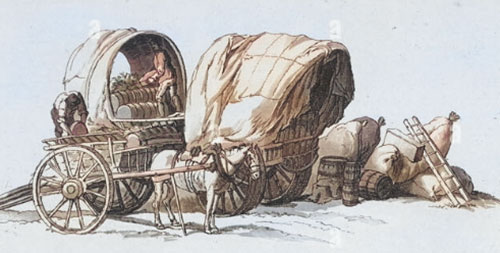
The dairy cows calved in the spring each year and produced their highest yields of milk from the protein-rich summer grass. In the winter they would be kept in yards with some partial covering and were fed mainly on hay, hence the title ‘Hay Cheese’. However, the secondary purpose for yarding stock in the winter was to produce the farmyard manure essential for maintaining land fertility. Distribution to the retailers of cheese was undertaken by cheesemongers who acted as middlemen between producer and retailer. They were not always popular with producers! Transport of the cheese to urban centres would be handled by land carriers as shown in the illustration (figure 2).
Other crops
Horham Hall Farm was not only concerned with cheese-making, as the valuation in 1807 shows. Harvest would have been nearing completion by the date of the valuation on 14 and 15 September. There were 43 acres of wheat, mostly Rivet, a bearded red-grained variety valued at £405.[£48,339]. Barley amounted to 37 acres, valued at £214. [£25,538]. Oats and peas, oats, peas, beans and tares amounted to a further 31 acres valued at £142. [£16,945]. There were two acres of peas but in the opinion of the valuer ‘not worth the expense of cutting and harvesting’. The total harvest was valued at £761. [£90,822]. In addition there were 40 loads of hay valued at £120 [£14,320] cut from about 35 acres, I estimate.
The valuation then continues with the ‘Tillages’ which were the summer cultivations of fallow land being prepared for the following year’s crops. The only way, at that time, to keep heavy land free from weeds was to fallow it, probably every third year. There were 58 acres under fallow in 1807. The cost of all the cultivations was assessed and, together with the value of the farmyard manure applied, were valued in total at £91.15.2. [£10,949]. Amongst these cultivations was the use of a Shym or Shim, sometimes twice on the same field. The purpose of this implement was to cut through the weed growth below the surface of the ground. To do this a flat blade was drawn through the soil which needed to be ridged up before. Arthur Young writing in 1807 described this operation in the following way:
‘Mr Hale at Bulmer [Essex] uses a ridge Shim which I saw at work and it performed perfectly well. He had summer-fallowed on 2 bout ridges on which the thistles and other weeds had got up: the cutting blade of the Shim carried a ridge at a time, and cut to its base, leaving all weeds to die and the ridge only a little flattened: a stout lad and a pair of horses worked it. The beam close to the block is occasionally loaded by twisting a heavy chain around it. Mr Ruggles of Spain Hall has one on which the boy rides if necessary.’10
I understand that Mr Ruggles was the inventor of this implement.
The Stock
The final part of the farm valuation is concerned with the remaining livestock and deadstock. Eight farm horses were kept valued at between £11 [£1,313] and £40 [£4,773] each. There was also a pony valued at £8 and 22 pigs and some ewes and lambs. All these livestock were valued by using the lettered code referred to earlier.
The deadstock was scattered around various buildings in the farmyard. The Cart Lodge contained two harvest wagons, three carts, one tumbril [tipcart] and one road wagon. Road wagons were normally kept by the larger farmers who not only transported their own produce to market and canal-head but also sought out ‘land carriage’ work and backloads to keep the wheels turning and money coming in. The farm implements at four ploughs and some harrows seems to be somewhat minimal for a large farm. There is no mention of the shim discussed above, nor was there any roller or ridger.
The farming stock and crops in total were valued at £1575.3.5. [£187,952]. The contents of the farmhouse, with which we are not concerned in detail, amounted to a further £245.4.6. [£29,237], making a total valuation of the tenant’s assets of £1820.7.11. [£217,189]. There is no mention in this valuation of any further assets such as cash in the house, cash in the bank, money out on loan, nor of any securities held by Mary Buttle. It should therefore not be regarded as a statement of her total wealth but as a farm valuation which would affect the incoming farm tenant taking over the farm assets. The acreage of the farm seems to have been some 280-300 acres. A survey of the estate conducted in 1749 shows Horham Hall being 314 acres but there may well have been some rearrangement of estate land by 1807.11
This concludes an analysis of Horham Hall Farm in the early 19th century. There is much that can be learnt about the way farms were run by examining similar valuations together with reading contemporary writings. Little seems to be known about cheese-making in North Essex, so I hope this contribution will throw some light on a long-lost craft. On a lighter note:
I never saw a Banbury cheese thick enough
But I have seen Essex cheese quick enough!
(John Haywood English Countryman AD 1500-1900)
Notes
- Rush, Seats in Essex: Horham Hall c.1916 (SW Town Library)
- Broxted Parish Records – Burials 1807
- ERO Wills 387 MR 13: Mary But(t)le, Broxted
- ERO 35/1/1-45 Horham Hall 35/1/14. These two references are but a small part of a very large collection of the working papers of 18th and 19th century Thaxted valuers, auctioneers, land agents and surveyors held in the ERO (Acc. 4911A D/F 35). The collection is fully described in the introductory notes. I would like to record my thanks to Mr L. Barker for pointing these out to me.
- Essex Wills 181 MR 12: 1763 Robert Buttle of Broxted
- Essex Wills 398 MR 12: 1774 Susanna Buttle
- Essex Wills 387 MR 13: 1807 Mary Butle, Broxted
- Vancouver, Charles General View of Agriculture Essex 1795, p97
- Young, Arthur General View of Agriculture Essex 1807
- Young, Arthur General View of Agriculture Essex 1807, p150 (SW Town Library) – the Shim is illustrated in Plate XXVII.
- ERO D/DSL/P3. A Survey of several Estates in the County of Essex belonging to Charles Smyth Esq as taken in 1749 by T. Skynner
See also our article ‘Some Stately Homes of North West Essex’