
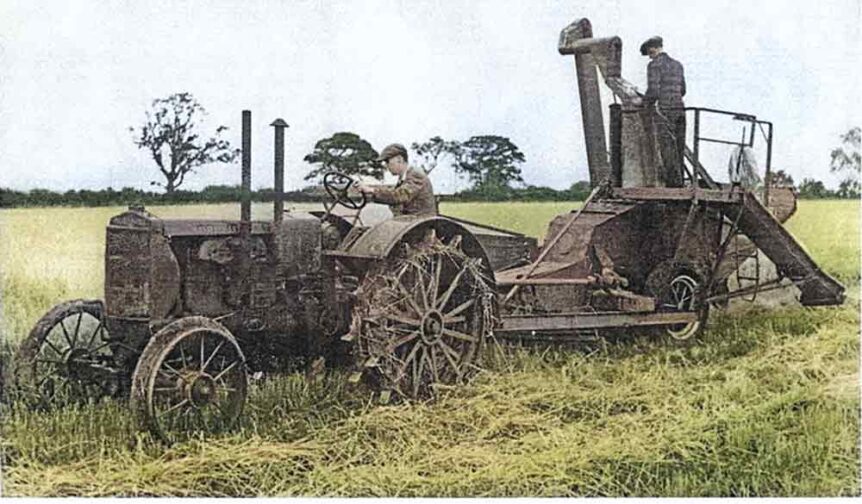
Figure 1 (above) Is a colourised image of an American -made Massey-Harris tractor towing a power take-off driven ‘combine harvester’ being demonstrated during the war at St. Ayletts Farm, Saffron Walden. The tractor is being driven by Mr. George Duke of Elmdon Lee. Illustration by courtesy of Ernest Arnold
First Published in Saffron Walden Historical Journal No. 26 Autumn 2013 (With recent update).
The State-directed food production campaign of the Second World War had more impact on British farming than any previous State intervention.
British agriculture was transformed in a mere five years from a low input, low output, recession-dominated industry, to one of intensive arable farming heavily dependent on scientific and production techniques and products such as fertilisers and machinery from outside the agricultural sector.
In the later 1930s, the threat of war became evident and ‘behind the scenes’ a Food (Defence Plan) was devised which later became the Ministry of Food. As far as agriculture was concerned, if war came, then food production was to be maximised by a rapid increase in arable production concentrating on cereals, mainly wheat and oats and expanding the potato acreage. This was to be at the expense of livestock enterprises, the only exception being the maintenance of milk production at pre-war levels. 1
Prior to 1939, County War Agricultural Executive Committees often nicknamed ‘the War Ag’ – were being formed. The objective was to have these bodies in place so that if war came they could lead the State-directed food production campaign headed by the Minister of Agriculture. In order to implement the campaign on the ground, District Advisory Committees were to be formed throughout the country. Eventually there were 478 of these bodies. In addition, but at county level, there were sub-committees which dealt with specialist subjects such as cultivations, machinery, land drainage, war damage, labour, pests and finance. Saffron Walden had its own District Advisory Committee consisting of a chairman, full-time secretary and nine ordinary members all of whom were established local farmers. This committee met usually at Newport Grammar School on a monthly basis.
The minutes of these meetings have been used as a source of information when compiling this article. These valuable records are today preserved in the Saffron Walden Town Library. Although they appear to be incomplete, they do cover the period from February 1941 to May 1944. By the outbreak of war in September 1939, plans for the State-directed agricultural industry were ready for implementation.2
The first and all important subject to be tackled was the increase in the arable acreage as rapidly as possible. To achieve this objective, it was essential that all former arable land taken out of production during the pre-war recession was ploughed up and growing an essential food crop. Farmers were offered £2 per acre subsidy for ploughing up and getting the land into production (Figure 2).
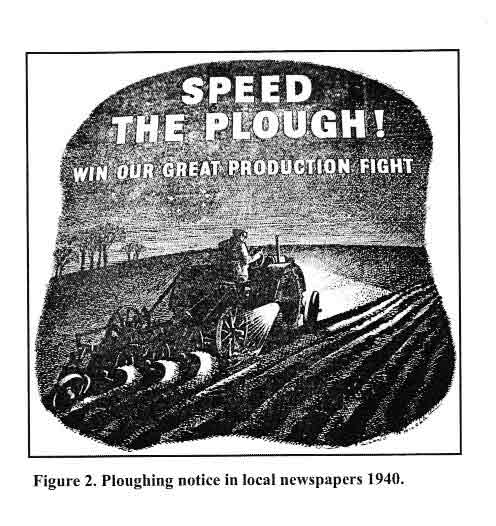
Many problems arose with the ploughing-up policy such as a shortage of tractors and ploughs after years of recession when many farmers could no longer afford to maintain up-to-date equipment. In order to assess the potential of the agricultural industry a national survey of all farms was to be carried out on a county basis. In Essex, 480 farms were inspected by members of the District Advisory Committees in 1940, covering 72,000 acres. Holdings were classified as being either ‘A’, ‘B’ or ‘C’, according to the standard of farming currently practiced.
‘A’ grade farms were operating on at least 80 per cent of their maximum potential, ‘B’ at 60 to 80 per cent and ‘C’ at less than 60 per cent. ‘A’ and ‘B’ farms were not normally inspected again but ‘C’ farms were to receive additional visits to help improve performance and move into a higher grade. Inevitably conflicts could and did arise as many ‘C’ grade farmers were reluctant to improve their methods.
To make matters more difficult members of the District Advisory Committees who carried out these inspections, were very often chosen from the larger farms who had the time to devote to this unpaid committee work. Penalties for refusal to co-operate were fairly draconian and could in the worst cases end with the committee recommending seeking possession of the farm in order to achieve some level of improvement. The committees had powers to direct a farmer to plough up grassland, grow any specified crop to buy and spread fertilizer, to reduce or increase the number of cattle kept, cut down overgrown hedges and lop shading trees, destroy weeds and if necessary spray crops. Peter Wormell, Essex farmer, author and agricultural journalist, posed the question: ‘The War Ag – Vital or Vicious?”3
In December 1940 each District Advisory Committee was asked to report progress towards achieving their targets for the ploughing-up campaign. The results submitted for Saffron Walden and Dunmow showed considerable success (Table 1).
| District | Target agreed (acres) | Actual land ploughed (acres) |
| October 1939 | December 1940 | |
| Saffron Walden | 3000 | 3728 |
| Dunmow | 1471 | 3778 |
| TOTAL | 4471 | 7506 |
Table 1. Ploughing campaign results December 1940
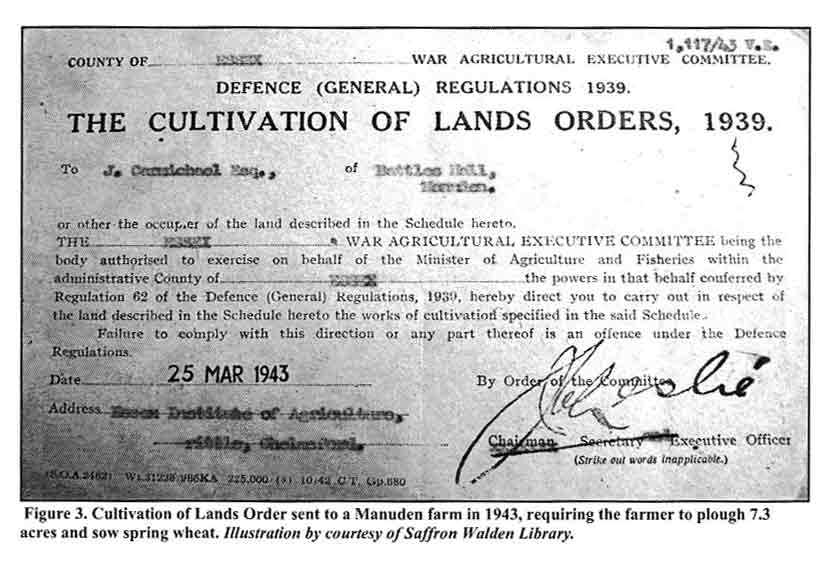
Much of the land recently ploughed had been lying wasted during the years of pre-war recession. 4 According to the minutes of the Saffron Walden Advisory Committee, by mid-1941 they had issued ‘Cultivation of Lands Orders’ for over 5000 acres of potential arable land and 3000 acres of grassland to be brought back into production (Figure 3). A selection of these orders are shown below in summary form. 5 (Note – Dates shown refer to the date of the relevant S.W.A.C meeting)
- Hadstock Playing Field. Mr Crawley agrees to plough it. 19.2.41
- Elsenham Bloodstock Stud. Owner The Hon Dorothy Windham Paget. 25% of their grassland to be ploughed up-140 acres ploughed since 1939 and now have 240 acres of arable land. A note in the minutes says ‘Preservation of studs to be considered from a national point of view’ 6 19.2.41
- Chesterford Park (this would I presume refer to Little Chesterford, not Great Chesterford Park Farm) Owner’s agent to select and plough 40 acres but so far no response – too much grass for the number of cows kept. 19.2.41
- Farmer at Famham (no name shown) clams victimisation -14 acres of grassland must be ploughed now (19.3.41)
- Derelict land at Wicken Road, Newport must be ploughed- committee may take over for allotment (16.4.41)
- Pounce Hall, Saffron Walden – ploughing-up order rescinded (see below).
- Debden Park Farm. May yield a further 65 acres for ploughing-notice to be served. Cattle from Pounce Hall formerly had access to grazing in Debden Hall Park (14.5.41)
Land at Chrishall specified in a ‘Cultivation of Lands Order’ not yet ploughed. Farmer to be asked whether he will act on this order by a given date (16.4.41)
In May 1941 the Ministry of Agriculture informed the County Executive Committee that the county was required to find a further 35,000 acres for additional arable cropping. It follows therefore that the District Advisory Committee would be expected to be allocated a proportion of this new arable land provided labour and machinery were available (14.5.41). A problem that was certain to arise when bringing new land into cultivation was the absence of adequate field drainage. Crops do not like ‘wet feet By March 1941, 3,004 acres had been mole-drained. This is performed by dragging a projectile-shaped iron ‘mole’ fixed on the end of a strong knife-edged coulter through the soil to form an underground tunnel. Normally carried out by a drainage contractor who owns heavy equipment not available on the farm. In addition on 5,202 acres drainage ditches had been cleared or re-dug where it was necessary to get drainage water away. By May 1942 this work was continuing representing 227 separate schemes of which 110 had been completed at a cost of £5,546. All of these drainage schemes would have required approval by the County Executive Committee (19.3.41 & 27.5.42). A further selection of situations requiring the attention of the Advisory Committee are shown below:
- Bomb damage to land caused by enemy bombers jettisoning their bombs and creating craters The authorities may be able to help if hardship was being caused but otherwise any settlement to be left until after the war. 19.2.41
- Land around the war memorial at Ashdon could be used for half an acre of allotments. Cultivation Order to be served on the parish council (19.3.41) [These would appear to be the same ones there today].
- There was a shortage of seed potatoes from Scotland- no assistance forthcoming and the farmer advised to use locally grown ‘once grown’ as seed 19.3.41. Increase in the acreage grown was critical to the success of the ‘food production campaign’? 7
- If school summer holidays could be delayed, use could be made of boys and girls labour during harvest and potato lifting. Seems that schools are reluctant (19.3.41)
- Volunteers for farm work required. An advert in the local papers to be prepared and approaches to the Home Guard and ARP to be made (19.3.41) There was also a message for boys leaving school to work on farms
- Home Farm at Audley End to be served with a notice to trim trees in the park to 15 feet to improve grassland (Home Farm was tenanted during the war). They are behind in all operations and a further inspection was necessary by the County Executive Committee with a view to taking over the farm and putting in a tenant acceptable to the committee. A further inspection was to go ahead sometime around 25 June. Farm must be let to a good tenant or alternatively £3,000 has to be spent bringing the farm up to a good condition. Order to plough and sow mustard by 1 August. (28.5.41)
- A proposal made for two holiday camps for boys at Radwinter and Clavering. Two University students will camp at Chrishall This type of labour requires close supervision. (9. 7.41)
- Concern expressed that damage to crops may occur by enemy incendiary bombs dropped during the harvest period. ‘Fire watchers’ in rural areas are inadequate. Thought that military might be asked to undertake watching during critical weeks (14.5.41)
- Chesterford Park Estate suggested that the whole acreage should be taken over. This proposition to be put forward to the Executive Committee based on advice from the Advisory Committee (28.5.41)
- Labour troubles on 70 acres of potatoes when the men were asked to work one hours overtime which they refused to do ‘point blank’. Executive Committee suggested a broadcast talk to farm workers on the lines of Mr Bevan’s recent address to miners. Many farm workers do not appear to understand the gravity of the national food position. 25.6.41
Mr Engelmann called attention to the fact that on June 8th when there was a race meeting at Newmarket the roads were crowded with cars using petrol for a purpose unnecessary while farmers must make do with less. Secretary to protest to the proper quarters. (25.6.41)
There were no further meetings in July or August in that year (1941), so that committee members, could get on with their own harvests. The next meeting after a two-month lapse (September) had plenty to discuss.
- Mr Baynes at Ashdon refused all communications and the committee agreed that the tenancy of the farm must be terminated and the 240 acres should be taken over of which 24 were in Cambridgeshire (17.9.41)
- Land at Sewards End neglected-order to be served. (17.9.41)
- Land at Saffron Walden Cement Works to be ploughed and the new owner charged (17.9.41)
- A farm at Clavering covered in thistles. An order to clear within seven days to be issued. Farm may have to be taken over (17.9.41)
- At Chrishall a ploughing order not complied with. Recommended possession to be taken of the land and handed over to a neighbouring farm. (1.9.41)
- Conscientious Objectors at Lansbury Gate Farm, Clavering. Much of their labour considered to be useless. All that can be done is to report findings in such cases and that they are taken off the list and sent into the army.8 (17.9.41) [See Figure 4]
- The mole-draining programme had fallen into arrears. The committee had applied for a track-laying tractor but had been refused. (17.9.41)
- Four ‘C’ grade farmers to appear before the committee. Subsequently three farmers were interviewed – some help to be given to obtain fertilisers – drainage work to be recommended the following week. The third disagreed that his farm had been neglected and said he would try harder. Farms to be inspected again in two months’ time. (17.9.41 & 1.10.41)
It was not always the small farms which were in trouble. One at Elmdon of 600 acres was badly farmed:
Occupier summoned to appear before the Committee. Farmer refuses to use ‘artificials’ [fertilisers made in factories] unless forced to do so. A schedule was to be made out and served upon him. A strict watch was to be kept on this farm. Farm to be repossessed without further argument if there was no improvement. (29.10.41)
One farmer was complaining that Italian prisoners-of-war were shirking and lazy while working on his farm and he will not have them back (29.10.41). The story of these Italian prisoners-of-war starts back in 1940 when we were holding a mere 46 by December of that year. In 1941 the situation altered rapidly as a result of successes in North Africa, which yielded 177,937 Italians and 66,000 indigenous North African prisoners-of-war.
Although, apparently, it was illegal to remove these prisoners from the ‘theatre’ where they were captured, but because it was impossible to house these men in North Africa, it was decided that 28,000 Italians should be despatched in monthly groups of 5,000 to Britain.
The Ministry of Agriculture was delighted to have available a new source of labour to work on farms. There were very strict regulations about the employment of these men and the maintenance of security when held in camps and while at work on farms. These strict rules were somewhat relaxed when it was found that the vast majority of them were of a peaceable disposition and had no wish to escape from an enforced wartime stay in rural Britain! When employed they would receive a small payment for the work done, and although it was illegal to do so, they were often well-fed on farms where they were working. The Government’s problem was to build suitable camps to house them. Of the 9,000 Italians held in Britain at the end of 1941, 2,000 were employed building camps. There was the prospect of a further 10,000 arriving in 1942. By the close of 1943, 60,000 Italians were employed in British agriculture and by the summer of 1945 the number employed had risen to 80,000. Italy surrendered after the fall of Mussolini in September 1943, and in May 1944 a provisional Italian government agreed on a ‘co-belligerent’ status supporting the Allied war effort. 9
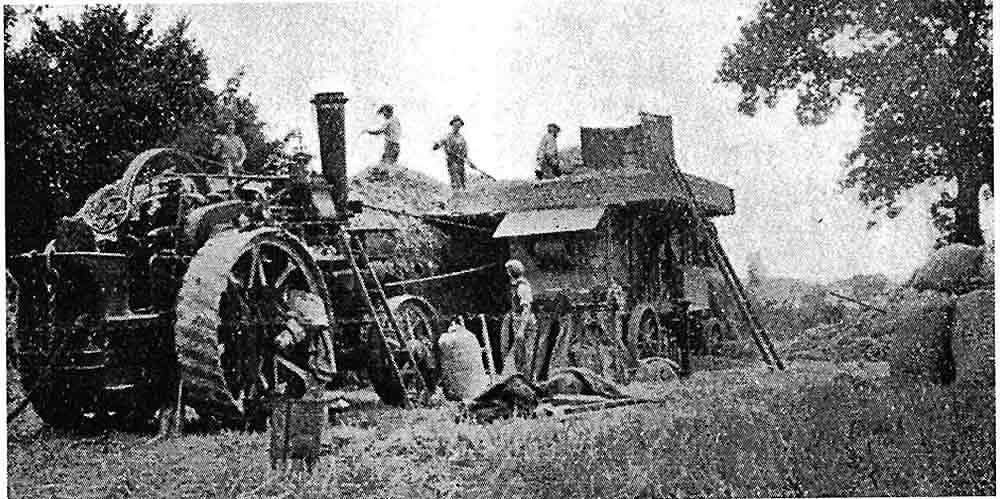
Fig 4.Threshing a corn stack at Lansbury Gate Farm, Clavering in 1940, using a steam engine. Illustration courtesy Martyn Everett.
At Radwinter Manor there was a large complex of huts forming a camp known as ‘Radwinter North Camp 180’ and it was from there that the prisoners were taken by local transport to the various farms. Transport was provided by some well-known local companies such as F.C. Moore, Tredgett and G. Griffen from Debden. By 1944 there was also a P.o.W Hostel established at Little Walden, housing men transferred from Royston. Farmers using this source of labour had to pay 40 shillings per six-day week. If they were willing and could accommodate and cater for prisoners, a deduction of 21 shillings per week was made. This arrangement was not popular as farmers complained that 21 shillings per week was insufficient reimbursement and furthermore accommodation which had to be of a satisfactory standard, was difficult to provide (21.1.42 & 9.2.44).
During the first two years of the war, 1940-41, much trial and error was inevitably involved in seeking the best outcome for each situation as it arose. By 1942 conditions tended to settle into a routine, but the emphasis changed for the Advisory Committee from ploughing-up to increased production of potatoes an sugar beet.
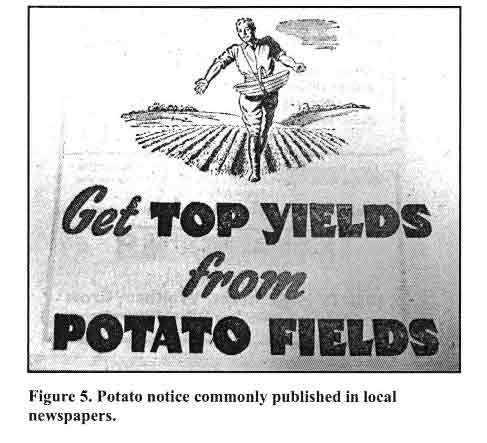
In Essex during 1942 the county grew 21,703 acres of potatoes. Even during the years of recession before the war, the potato acreage had held up well and in 1938, 17,268 acres had been grown. The additional 4,435 acres grown by 1942 were most welcome as potatoes were a vital source of food during the war years. (Figure 5).10
The other root crop widely grown in Essex was sugar beet, but nevertheless the Government demanded an increase in production to save vital shipping capacity employed in importations. Back in 1926 a sugar beet processing factory had been built at Felsted. At the time Essex grew only 5,598 acres. In the later pre-war years the acreage steadily increased, so that by 1939 the crop was well established in the county and 12,820 acres were being grown. Understandably a potential for expansion still further seemed possible.11
Most farmers in the Saffron Walden and Dunmow areas had already considered growing sugar beet and had firm ideas about whether the crop was right for them and their farms, so it was not going to be easy to find new growers. The first entry in the committee’s minutes to mention sugar beet listed the parishes where objections had arisen to growing the crop. These were recorded as ‘land unsuitable’ “labour shortage’, ‘food for cows already grown’- almost certainly mangels, another rout crop not dissimilar to sugar beet, and finally, ‘bought seed potatoes. There were a few other objections as well. Eighteen farmers in the 12 parishes expressed these reasons for not getting involved. One ”B” grade farm, Bollington Hall, Ugley had been given an allocation of 20 acres but refused to sign the contract claiming ‘insufficient labour’ to cope with the crop which in those days was labour-intensive. It would seem that they delayed long enough to miss any chance of drilling the seed in the current year 1942. Another troublesome farm was St Aylotts at Ashdon where again it would seem they never did grow sugar beet, although the Executive Committee were asked to prosecute (13.5.42). On the positive side, 63 new acres were eventually planted/drilled in 1942 by eight new growers. There would also have been additional acres grown by some existing growers (4.3.42).
While efforts to expand the sugar beet acreage in 1942 took up a lot of the Committee’s time, there were many other matters that had to be considered, the most important of which was the supply of new tractors and implements, both of which were in very short supply. To obtain new equipment farmers had to apply to the District Committee whenever new supplies became available. Ford at Dagenham were the only major tractor manufacturer in the UK and their peacetime production was about 250-300 tractors per week. They also made tractor ploughs. This level of production was quite inadequate for the planned expansion of arable farming and the ploughing-up of grassland. It was estimated that one tractor and plough could cultivate only 100 acres per year. Ford’s agreed to increase production during 1940. At the same time the Ministry of Agriculture placed orders in the USA for tractors and implements, which began to arrive later that year (see Figure 1,). The Ministry also placed orders for harvesting equipment and potato planters etc with British manufacturers.
By the end of 1940, the demand for machinery far exceeded the supply. British national production of three and four wheel tractors increased from 17,906 in 1940 to 24,000 by 1942 after which annual production was slightly reduced. During the war years the number of tractors on UK farms rose from 76,000 in 1940 to over 179,000 in 1945. In the same period there was a steady reduction in the number of farm horses, 12
Locally, the Saffron Walden Advisory Committee was required to make recommendations for the supply of new tractors and implements on the basis of ‘farmer need’ as and when supplies became available from government stocks. Grading of all the applications from farmers were considered under the following categories. ‘A’ being ‘most urgent’, ‘B’ & ‘C’ ‘could be delayed’ and ‘D’ ‘unnecessary. As an example, on 18 February 1942, ten were considered urgent and nine could be delayed but ‘supplied as soon as possible or postponed. Applications were considered on a quarterly basis. Supplies became more plentiful after 1942. A similar allocation system was employed to ration supplies of fertilisers and many sundries such as baling wire and cartridges for vermin control. The county was expected to find a further 15,000 acres to be ploughed up in 1943 and of this total, 750 acres were considered by the County Executive Committee to be a reasonable acreage to be found by the Saffron Walden Advisory Committee. Ploughing-up orders had to be served by 30 June. While there was an insistent call for extra acres to be ploughed, the county was asked to produce 26 million gallons of milk, an increase of 25% over the previous year. Every dairy farm had to be inspected and graded to satisfy the inspectors that all stock could be fed with silage produced from the farm which would therefore be self-sufficient requiring no bought-in animal feeds for the dairy cows. Any dairy farm graded ‘C’ was to be fully investigated by the Committee. Relinquishing dairy farming was only permitted with the approval of the County Executive Committee.
From 1942 onwards land was being commandeered by the military authorities and fears were expressed concerning the new aerodrome at Little Walden where Mr Fairhead, a dairy and arable farmer, would be left with 200 acres of ‘backland’ which he could not farm (19.8.42). Then again at Stansted more land would be lost to the new aerodrome (27.7.42). At Elmdon about 300 acres of land had been requisitioned for a bombing range. The RAF were being asked to look elsewhere as this was first-class agricultural land. Later on they were asked to restore the weed-infested, bomb-cratered land but the committee were told that this would have to wait until the war was over. In the event somehow or other the farmer brought the land back into cultivation in 1943. Also in 1943, Bassingbourne Hall Farm at Stansted was requisitioned by the Air Ministry making it impossible to farm it. There were 62 beasts on this farm which would have to be moved off and it was suggested that the owner became a tenant on another farm (3.2.43). Bassingbourne Hall Farm now lies under Stansted Airport Passenger Terminal.
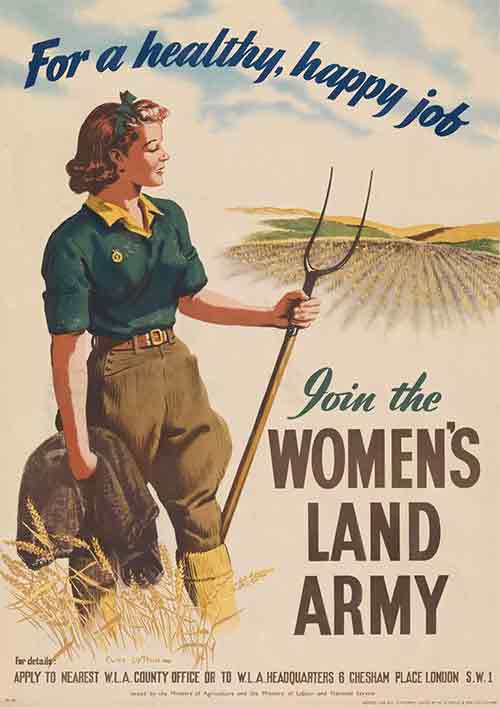
On 1 June 1939 the Women’s Land Army had been re-formed-it had existed during the First World War (Figure 6). Very soon recruitment began to attract 50,000 potential members. Early in the war, a training scheme was set up at Writtle Agricultural College and 30 young women were given training there on a two-month course. By 1943, 12 training farms had been established and over 1,200 Land Girls were employed on Essex farms. Initially there had been some farmer resistance to employing these young women, and exhibitions were staged in Corn Exchanges, including Saffron Walden, to overcome this resistance.
Figure 6. Recruitment notice for Land Army
The WLA made a great contribution to the war effort and by the end of 1945 over 2,000 WLA personnel were employed on Essex farms. They participated in all types of farm work and were especially noted for their work on dairy farms. The organisation was not disbanded until 1950.13
In 1943 the question of getting additional help with harvest and potato lifting was again discussed with the education department. To be fully effective it would be desirable to delay the summer holidays until 7 August or preferably to 14 August to coincide with farming operations. The proposal was that boys from Twickenham, Chingford and Leyton would be in harvest camps at Clavering, Newport and Radwinter. Girls from Isleworth could be housed in existing buildings at Quendon. Whether these plans ever came to fruition is not recorded in the minutes, but information on schoolboy camps at Radwinter and Clavering has been documented elsewhere (16.6.43).14
Also during 1943, the Home Farm at Elsenham Stud was ordered to plough up a further 53 acres of grassland. They also came to the notice of the committee as they were using fresh milk from their own herd to feed foals – was this allowed in wartime? No resolution was recorded! The Stud owners were displeased because one of their meadows had been left in an unworkable condition after the departure of a searchlight unit who had previously taken it over. In December 1943 they were in trouble again for failure to fence in their com stacks in contravention of “Rats Orders’ that had been issued to them.
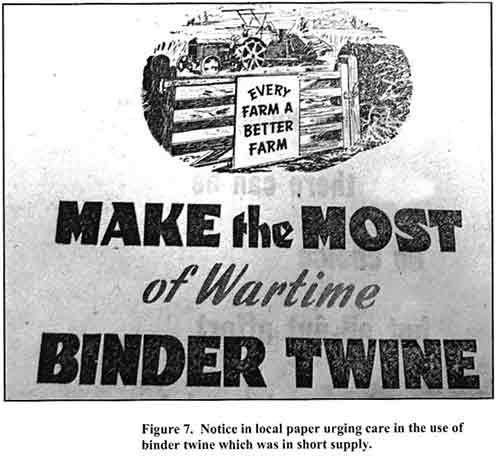
During the remainder of 1943 and into 1944 many similar problems arose as had been dealt with in 1941-42, but normally on different farms. Generally the availability of tractors and implements improved, the one exception being a shortage of heavy, more powerful tractors, most of which had to be imported from the United States. There was a national shortage of baling required during threshing operations and rationing had to be introduced and spares for threshing machines were difficult to provide (30.6.43, 8.9.43, 22.9.43). (Figure 7).
The battle training area at Chesterford Park gave cause for concern as there was no rabbit control and the whole area was a fire hazard. Rabbits were causing damage to adjacent farm land and the military authorities were doing nothing to improve the situation. It was suggested that the area be formally transferred to them, presumably so that a notice could be served upon them (12.1.44).
The Advisory Committee continued to meet until the war ended in 1945, after which farming slowly returned to a peacetime footing but this took many years to achieve in the post-war years of rationing and shortages.
There can be little doubt that the national State-directed food production campaign was one of the outstanding achievements of the war years. The county of Essex can be proud of their achievements and played its part by increasing the acreage of essential food crops. Production of wheat in Essex increased by 25 per cent, barley 43 per cent, sugar beet 66 per cent and potatoes 73 per cent. 15
Although many foods were rationed, often meagre, nobody starved and generally ‘fair shares for all’ prevailed. The vast majority of farmers and their employees accepted the urgent need for change and increased production of essential food crops. Without their co-operation it could never have been possible. Churchill had said in a speech to the National Farmers’ Union in October 1940, one of the blackest years of the war:
“We rely on the farmers. We depend on their efforts they put forth in the fields of Britain…. Today the farms are the front line of freedom” 16
The industry was not found wanting
References
1. Short, B., Watkins, C., Martin, J. (eds). ‘The Front Line of Freedom: British farming in the Second World War’. Agricultural History Review Supplement, Series 4 (2006). pp. 4-35.
2. Short op.cit, p.160, Fig 12.1, Loaves & Fishes, Ministry of Agriculture, Fisheries & Food (S. Foreman, 1989), pp. 33-38.
3. Short op.cit., p. 180; Wormell, P., Essex Farming 1900-2000 (1999), pp. 81-95.
4. Wormell, op.cit., p.79.
5. Minutes of the Saffron Walden District War Agricultural Advisory Committee (Saffron Walden Town Library), 19 Feb 1941-12 May 1944.
6. She was a somewhat eccentric lady well-known in racing circles pre-war- she owned Golden Miller 1927-57, a famous racehorse which had 29 wins.
7. See Ball, G., Saffron Walden Historical Journal No 20 (Autumn 2010), p.13.
8. See Cooper, J., Clavering at War (2012), pp. 94-95.
9. Short op.cit., pp 117-131; Custodis, J., Employing the Enemy… during and after the Second World War. Ag. Hist. Rev. Vol 60, Pt II (2012), pp. 243-265.
10. See Ball, op.cit., p.13; Wormell, op. cit., pp. 190-194, Table 3, p.312.
11. Wormell, op. cit., pp. 184-190.
12. Dewey, P., Iron Harvests of the Fields (2008), pp. 225-254.
13. Wormell, op.cit., pp71-73; Short, op.cit., pp 101-116.
14. See ‘Radwinter Harvest Camp‘ by Michael Southgate, SWHJ, No 10 (Autumn 2005), pp. 23-24. See also Cooper, op.cit., p. 98.
15. See Essex Crops Stock, Tables in Wormell, op.cit., 308-317.
16. Cited in Forman, S. op.cit., p.33.

Note: Geoffrey Ball, who sadly died in November 2022 lived in Saffron Walden, researched agricultural history and was the author of the SWHS book Land, Agriculture & Industry (2009). Illustrations except where otherwise given, are by courtesy of Saffron Walden Town Library.