
The Will and Codicil of George Stacey Gibson
© Jeremy Collingwood
Reprinted from: Saffron Walden Historical Journal No 15 Spring 2008
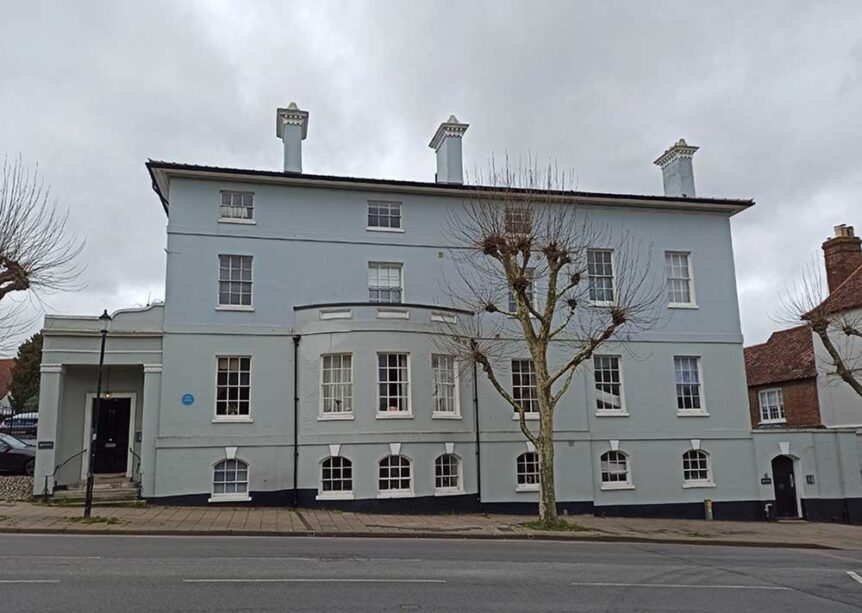
The above 2026 image is of Hill House, George Stacey Gibson’s residence in Saffron Walden High Street. © Saffron Walden Historical Society
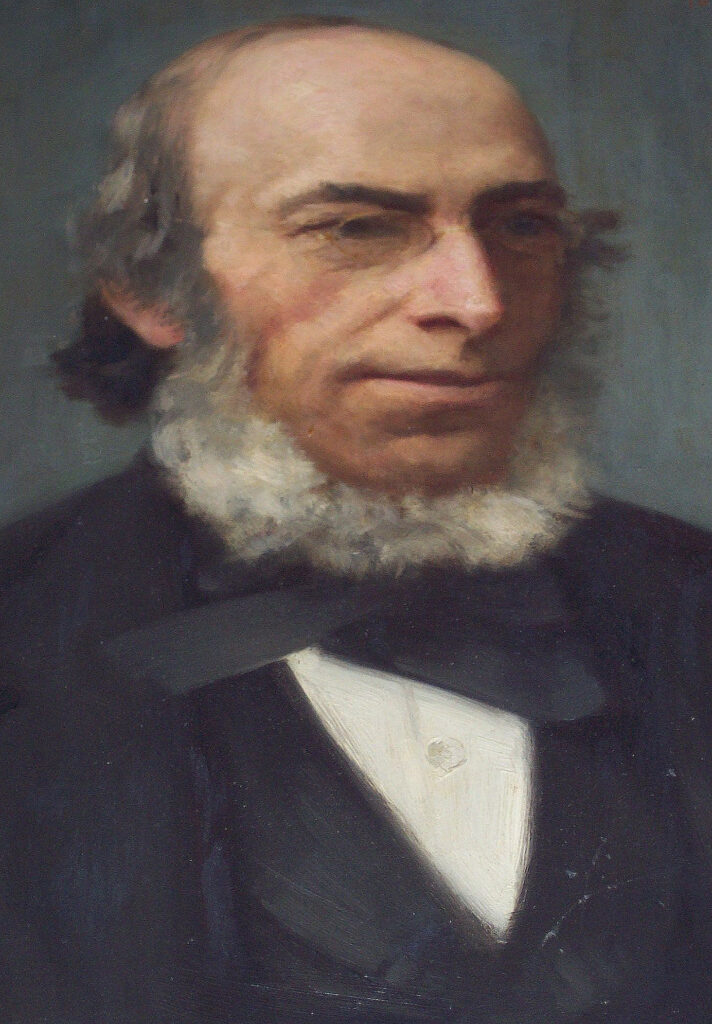
George Stacey Gibson was not only Saffron Walden’s greatest Victorian benefactor but he was also probably the richest citizen of the town in his lifetime.
When he died on 5 April 1883, Gibson left an estate valued at probate as £342,456 18s 0d. This was a very large sum. It is very difficult to compare that amount with today’s money values, but whichever measure is used, Gibson left a very large sum of money.1
Gibson’s estate was in fact the fourth largest granted probate in 1883. The biggest estate was that of another banker, Samuel Jones Loyd, Baron Overstone, whose personal property was valued at £2,118,803 with land worth £3,114,262. Lord Overstone was far ahead of Sir Charles William Siemens, the electrical engineer and metallurgist, who left £393,857, and Edward Cazalet, merchant and industrialist, who left £346,414. We can see that Gibson was thus one of the big players on the probate scene in 1883. He even outstripped the seventh Duke of Marlborough (£146,660) and the seventh Earl of Shaftesbury (£32,352 with lands worth £16,440). In the same year Archibald Campbell Tait, the Archbishop of Canterbury, left £77,773, Anthony Trollope, the novelist, left £25,892, and Karl Marx, revolutionary and thinker, left £250.2
As a wealthy testator, Gibson clearly gave much thought to the drawing up of his will, which was dated 27 October 1879. It was a complex document originally of some 28 pages drawn up in the offices of the London solicitors, Messrs Richard Smith and Wilmer of New Square, Lincoln’s Inn.3 Four months before he died Gibson added a three page codicil. This, dated 5 December 1882, was drawn up in Saffron Walden by Gibson personally and witnessed by two of his bank clerks. On the 5 September 1883 probate of the will and codicil was granted to Elizabeth Gibson widow, Lewis Fry and William Murray Tuke, as the three executors.
Wife and Daughter
Gibson’s first consideration was to make ample provision for his wife, Elizabeth (née Tuke) and his daughter, Mary. To his wife Gibson bequeathed his watches, jewels, ornaments and wearing apparel, plate, furniture, linen, glass, china, pictures, prints, and other articles of household use, horses, carriages, saddlery, etc., and a legacy of £20,000 to be paid within six calendar months of his death. To his daughter Gibson gave a legacy of £10,000 to be paid as soon as conveniently may be after his death, with interest at the rate of four pounds per cent per annum. Gibson devised the family home, Hill House in the High Street, Saffron Walden, to his wife and daughter. The wife and daughter also received additional legacies of £10,000 each, but Gibson specifically stated that his charitable legacies were to take precedence over these additional legacies to Elizabeth and Mary. Gibson’s will also contained elaborate provisions for his daughter, Mary, in the event of her getting married, as well as if she remained single.
Family, friends and employees
Gibson was liberal in his gifts of personal legacies to relatives, friends and servants. Some 54 individuals are specified and the sums involved vary from £100 to £5,000, and total £35,450. The executors other than his wife each received £1,000 each, and Lewis Fry an additional £1,000. The executors were also directed to apply a sum of £1,600 for the benefit of three named individuals. The children of Gibson’s cousin, Elizabeth Midgley, the daughter of his uncle, Jabez, each received £500 each. Legacies of £500 each went to the children of his uncle, George Stacey, on his mother’s side. Three Tuke brothers-in-law received substantial legacies totalling £13,000. Sisters-in-law and their offspring were not forgotten and received sums varying between £500 and £2,000 each. For cousins the sums were from £300 to £1,000. The three daughters of Samuel Lury of Bristol received £300 each. Eight friends in Saffron Walden were named in the will, and two former servants received £200 each, as did three clerks in the Gibson and Tuke Bank. In addition six employees or former employees received £100 each (£100 in 1883 = £6921 in 2006 using the retail price index and £48,368 using average earnings).
When Gibson came to write his codicil in December 1882 three legatees had died, so that two legacies totalling £700 lapsed. Gibson added further legacies of £4,850 to eleven named legatees of whom seven were new names.
Charities
Gibson’s bequests to charities showed a very careful balance between (a) town institutions such as the hospital and the museum; (b) Quaker schools and missions; (c) ecumenical causes such as the British and Foreign Bible Society and the London City Mission, and (d) orphanages and industrial schools which appealed to his compassion. Gibson bequeathed money to the following charitable institutions in his will [he added to these bequests in the later codicil which sums are indicated by italics]:
- Saffron Walden Hospital: a legacy of £2,000.
- Saffron Walden Museum: a legacy of £2,000. In addition Gibson bequeathed his collection of ‘natural history and curiosities’ to the Museum subject to the right of his wife and daughter to have the use of them during their lifetimes. His collection of autographs (signed letters) was to go to the Museum, except for autographs of members of the Society of Friends purchased from Silvanus Thompson. These Quaker letters were to be bound in five folio volumes with the remainder in portfolios to be deposited and kept in the Friends’ Library at Devonshire House in London.
- Saffron Walden Literary Society: a legacy of £1,000 plus £1,000 by codicil. Gibson directed that his books, maps and manuscripts should be bequeathed to the Library, subject to the right of his wife and daughter to select whatever they wished.
- Saffron Walden British Schools, Boys and Girls: a legacy of £1,000 plus £1,000 by codicil, but if converted into Board Schools then to revert to the Grammar School.
- Saffron Walden Friends Meeting Trust: a legacy of £2,000.
- Saffron Walden Grammar School: a legacy of £1,000 plus £1,000 by codicil.
- Bedford Institute: a legacy of £1,000.
- Ackworth Friends School: a legacy of £1,000 (in his codicil Gibson specified that this sum should be used for prizes and scholarships and not treated as regular income).
- Saffron Walden Friends School: a legacy of £2,000 plus £1,000 by codicil to be applied for establishing prizes or scholarships.
- Flounders Institute (endowed by Benjamin Flounders at Ackworth): a legacy of £2,000.
- Friends Training School for Female Teachers: a legacy of £1,000.
- Friends Foreign Mission: a legacy of £500 plus £500 by codicil.
- Friends Institute in London: a legacy of £300.
- Halstead Industrial School (this provided industrial training for 70 poor girls): a legacy of £500.
- Chelmsford Industrial School (For the education and training of destitute boys, established in 1872 for voluntary cases and boys unconvicted of crime sent under magistrate’s order, in pursuance of the Industrial Schools Act of 1866. The boys were ‘half time’ in school and ‘half time’ employed in house and garden work, shoemaking, tailoring and paper bag making; the religious teaching was protestant, but undenominational): a legacy of £500 plus £500 by codicil.
- Colchester Idiot Asylum (covering the Eastern counties): a legacy of £500 plus
£500 by codicil.
He gave to the following institutions money for general purposes, which was not to be re-invested but treated as part of the current income:
- British and Foreign Bible Society: a legacy of £1,000.
- British and Foreign School Society: a legacy of £500 plus £1,000 by codicil for prizes and other uses connected with the Training College at Walden.
- London City Mission: a legacy of £500
- Muller’s Orphan Homes at Ashley Down Bristol: a legacy of £500
- Dr Barnardo’s Orphan Homes at Ilford: a legacy of £500
Charitable Trusts
The centrepiece of Gibson’s will was his establishment of three charitable trusts. These were the Saffron Walden Fund, the Friends Fund and the Mexican Fund. Under the terms of the Saffron Walden Fund, the trustees of his will were to appoint 12 persons to act as trustees of the Fund. They were to hold and invest £10,000 in stocks and shares and to apply the dividends and interest at their discretion for the benefit of Saffron Walden charities, in particular the Hospital, the British Schools, the Museum, the Library, the Almshouse and other charities in the town. In addition the trustees of the Fund were given the authority to apply up to a quarter of the Funds in any one year for the benefit of any persons of approved industry and good character who had resided in the town for ten or more years, who though not in extreme destitution were in need of pecuniary assistance. A strict condition was that no part of the Saffron Walden Fund was to be used for any sectarian or denominational purpose. Future trustees of the Fund were to be selected so as to be representative ‘of the religious belief of all bodies of professing Christians at Saffron Walden’.
The Friends Fund required the appointment of four trustees to hold and invest £10,000 of stocks and shares for the benefit and assistance of members of the Society of Friends in limited circumstances. The money so given was to help Quakers enter into business or where, in the opinion of the majority of trustees, Quakers might require special pecuniary aid. In addition the trustees were empowered to establish exhibitions or scholarships for members of the Society without distinction of sex at any school or college. They could also apply the Fund for and towards any objects for the promotion of the Society of Friends. The Friends Fund was subject to the overall control of the Committee called the Meeting for Sufferings of the Society of Friends in London.
The odd-sounding Mexican Fund was set up by Gibson in his codicil dated 5 December 1882. The name of the trust referred to £10,000 of eight per cent Preference Stock of the Mexican Railways to be transferred to the trustees of the Fund for the permanent endowment of the following objects, and so that the annual income might be applied in the following proportions:
- One-half to the Orphanage recently established by Gibson in South Road, Saffron Walden (£5,000);
- One-eighth as an endowment to the four Almshouses lately built by Gibson on the west side of the King Edward VI Almhouses (£1,250);
- One-eighth to the Saffron Walden Museum for the payment of a Curator or any expenses connected with efficiently keeping it up and in addition to the amount left to the Museum in the Will (£1,250);
- The remaining one fourth to the maintenance and endowment of the ten cottages in Abbey Lane built by Gibson and his father and occupied by persons who received three pounds quarterly each (£2,500). Gibson expressed the wish that priority for accommodation in the cottages should be given to those connected with the Gibson family as servants or otherwise.
Real Property
Gibson was a substantial landowner and it was the income from his land holdings which was the principal source of his wealth along with his banking and investments. This part of the will is complicated and replete with terms such as ‘without impeachment of waste’, ‘tail general’ and ‘hotchpot’4. But putting the will in its simplest terms, Gibson divided his land into 16 parcels headed A, B, C etc. to P. The main beneficiaries were members of the family. Gibson devised his several estates (A-P) as follows:
(1) To his wife and daughter:
[L] The land and premises occupied by Gibson himself called Hill House Saffron Walden, together with those then occupied by George Marsh and the land adjoining both, and also the real estate situated on the west side of the High Street between Almshouse Lane and the London Road and including that in Abbey Lane.
(2) To his cousin Edmund Birch Gibson:
[A] New House Farm at Radwinter and cottages and land at Sewards End.
[B] Hawes Farm at Wimbish occupied by Susan Andrews, widow.
[C] Farms at Peaslands and Shire Hill in Walden parish occupied by John Parish and Mrs Housden.
[D] Farms at Peldon (south of Colchester) occupied by G Fairhead and Henry Woodhead.
[E] Wimbish Hall Manor Farm subdivided and occupied by Henry Myhill and Daniel Kent Emson.
[F] Dykemarsh Farm at Thorne near Doncaster in Yorkshire occupied by Makin Durham.
Provision was made for the division of the land on the decease of Edmund Birch Gibson between his five sons, Edmund Wyatt Gibson (A and B), Theodore Francis Gibson (C), Alexander Gibson (D), George Henry Gibson (E) and Claude Gibson (F).
[M] The house and garden occupied by John Green Emson in the High Street with the garden and outbuildings.
[N] Gibson’s houses in Church Street and Market Hill, formerly the Sun Inn and the Gibson Bank.
[O] Gibson’s houses in South Road and West Road, including Bells Mill and Builders Yard.
[P] Land purchased from Gayton situated in South Road Walden and extending to the Thaxted Road.
These lands were to be held by Edmund Birch Gibson during his life and then divided amongst his sons.
(3) To the children of his deceased cousin, Elizabeth Midgley, in equal shares:
[G] Three farms at Steeple Bumstead: Latchley Farm occupied by Samuel Willett; Herstead Green Farm occupied by George Colman; Smiths Green Farm occupied by George Colman and others.
(4) To Arthur Midgley, one of Elizabeth Midgley’s children:
[H] The dwelling house in London Road, Saffron Walden occupied by Arthur Midgley; also Gibson’s adjoining dwelling house in the occupation of James Archer; also two dwelling houses in Borough Lane and a field in the same lane on the south of the railway and a field adjoining the second mentioned dwelling house.
(5) To Lewis Fry (the husband of Gibson’s cousin, Elizabeth Pease Gibson) during his life with remainder to the use of Lewis George Fry:
[I] Monks Hall Farm at Walden and Ashdon in the occupation of Jonas Tree.
(6) To Francis Gibson Fry in tail general with remainder to the other children of Lewis Fry:
[J] Land in the parish of Hadstock occupied by Henry Tree; a farm in that parish occupied by Samuel Duke and any other land that Gibson might have in that parish.
(7) To William Murray Tuke, Gibson’s partner in the bank and his brother-in-law:
[K] A farm at Sampford let to Peter Cowell; also cottage and land adjoining occupied by George Graves and a farm at Sampford let to G Wright.
Gibson bequeathed all property held by him under leasehold tenure to his three executors. He similarly bequeathed his leasehold house, called Meadfoot Lodge at Torquay,[ 2026 update-Grade 2 listed Villa, c1836-40, now holiday flats], with the cottages and premises adjoining to the executors to hold on trust for his wife and then to his daughter and finally for Gulielma Richardson of Hendon Torquay. However by the time Gibson entered into his codicil in December 1882, Meadfoot Lodge had been sold, and so Gibson gave £500 to each of the six children of Edward and Gulielma Richardson.
It is apparent that after making provision for his wife and family and his special charities, Gibson ensured that the largest part of his estate passed to his cousin, Edmund Birch Gibson, who was also his residuary beneficiary. But the people of Saffron Walden can be grateful today that Gibson not only left many evidences of his munificence in brick and stone, but also was concerned that his wealth should be widely distributed for the benefit of the citizens of his native town.
Notes
- There are various measures which can be used. The retail price index takes a bundle of goods and services purchased by a typical household. The problem with this is that the bundle alters over time, and thus you cannot compare like with like. Another measure compares average earnings. Using the retail price index £342,456 in 1883 was worth £23,701,903 in 2006, and using average earnings the same sum was worth £165,641,095 See Officer, L.H., Five Ways to Compute the Relative Value of a UK Pound Amount, 1832-2006 MeasuringWorth.Com, 2007. [In 2026, the same website, using the RPI method, estimated the value at £ 46,520,000; at the same time, the online CPI inflation calculator estimated the value at more than £54m].
2. See ‘Wealth at Death 1883’ in Oxford Dictionary of National Biography
3. Gibson signed for 28 pages but the copy of the will that I have examined (that held by Dame Jane Bradbury School) has the will on pages 1-24, the codicil on pages 24-26, and is followed by two pages of index with the legacies summarised on a third page.
4. Many of the terms used in the will no longer apply since the Law of Property Act, 1925.
NB: This article is an extract from a book in our ‘Recommended Reading’ section: Mr Saffron Walden: the life and times of George Stacey Gibson (1818-1883) by Jeremy Collingwood (2008).