
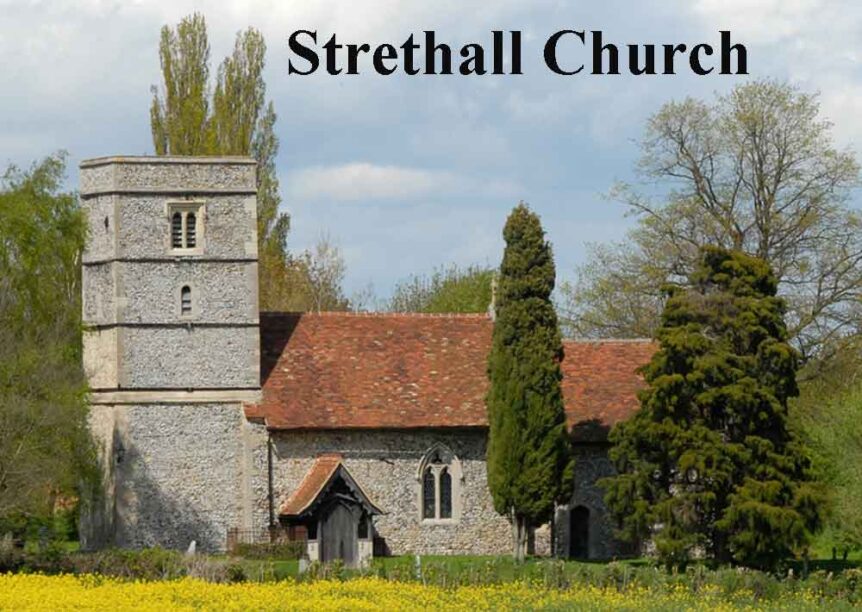
19th century links between the Empire and its smallest parish
© Oriel Williams. First published in Saffron Walden Historical Journal No.20, Autumn 2010
Fixed to the north wall of the chancel in Strethall Church, is a handsome brass plaque (Fig. 1).
It was made by Barkentin and Krall, Royal goldsmiths at the beginning of the last century, and records the simple fact that William Raymond Lluellyn, a Colonel in Queen Victoria’s Army, was Lord of the Manor here from 1890 to 1900.
This plain statement is one of the few written indications of a truly remarkable period in the history of Strethall, when a sequence of distinguished and related Lords created links between this tiny parish and a great many parts of the burgeoning Empire.
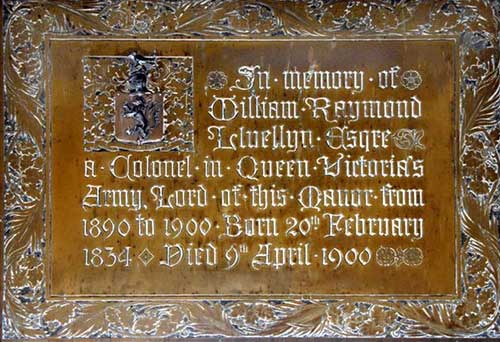
Fig. 1 Lluellyn plaque in Strethall Church.
Photograph by Gordon Ridgewell
These men were nearly all officers at a time when the British Army was a formidable fighting force engaged in conflicts which took them all over the globe.
The founder of this military dynasty was William Raymond, the son of James, mayor of Saffron Walden in 1762. William joined the 22nd of Foot (known as the Cheshire Regiment) as a captain on 23 May 1779, leaving shortly to fight in America during the War of Independence. He married the heiress Ann Forbes, the ward and half-sister of Thomas Fuller, at Saffron Walden in 1780, William and Anne moved to Georgian Bath and very shortly had a son and heir, William Forbes Raymond, followed by three daughters. A miniature portrait of William Raymond was made at this time as was often the fashion (Fig. 2).
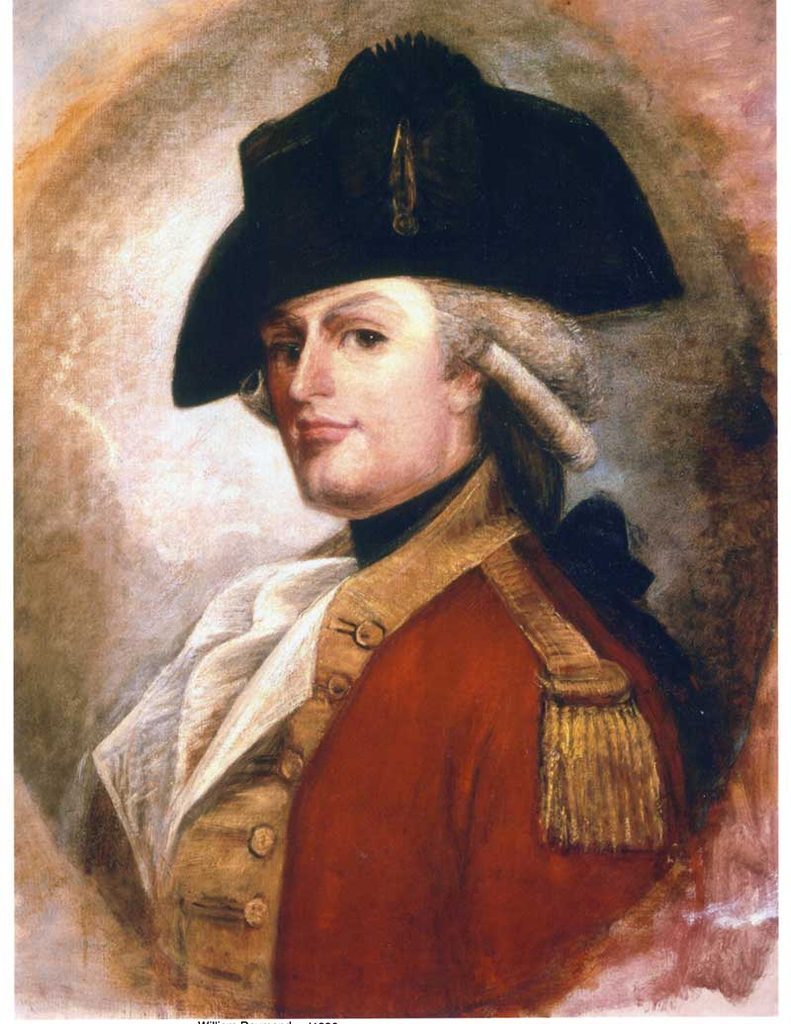
Fig.2 Captain (later Major General) William Raymond of the Lee, Essex, c 1790.
Illustration by courtesy of the National Army Museum, Chelsea.
During the 1790s, William Raymond saw active service against the French in the West Indies during the capture of Martinique, St Lucia and San Domingo, earning himself promotion in the various forces in which he served. The West Indies Campaign was noted for the high mortality rate from disease, which led to various strategies aimed at keeping losses to a minimum. For those who did survive, the chances of promotion were enhanced by ‘dead men’s shoes’ in its grimmest and most literal sense. By 1795, he was listed as a first lieutenant of the Marine Forces. On 29 July 1799 he was a Major of the 89th of Foot, promoted the following year to lieutenant colonel. By 1810 he was listed as Deputy Adjutant General in Ireland, as well as having been a colonel since August 1808. In 1812, Raymond was made up to major-general and in 1815 he was listed as the Colonel of the Royal Veteran Battalion.
Following the battle of Waterloo, peace returned to Europe. Raymond was now able to turn his attention to matters closer to home. William Raymond was a second son with four unmarried children to marry. His older brother James had possession of the ancestral seat in Rickling, but spent his working life in the shadow of the Temple Courts as a senior and much-respected barrister. Good fortune intervened. Raymond inherited Elmdon Lee amongst other properties from his brother-in-law, Thomas Fuller of Wood Hall in Arkesden, who died in 1820. Thus he became Lord of the Manor of Leebury (Elmdon Lee), which he enlarged and consolidated from the common land through a series of private acts of parliament. Raymond now owned a country estate in addition to his London home in Montagu Square, further enhancing his daughters’ marriage prospects. He had a gift for arranging profitable matches for his children; all three alliances were made with families who, like Raymond, had achieved important successes in military life. The fact that the chosen sons in law were closer to Raymond in age than they were to his daughters, does not appear to have been in any way an impediment.
In 1822, the young Margaret Mary married 58-year-old General Sir William Inglis, KCB – a hero of his time by any standards. He fought for ten years in North America during the War of Independence, followed by active service in Flanders, France and the West Indies. In his later career he was engaged in the battles of the Peninsular War in Portugal and Spain. After being wounded in the shoulder by grape shot at the battle of Albuerra, he is credited with uttering the immortal words ‘Die hard! Fifty-seventh! Die hard! It is recorded that, of the total of 579 men in the 57th regiment, no fewer than 23 officers and 415 of the rank and file died in the attack. The regiment became known as the Die-hards ever afterwards and the English language was further enriched. Such was his active engagement in similar encounters that two of his horses were shot from under him. On his death, the General was buried in Canterbury Cathedral and a splendid marble memorial erected in his honour. He left two sons, born in quick succession after his marriage, who were also army officers in their turn.
William Raymond’s life was drawing to its close. He became Lord of the Manor of Strethall in 1828, marking the occasion with the gift of a silver bowl to the church that is still in its possession. His funeral hatchment (heraldic shield) was hung in the church tower on his death in 1830 and remains there to this day. (See featured image above).When William’s brother, James Raymond of Rickling died childless five years later, William’s own children were the recipients of substantial legacies, in addition to the money and property their father bequeathed them.
Within a year of her father’s death, Elizabeth Augusta, then aged 29, captivated a distinguished soldier of her own and in 1831 married Sir Richard Lluellyn C.B., 21 years her senior. He had also fought at Albuerra and in many other campaigns of the Napoleonic Wars, culminating in the battle of Waterloo where he was severely wounded, promoted to lieutenant-colonel and awarded the Order of Companion of the Bath for his services. The marriage produced a number of children, of whom the eldest two sons joined the army.
William Forbes Raymond resisted family pressure to join the army as a career. He was extremely talented and, apart from his lordship of the manor, he became one of Strethall Church’s longest serving rectors. In ecclesiastical terms, his greatest achievement was to be appointed Archdeacon of Northumberland; although his contemporaries believed he could have accepted higher appointments still. What is certain is that he had a fine and inquiring mind and a precocious talent for classical languages, which earned him a place at Trinity College, Cambridge at the age of only 17. The patronage of a well-connected sponsor in the form of Bishop Maltby provided him with opportunities for advancement, firstly at Chichester and later in Durham.
An able speaker, Forbes Raymond was invited to return to Charterhouse School on its founder’s day in 1824 and also preached the sermon at Bishop Maltby’s inauguration. He succeeded Maltby as the preacher at Lincoln’s Inn, an honour which placed him in the very best scholarly company and marked his suitability for greater things. The Northumberland appointment brought with it the living of the church attached to Howick, the seat of Earl Grey, who in younger days had commanded the Cheshire Regiment in the West Indies campaigns. In spite of his academic talents, ability and connections, William Forbes Raymond resisted the enticements of higher office, passing the remainder of his life quietly. In retirement, the Venerable Archdeacon enjoyed lectures at the Royal Geographical Society in London.
A late and short-lived marriage to Marianne, second daughter of Rear-Admiral Henry Evans, failed to produce an heir to the Raymond fortune. William Forbes Raymond had earlier inherited the Raymond property portfolio, which now comprised the Fuller inheritance from 1820, the family seat of Rickling Hall with its manor court and the majority of land in Rickling parish. It was left to his sisters, Margaret Mary and Elizabeth Augusta, to continue the Raymond line for the next generations. Between them, they produced five grandsons, all of whom were named either or both William and Raymond amongst their forenames, to the confusion of future historians.
Raymond died a wealthy man with no family of his own, so his sisters and nephews were the beneficiaries. He made the decision in later life that the collection of properties which came from Thomas Fuller in 1820 should stay undivided between his married sisters’ families- the Inglis and the Lluellyns. The Archdeacon even made provision for maintenance grants to be provided from his estate in order not to burden them with the costs of making necessary repairs and unusual improvements. The result of this arrangement was that Strethall, Elmdon Lee, Green Farm and other lands were kept in the two families continuously from 1860 to 1920. The lordship of the manor and the demesne land was shared between the eldest relative of the Inglis and Lluellyn families under the terms of Forbes Raymond’s will. These were gradually replaced as the older generation passed away and were succeeded by their heirs.
All four of Major-General William Raymond’s grandsons of fighting age were serving officers when the Crimean War broke out in 1854 and all four saw active service in the region. This short but bloody war was part of a long running contest between the major European powers for influence over the territories of the declining Ottoman Empire. The losses on the British side were over 20,000, of which more than three-quarters died of disease. The event also provoked severe criticism of the government for mismanagement and incompetence, which ultimately led to substantial reforms in particular the abolition of the sale of commissions.
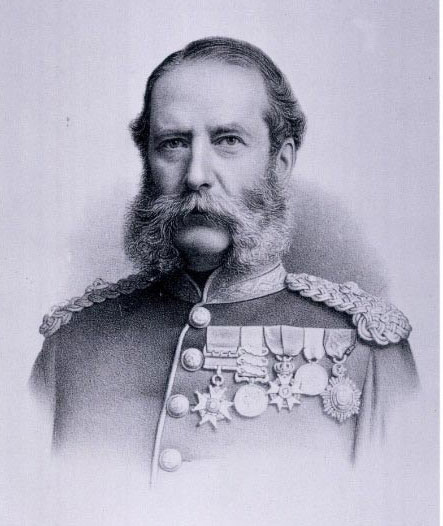
The first to arrive in the Crimea was the eldest, 31-year-old William Robert Inglis, on 23 September (Fig. 3). He fought in the battles of Balaklava and Inkerman, where he commanded the 57th Regiment after Captain Stanley was killed. He was mentioned honourably in Lord Raglan’s despatches, fought subsequently at the fall of Sebastopol, the assault of Redan on 18 June and the expedition to Kinburn. He was awarded the medal and three clasps, brevets of major and lieutenant colonel, knight of the legion of honour and 5th class of the Medjidie. William Robert was shortly joined in the Crimea by his brother, William Raymond Inglis- the younger of the two brothers- had been made a Captain in 1850 with the Royal Irish 18th Regiment of Foot.
The Inglis brothers’ first cousin, Richard Lluellyn, a 22-year-old lieutenant with the 46th Regiment, sailed on The Prince to Sebastopol in October 1854, and recorded the experience in his anonymous memoirs, Winter Sketches from the Crimea 1854-55 by an Officer of the 46th Foot. This is a masterpiece of understated suffering, and also constituted a damning indictment of official incompetence at the War Office and military mismanagement in the field. For many years the authorship of the piece was uncertain. When he wrote it, Richard Lluellyn had his father, brother and cousins to consider, all serving officers in the British army at that time. He resigned his commission on returning to England and, although he later joined the Durham Militia, he never returned to a theatre of war.
In the aftermath of the Crimea, the Queen appointed William Robert Inglis as the second President of Council for the Turks and Caicos Islands – the first to actually go and live there. The islands were annexed by Britain in 1790 as part of the Bahamas at a time when William’s father was serving in America. During William Robert’s presidency, which lasted from 1854 to 1862, he saw to it that a code of laws for the islands was compiled and this was published under his authority in 1862.
Inevitably, whilst battles were being fought defence of the realm all over the globe, these lords of the manor were infrequent visitors to North-west Essex. During the 1870s, General Inglis and Dam Elizabeth began the process of doing deals with the fringe copyhold tenants and by enfranchisement converting their holdings to freehold. Dame Elizabeth died in 1878 and Richard Lluellyn succeeded her. Strethall then had two Lords of the Manor, both of whom owned parts of the land. Ten years later when General Inglis died in 1888, the joint holdings amounted to 370 acres or rather more than half the parish. The remainder had once been the property of the farmer Nehemiah Perry but was now owned by a Saffron Walden estate agent. Over the next four years, this too was purchased and added to the freehold property.
Richard Lluellyn must have become increasingly conscious that he lacked an identifiable territorial base which he could pass on to his son. The two families owned much land elsewhere in neighbouring parishes and in the two years after the death of General Inglis, a Deed of Partition was drawn up with his heirs – his widow Mary and his son William Raymond Inglis. Under the terms of this Deed, Colonel Richard Lluellyn exchanged land he owned outside Strethall for all their holdings within it. Thus for about three months before his death at Brighton on 27 September 1890, Colonel Richard Lluellyn became the sole Lord of the Manor of Strethall and owner of almost all the land within it. He was now able to pass this estate on to his younger brother, Colonel William Raymond Lluellyn in trust for his son, Richard Chester Lluellyn, who was then aged only 15. Although there is no evidence that he ever lived there, it is significant and rather touching, that his obituary notice in The Times described him as ‘of Strethall’.
Colonel William Raymond Lluellyn, to whom the Strethall lordship now devolved, was a lifelong career soldier who began life in barracks at the age of 14 and remained in service until he retired. He served in Gibraltar, in the Crimea for two months in 1856, then in India, Aden and Abyssinia (for which he received the Abyssinia Medal), Jamaica, Egypt and Malta. He was a gunner and in November 1884 was appointed Royal Artillery commander in Egypt, and in Malta the following year. During the decade in which Colonel Raymond Lluellyn held the lordship, he established a free library for the benefit of the people of Strethall and Catmere End, as proven by a bookplate which sets out the conditions of the loan. These same residents ‘by the kind liberality of Col. Lluellyn’ also received an extra hundredweight of coal during February 1891, according to a local newspaper report. In 1900, Colonel Lluellyn died, and is commemorated in Strethall Church by the brass plaque which we can still see today.
On his death, the Colonel left Strethall to his cousin, William Raymond Inglis (Colonel of the Connaught Rangers), in trust for his nephew, Richard Chester Lluellyn, who would by now have been 25 and would have theoretically been able to inherit in his own right. Nevertheless, William Raymond Inglis now held Strethall with other trustees. Inglis was denied his campaign medal in the Great War by dying on the eve of departure for the Front, worn out by the strain of the intense preparations. He was buried with his son at Rickling.
Another trustee was therefore needed and Richard Chester Lluellyn’s younger brother, Raymond Chester Lluellyn stepped into the breach. He was also in the army and was commissioned as a second lieutenant of the Lincolnshire in December 1915 having already been wounded as an NCO. He was wounded again- this time severely -in February 1916 and evacuated to England. In October of that year, he relinquished his commission on account of his wounds and rejoined the colours the following month as a private of the Lincolnshire Regiment.
Only three months before the war ended, on 13 August 1918, he was tragically killed in action on the Somme and is buried in France. Thus both the Lluellyn brothers received campaign medals, Raymond being the one killed in action and Richard, life tenant of Strethall under the trust conditions, the one that survived.
In 1920, Richard and the other trustees brought this whole military episode to an end by selling Strethall to the resident farmer, W.C. Emson. At the same time the Inglis sold up all their properties, which included Elmdon Lee, Green Farm in Littlebury Green and Rickling Hall. The twin strands of William Raymond’s descendants had finally severed their connections with North-west Essex.
The upshot of this sequence of lords of the manor was a truly remarkable number of links between this tiny parish and many, many parts of the Empire, both near and far, and in battles fought for its defence or enlargement. While their lands were being tilled and harvested in the tranquil fashion that had been the norm for centuries, the lives led by the lords of the manor were often tempestuous and very different. The struggles began with the War of American Independence, followed by the Napoleonic Wars, which spanned several continents and many years, from the capture of St Lucia, Grenada and Trinidad to the Peninsular War in Portugal, Spain and France, and finally the engagements in Flanders at Quatre Bras and Waterloo at which the Raymond sisters’ future husbands distinguished themselves. A generation later saw their sons fighting, now alongside the French in the Crimea. The latter half of the Victorian era brought fresh areas of dispute across the Empire, which were vigorously repulsed, in Aden, Abyssinia, India and Egypt. The final chapter in the Raymond story, as it relates to Strethall, is the Great War, when four great grandsons of William Raymond fought for their country.
It is quite extraordinary that such a small parish should have had these multiple links with the worldwide growth and defence of the British Empire over this period of some 125 years. Set against this background, the bland statement on the brass plaque in the church, that a certain William Raymond Lluellyn was Lord of the Manor here from 1890 to 1900, can now be seen as a masterpiece of British understatement and, in fact, the tip of a most dramatic iceberg of public service to this country, replete with tales of heroism and ‘derring-do’. It is a story which should certainly be told.
Sources
Charterhouse registers: 1769-1872.
Collected Sermons of the Venerable Archdeacon William Forbes Raymond. British Library Special Collection.
Hart’s Military Lists, National Army Museum, Chelsea.
Military Records of the Great War, The National Archives, Kew
Sales Catalogue No. SC 00360 1919, English Heritage.
Sir William Inglis, and James Raymond: Probate 11/1773, 11/1855, 11/826.
Sun Insurance Manuscripts MS 11936/450, Guildhall Library Collections.
Wills of Major General William Raymond,
Cannon, R., History of the 22nd or the Cheshire Regiment of Foot.
Oxford Dictionary of National Biography.
Proceedings of the Royal Geographical Society, 1858-1860, Pt 4, Vol 4.
Robins, Major C. (ed.), The Murder of a Regiment, A Crimean War Officer’s Journal (1994).
Venn’s Alumni Cantabrigienses, Pt 2, Vol 5.
The author would like to thank Dr David Melford and the late Mrs Lizzie Sanders for all their kind encouragement, advice and support.
Note: Oriel Williams is a local history enthusiast and former management consultant.