
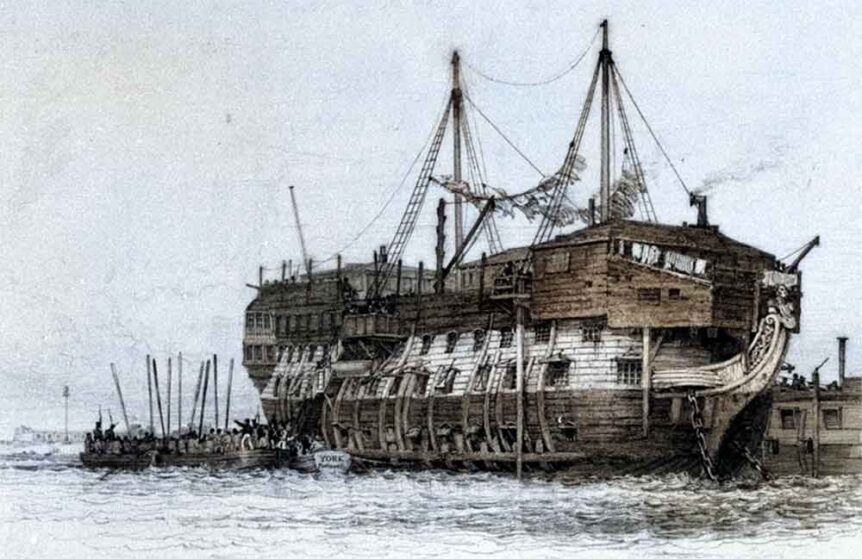
The above featured colourised image is of the prison ship York in Portsmouth Harbour with the convicts going on board. Plate from Shipping and Craft by E W Cooke 1829
© Robyn Bodey & David Melford. First publisehd in Saffron Walden Historical Journal No.6, Autumn 2018

More often than not, history is concerned with the activities of the great and the good. It is a rare event indeed to be able to give an account of the adventurous life of a farm labourer born in a remote rural community almost 200 years ago. What follows, however, is just that.
One winter’s night in the week before Christmas, Nathan Warren, gamekeeper for John Wilkes Esq. of Wenden Lofts in Essex, heard shots in the dark. Wilkes owned a large estate – extending across the neighbouring parishes of Elmdon, Heydon and Chrishall – on which the rearing of game birds was a top priority. He was fiercely protective of his birds – employing six gamekeepers for the purpose and so successful were his methods in laying the foundations of a great shoot that, 60 years later, it was judged the finest in England.
On this particular evening, Thursday 18 December 1828, alarmed at the apparent evidence of poachers at work, Nathan quickly assembled his six assistants and set out to see what was going on. The number of shots caused him to send to Elmdon for more assistance and another 13 men responded. By the time they had been assembled, the action had shifted to Pond Street Wood in the parish of Wenden Lofts itself. It was here that the final confrontation took place with about 20 poachers who were eventually arrested. Thomas Gates, a 16- year old farm labourer from Strethall who had made a last minute decision to join in, was one of them. Research in this country and Australia has now revealed what subsequently happened to him.
The poachers were tried at Chelmsford Assizes in 1829 and the trial was fully reported in the pages of the local newspaper.1 Eighteen men were indicted for being found armed in a certain wood for the purpose of destroying game. They were all found guilty and 17 were sentenced to transportation to a penal colony in Australia – ten of them for 14 years each and the remaining seven, one of them Thomas, for seven years apiece.
Strethall is a very small parish of only 600 acres, populated in 1841 by a mere nine households, located on two nothrough roads and therefore somewhat remote. It has been that way since before Domesday. The Gates family had lived there since 1801 and Thomas Gates worked – like most of the rest of the village – for Nehemiah Perry who farmed most of Strethall at the time and was later to achieve notoriety for shooting a gipsy. See our article ‘Skulduggery in the History of Strethall-A Millennium of Malfeasance in the Smallest Parish’
A sentence of transportation could, and often did, amount to the death penalty. The chances of surviving the passage without dying from disease or drowning had, on occasion, been no better than about 70 per cent. Thomas Gates had somehow escaped baptism at birth. Realising now that he would very likely be transported and not wishing to perish unbaptised, he hastened to remedy this omission. The Strethall clergy at the time were surprisingly eminent and consequently hard to find when you needed them. The Rector (and Lord of the Manor), William Forbes Raymond, contrived also to be Archdeacon of Northumberland and his Curate, Thomas Sparkes Griffinhoofe, was not only Rector of Arkesden but also Chaplain to the Duke of York. It was, therefore, a locum who baptised Thomas Gates and helpfully noted his actual birth date in the margin of the Strethall Baptism Register.2 Thus we know that he was born on 24 November 1812 to Thomas Gates of Strethall, labourer, and his wife Keziah (Fig. 1). He had just turned 16 when he was arrested.
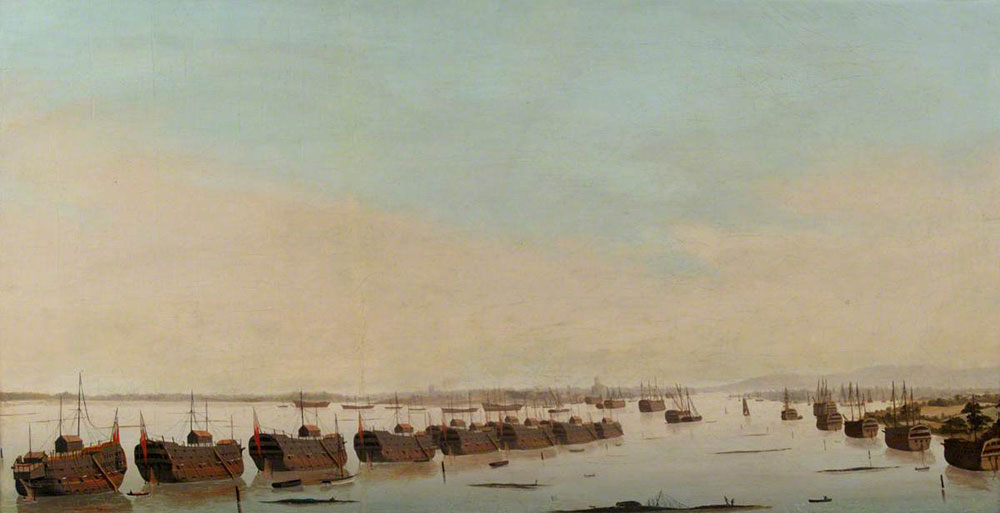
It seems that Thomas was more usually known as Joseph and, even at his trial, was referred to as Joseph Gates ‘also known as Thomas’. Therefore, it is as Joseph that he will be referred to from now on. After his conviction on 9 March, he was held for about a month in the newly-built county jail at Springfield, a few miles from Chelmsford, where it entirely possible that his family could have visited him. He was then transferred to the prison hulk ‘York’ moored in Portsmouth Harbour [ see featured image above] to await transportation. He also spent time on another of the hulks, the ‘Hardy’. The painting shows a line of ten such hulks anchored in the harbour (Fig. 2).
Treatment of the convicts in the Portsmouth hulks was severe. A letter from a convict records: ‘Our Food is very Bad. We never have any Fire. Our Shirts is very Damp so is our Rugan and Blankets….we are allowed only 1d of soap Per Week to wash our Stocking Hanchife and Skin. They allow no Coffee, no Tea, no Sugar, no Butter, no Greens, no Potates. We get but Little Water and [for] that we Pay one Penny Per Week. Six in my mess wash ourselves this morning only one Qt Water that is all allowed us. I have Six Pound of Iron on my Leg. God help the Poor Unfortunat Convicts. 4
Joseph spent just under a year in such dreadful conditions before being embarked on the ‘Lady Feversham’ for his journey to Australia. She was a relatively new ship of 430 tons, built at Whitby in 1826, and she sailed from Portsmouth for New South Wales on 8th April, 1830. The voyage under her master, Stephenson Ellerby, took 112 days and she arrived on 29 July.5 During the trip, Joseph was consigned to the sick bay by the surgeon, Mr Wilson, having been diagnosed with Phlogosis – also known as St. Anthony’s Fire. This is a streptococcal infection which disrupts the red blood cells, giving rise to extensive skin inflammation and considerable pain. He was discharged after three weeks, shortly before the ship arrived in Sydney.
Although he had evidently been claiming to be 18 while on board, he was still four months short of his 18th birthday when he landed in Australia. Few, if any, of the other convicts were known to him at the outset. His time on hulk and convict ship must have been a terrible ordeal for one so young, plucked precipitately from a close-knit, very small and very rural community. His most adventurous travel to date had probably been the four miles to Saffron Walden on a market day – now he was transported to the other side of the world. However, after what must have been 15 miserable months, Joseph’s luck seems to have changed. He was assigned to work for John Wild.
Lt. John Wild of the Northamptonshire Regiment had arrived in New South Wales at the end of August 1817, accompanied by his wife, Mary, stepdaughter Margaret and son, John. He remained in the army for a further five years until discharged from the Regiment in September 1822. He was then appointed Principal Overseer of Government Stock based at Cawdor, a small town about 30 miles SW of Sydney and just south of Camden. The following year he was granted 2,000 acres of land on the Werriberri Creek, about 40 miles WSW of Sydney. The Tharawal were the local aboriginal people and ‘werriberri’ was their name for the song of the willie wagtail. The area had become known as The Oaks – not surprisingly because of the large number of such trees which grew there. These were not oaks as understood in the UK and Europe but She-oaks of the genus Casuarina rather than Quercus. The She-oak is more like a conifer with fruits like a pine-cone.
John Wild called his new estate Vanderville and here in the late 1820s, with the help of aboriginal and convict labour, he built a homestead in what was, and still remains, a beautiful part of the country. Sheep, cattle and pigs were raised, wheat farmed and a dairy established. Mary Wild was the first white woman to live in The Oaks.
It was into this newly-established rural idyll that Joseph Gates was decanted by the penal system in 1830. He must inevitably have compared it with Strethall and concluded that it was in effect something of a home from home – but on a much larger scale.
According to the regulations current in 1830, a convict sentenced to seven years and serving in an exemplary manner could expect to receive his freedom after four years. At that time he was also entitled to claim a grant of 30 acres of land from the Government as a contribution to his rehabilitation as a respectable citizen. Joseph must have regarded this as a major inducement to good behaviour and been very disappointed when the privilege was rescinded in 1831. Nevertheless, he evidently continued behaving well and was further motivated by the arrival at Vanderville in October 1833 of another convict, Nancy McMenamy. Nancy came from Greenock, was two years older than Joseph, and had been sentenced to transportation for life for ‘manrobbery’ i.e. robbery from the person.
The following year was an eventful one. In March 1834, John Wild died and in April so did his wife.6 Vanderville was inherited by their son, John Benton Wild whose community duties included that of local magistrate. Fortune now began to smile ever more broadly on Joseph. First of all he wooed and won Nancy. Their application to marry is dated 5 July – only four months after John Wild’s death. Three weeks later, as was the requirement when applying for a Certificate of Freedom, Joseph made his declaration before a local magistrate – very likely John Benton Wild himself. Confident that this would be granted, he and Nancy were married on 21 August of that year.7 On 29 November, Joseph, having evidently maintained his record of exemplary behaviour, received his certificate and became a free man.8
Not only was Joseph free but his new wife, now re-assigned to his custody, could also live a free life as long as she stayed within the District of Camden and demonstrated good behaviour. While emancipated convicts were free to move on, many chose to remain on the Vanderville estate working for John Benton Wild. This was due to the fair treatment they received. That this was so, is evident from the publishing of an extraordinary and apparently spontaneous testimonial commending him for his ‘untiring zeal… inpromoting the best interests of this district’ and for his ‘independent, impartial and upright conduct on the Bench’. It was signed by 154 individuals of all classes, Joseph Gates by now a free man – among them.9
By the early 1840s, however, the times they were a-changing around the Oaks as a result of the economic consequences of the transition from a penal colony to a free colony. The assignment of free convict labour ceased in 1842 and large estates – which depended on it – found themselves shorthanded. As their existing labour force was emancipated and moved away, the estates began to run down. The situation at Vanderville can only have been made more difficult by the frequent absence of John Benton Wild on political duties. He was a member of the first Legislative Council for the County of Camden from 1843 and of the New South Wales Legislative Council as well from 1845. Somewhat later, towards the end of 1848, Wild suffered insolvency problems but managed to avoid bankruptcy.10
In 1836, however, the new Colony of South Australia had been formed. Here,once again, land was plentiful and cheap. Under the circumstances now prevailing in New South Wales, South Australia became an increasingly attractive proposition to Joseph and Nancy and made them feel that it was perhaps time to move on.
A son, John, was born to the young couple on 7 May 1842 – Joseph describing his occupation as ‘farmer’ on the birth certificate.11 This clear step up from ‘farm labourer’ was not likely to have been achieved had he stayed in Strethall. They had become friendly at this time with two other couples who were both assisted emigrants. John Gilbert, a blacksmith-cum-preacher, from Sussex, had arrived with his wife and several children in 1839 and a younger man, Joshua Hepworth, a sawyer born in Cheshire, arrived with his wife in 1842. Their eyes, too, began to turn towards the opportunities offered by the new colony in South Australia.
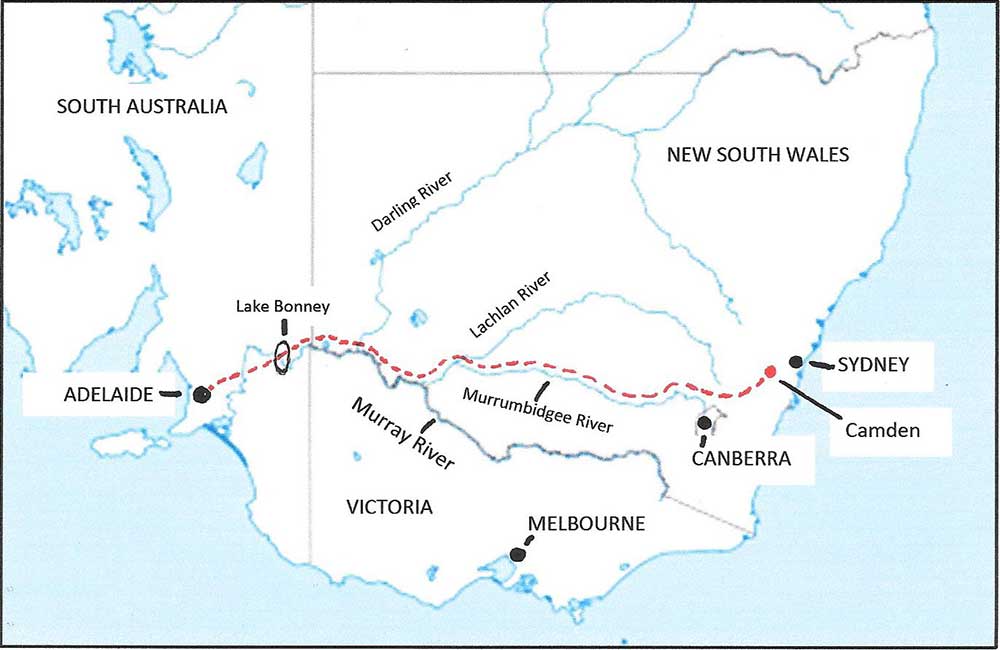
The journey from New South Wales to South Australia had never before been attempted by families, although the explorer Charles Sturt had shown the way in 1829/30. While Sturt had pioneered an overland route along the banks of the Murrumbidgee River and then by boat to the mouth of the Murray River, it was not until 1838 that the route was travelled entirely over land. Sturt had been accompanied then by (Sir) George McLeay who now resided at Brownlow Hill, the McLeay family estate that adjoined Vanderville. Word of his exploits no doubt circulated locally thus providing useful information about the route.
While the distance by modern road is at least 850 miles, in 1848 the tracks followed the meandering river courses resulting in a far greater distance. In some cases, flooding would have made crossings impossible and meant that parties were delayed for days until water levels subsided. Together with the task of scouting ahead to find suitable fording places at which to cross the rivers and numerous streams, a myriad of other factors probably extended such journeys in both time and distance.
Experience gained by stockmen driving cattle along this route suggested that September to December were the worst months for flooding – particularly of the Darling River. Such advice was published in 1846 and would therefore also have been available to Joseph.12 The three families evidently planned their journey thoroughly in advance. Nancy received her Conditional Pardon – portable evidence of her freedom – on 31December 1847.13 Only four weeks later, on 28 January 1848, the six adults and thirteen children all set off from Camden thereby stepping into the pages of Australian history (Fig. 3). Survival would have been the concern uppermost in their minds.
With hindsight, however, overland communication between the sparse and widely separated coastal communities was integral to the growth of a great nation.
It took a great deal of courage to embark on this tough and certainly hazardous endeavour and it is hard to imagine the hardships endured. As was the case with most early pioneers, the three families had no option other than to rely on strong, patient and reliable bullocks and slow-moving, cumbersome drays to carry them across country to the new settlement.
The heavy drays were loaded with all the necessities for their new life and enough supplies to last many months. Each was drawn by a team of six to ten bullocks, the manoeuvring of which required considerable skill. While nonexistent roads and rugged tracks would have limited the drays to a speed of about two and a half miles an hour, they were at least designed to withstand the rough terrain – the principle hazard being broken axles. These would have represented a major disaster if one of the three men, John Gilbert had not been a blacksmith. Even so, constructing a makeshift forge and raising iron to the temperature required for reliable pressure welding would have required great ingenuity and skill. Progress would inevitably have been slow. The bullocks had to be yoked and unyoked, fed and watered – shelters of some sort erected and dismantled each day and many children had to be looked after and fed.
As if the physical hardships were not enough, there was the constant fear of attack from the indigenous tribes along the waterways or indeed from escaped convicts turned bushrangers.
The vulnerability of the small party was further increased by the fact that Mrs Gilbert was pregnant with her tenth child and Mrs Hepworth with her fourth. Mrs Gilbert kept a diary and, quite remarkably, three pages of this priceless document still survive in the State Library where their provenance had hitherto remained unrecognised. The writing is difficult but the library archivists have made a transcript from which the following quotes are reproduced with their permission.14
The first records the birth of her son:‘… tonight was Confind son Thursday 25th May at the Crick’. The small convoy apparently tarried for three days ‘at the Crick’ while she recovered. Then, on Monday 29 May: ‘Lave the Crick After my Confinement to go [?] scrub 15 mills to Leak Bonny [Lake Bonney]… Chasin Bulluck up all night…’ . They were tough ladies.
In the event, all went well. Both babies were born safely en route, plenty of food and water was found for the animals, there was no harassment from the aborigines and the journey took them exactly five months. They arrived in Adelaide on 28 June 1848. The Gates family settled in the Onkaparinga district east of the city where Joseph was to remain based for the rest of his life.
Unlike New South Wales, South Australia was colonised entirely by free people without any support from the British Government. In the early days of the colony there was a ready market for timber and the Adelaide Hills region, about 20 miles south of Adelaide itself, was thickly forested. Joshua Hepworth’s skills as a sawyer could now be turned to good account. The heavy drays and the bullocks were likewise ideal for shifting the cut timber. To extract timber from Government land required a licence, however – and one such was issued to Joseph in 1850.15 Then, after only two years in the timber business, his life took another adventurous turn. Gold was discovered in Victoria.
Hepworth and Gates set off by boat in January 1852.16 The first finds were alluvial and could be had by simply panning the soil. They did well to make an early foray. By March 1852 it was reported that a third of all the males in South Australia had left for the goldfields. It was estimated that of every 100, five made a fortune, 45 made a living and 50 were ruined – often without the funds even to pay for their return passage. Since both Hepworth and Gates returned to South Australia in May after only five months, they clearly could afford the fare.17 There must also be a good chance that they fared sufficiently well for both of them to buy adjacent blocks of Government land when it became available. By 1856 Joseph had acquired enough capital to purchase about 150 acres. Fourteen of these he cleared and planted with a thousand fruit trees.
Joseph clearly prospered in this new environment, adding to his timber business that of supplying soft fruit to the jam-making industry. His first wife, Nancy, died in October 1860 at the age of 50 and some four years later, now aged 52, he married an Irish girl, Winnifred Carroll, thought to be aged about 23.18 This second union produced a further ten children, the last of which was born only a month before Joseph died. After a life full of adventure, Joseph Gates died on 3 July 1880 at the age of 68.19
After the death of his second wife, his property was advertised as: ‘130 acres thickly timbered, 14 acres under cultivation with 1000 fruit trees, house and stables.’20 Had he stayed in Strethall, he would probably have remained a farm labourer living in a tied cottage. His chance of becoming a landowner would have been small indeed. With the luxury of hindsight, the casual decision to go poaching that December night changed his life. It was one of the most important he ever made.
The lad from Strethall did OK.
Acknowledgements
The authors are grateful to Noel Robson for his comments on the poaching episode and subsequent trial. The late Robyn Bodey, a descendant of Joseph Gates, lived in Perth, Western Australia and was responsible for all the research on his life in that continent. After her death some four years ago, her family kindly agreed that this account may be published. Fig. 1 by kind permission of Essex Record Office ERO D/P 326/1/5.
Fig. 2 © National Maritime Museum, Greenwich, London.
References
- Chelmsford Chronicle, 20 March 1829. ERO T/B 171/1-40
- ERO D/P 326/1/5, 1813-1986
- ‘Prison Hulks in Portsmouth Harbour, 1810’ , painting by Daniel Turner in the National Martime Museum, Greenwich
- Supplement to the Sydney Gazette, 22 October 1828
- The Sydney Gazette & New South Wales Advertiser, 31 July 1830
- Ibid. 26 April 1834
- New South Wales Registry of Births, Deaths and Marriages, 1834
- New South Wales Convict Records, 1834
- The Sydney Morning Herald, 16 May 1843.
- Ibid. 29 March 1849.
- New South Wales Registry of Births, Deaths and Marriages, 7 May 1842.
- The Sydney Morning Herald, 8 May, 1846.
- New South Wales Convict Records, 1847.
- Extracts from Mrs Gilbert’s Diary. SLSA: D 5596 (L). [courtesy of the State Library of South Australia.]
- The South Australian Register, 17 May 1850.
- Ibid. 26 January 1852
- Ibid. 8 June 1852.
- South Australian Register of Births, Deaths and Marriages, 4 March 1864.
- Ibid. 3 July 1880.
- The Advertiser, Adelaide, South Australia, 7 June 1911.