
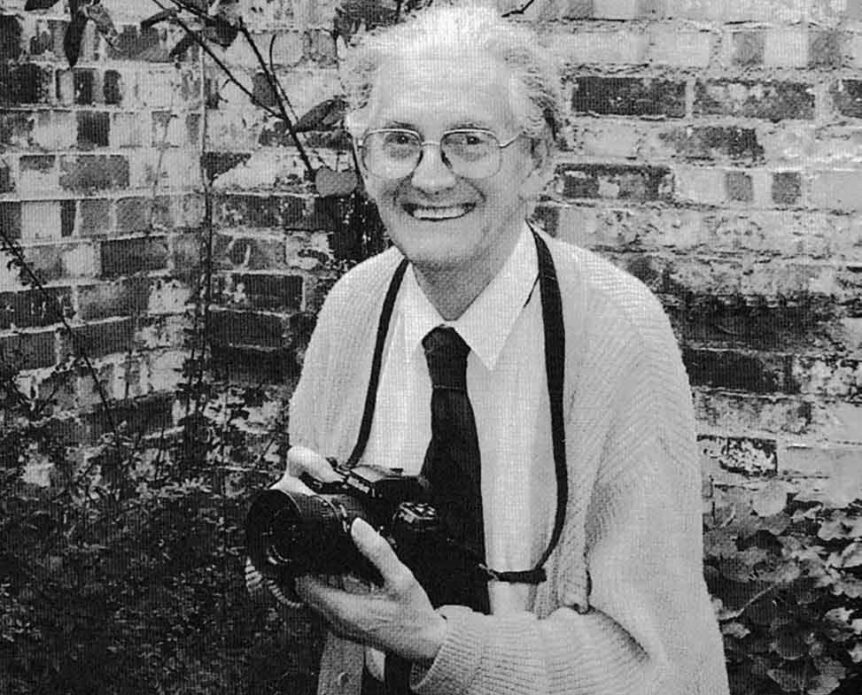
The above image is of David Campbell in 2000. © John Brooker
© Christopher South. First published in Saffron Walden Historical Society Journal No. 32 Autumn 2016
Everyone and no-one knew David Campbell. Everyone from Rab Butler and Stanley Wilson to the little boy playing an angel in the Nativity play and the little girl in the fancy dress parade knew David. I knew David. Yet I did not. And they did not. So who was this man who has an important place in Saffron Walden history and whose immense body of work appears in books, exhibitions and in the pages of this journal?
David was a very private person who rarely gave glimpses of what made him tick. The surprising clue was his alter ego as a romantic crooner. He had a pleasing tenor and sang Hollywood ballads, occasionally in public, with the conventional mid-Atlantic accent. Walking round the town with one of his succession of adored spaniels you could hear him softly whistling American love songs.
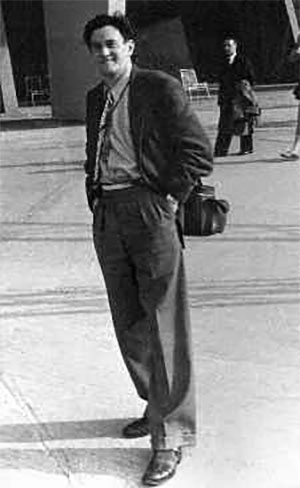
He admired all things American except in cameras when he admired all things German. I came to the conclusion after working with him for several years that what drew him as a boy to his life’s work was not photography but cameras. He cannot have been particularly prosperous but, no matter how expensive the latest Leica or Rollie, he had to have it, even if he had barely given himself time to master the previous model. He just loved cameras.
I once bought an antique Ticka camera disguised as a pocket watch in a box of junk at an auction in the old Corn Exchange. The 16mm film cassette was missing but he was not happy until we had shaped a tiny square of sheet film in his dark room, wedged it in and taken it outside to snap a slightly distorted and fuzzy view of Church Street. Pleasing for me but a triumph for David the camera king.
I worked with him for only three years in the early ‘50s but remained in touch as he slowly accumulated the huge catalogue which we now delight in and on which we now rely. We should not dwell on dear David’s weaknesses but it should be explained that he suffered from what I took to be a form of vertigo. He could not even stand on a low chair or a beer crate to get a bit of height for a certain shot. That is why I became familiar with his costly kit. I climbed control towers, balanced on balconies, trod the leaded roof of St Mary’s with his treasured cameras to get views he sadly could not.
I eventually mastered his Speed Graphic, a massive camera using sheet film and with two sets of shutters. Before risking an exposure using the first shutter, I had to remember to remove the screen from the film slide and open the back shutter. When using the back shutter at 1000th of a second it came down like a guillotine. This was useful for sports pictures although David was never keen on the action stuff, preferring footballers to stand still in rows like brides and grooms and their attendants and families at a village wedding. He was the confirmed bachelor who officiated at a thousand weddings. He never owned a car or learned to drive. This limited his availability as a quick-response newsman but he got there somehow even if he sometimes might have wished he hadn’t – like a horrible scene of an air crash.
The town felt fond of David not only because of his work but for his pleasant nature. He had a good eye but his work was sometimes marred because, being a nervy sort of chap, he persisted in smoking in the dark room in his rather higgledy-piggledy home in Church Street. With a fag between his lips as he worked the enlarger, ash would fall on the print and occasionally leave speckles on the finished product.
Perhaps another reason the town grew fond of David was that we could all see the child in him although his own early years, of which he never spoke, were widely supposed to have been difficult and seen as the cause of his slight stammer. He also suffered from what one suspected was spina bifida. Yet in the rather good looking young man a happy child was sometimes visible. When the Walden Cinema reopened, the local editor sent David to secretly capture the kids’ reactions at a Saturday matinee using infra-red film. David was so entranced by what the audience was watching that he forgot why he was there and took no pictures.
Perhaps it was the influence of his equally gentle mother, a stalwart of the WI who gave shorthand lessons, but another reason he won our affection was the way he treated everyone with the same respect, no matter if it was some cantankerous, puffed-up alderman or the British Legion war veteran who supervised parking on Market Square. I seldom saw David’s father, known as Jock. All I recall is that he was Scottish and worked at RAF Debden.
In retrospect I see how both Walden and David were blessed to have one another. The town was at one of its peaks of pride and individuality, replete with complex culture and strong characters. They and their doings were the subjects for his canvas, he was their artist. Bunkum’s Breughel.
Note.
The author formerly worked for the Saffron Walden Weekly News, and is a broadcaster with BBC Radio Cambridge.