
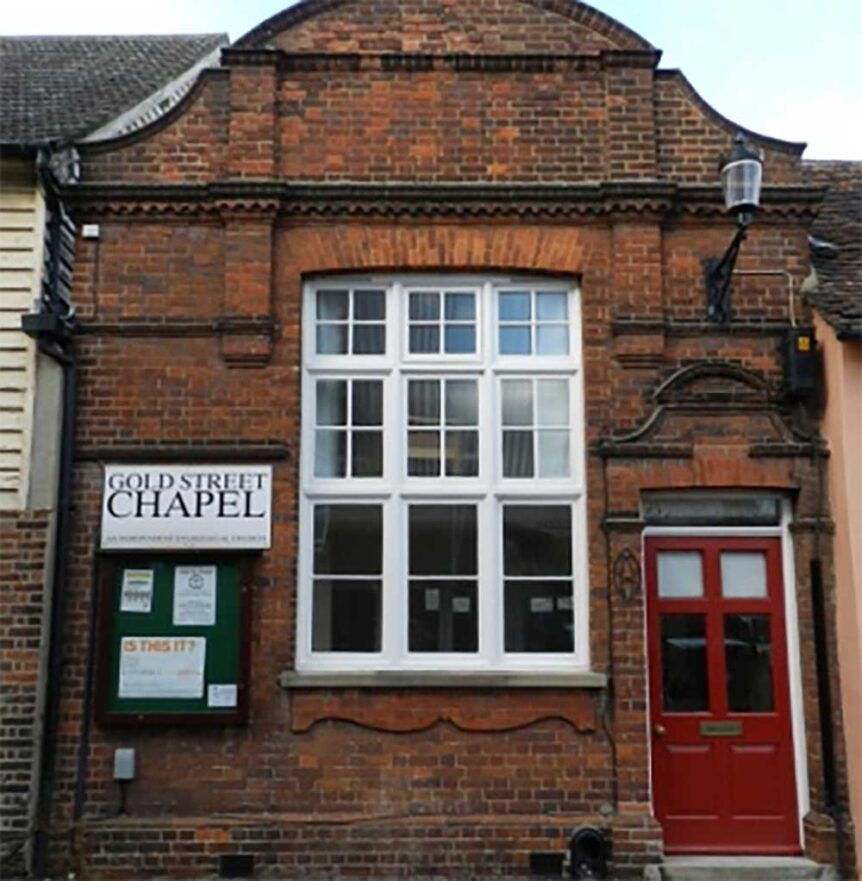
The above image is of Gold Street Chapel, Saffron Walden . © Saffron Walden Historical Society
The Plymouth Brethren, 1941-1954
© Michael Yarrow
Originally printed in Saffron Walden Historical Journal No. 33 Spring 2017
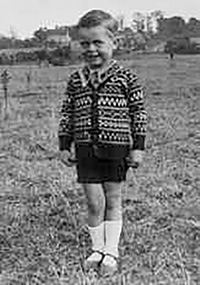
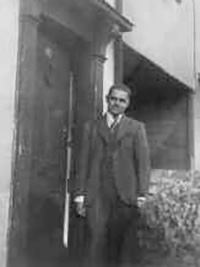
I was born in Walthamstow, in April 1940 during the WW2 Blitz (Fig. 1). As a family we were sent to live in Saffron Walden, where my father, who was a conscientious objector, was to serve in the grocery trade throughout the duration of the war (Fig. 2). Walker’s, or World Stores, where he worked, was at the bottom of the High Street, opposite the Post Office. Our home was number 45 Radwinter Road, a two-up, two-down, terraced cottage, rented from a maiden lady, Miss Hagger, a member of the Plymouth Brethren Assembly. My parents, Leslie and Amy Yarrow, were also members of the Plymouth Brethren, a somewhat exclusive nonconformist denomination, which met at the gospel hall in Gold Street (See above image). They tended not to mix with folk of other churches but would travel to meet other Brethren folk in their chapels in the area. My dad did this maybe more than most being a lay preacher, so having use of a vehicle was extremely useful. After the war ended in 1945 he was still able to use the store’s van, though petrol was still rationed.
Back in the 1940s every girl and lady would wear a hat or a bonnet in the meeting; most men wore a hat in the street, which they took off to go inside a building. Sunday was going to church day, with a meeting in the morning, Sunday School in the afternoon and another meeting at night. Once I was considered old enough I went to all three. The morning meeting (11.00 – 12.15) was focused on ‘The Breaking of Bread’, in other churches known as Holy Communion or Eucharist. We sat on wooden benches facing the front, where there was a table on which the bread and wine were placed. There were benches beside the table, at right angles to ours.These were for the families of influence in the congregation, the leading men, known as the Oversight and a few others, like our landlady. There was no formal structure to the meeting, any man could announce a hymn, pray extemporarily, read a Bible passage or even say a few words of encouragement or teaching (a micro sermon, so to speak). Probably after 30-40 minutes one of the leading men would begin to pray, giving thanks for the bread and wine, and what it stood for, the sacrifice and death of Jesus. Bread, then wine, would be passed round and everyone who was a congregation member could partake. Visitors could not, unless they had brought a letter of introduction from their home congregation. The meeting would end with a final hymn and extemporary prayer.
Children like myself were simply observers, we could not participate, and no female adult could speak during the meeting, though we could all sing the hymns.
For the evening meeting (6.30 – 8.00) all the benches faced the front and the proceeding would be led by one of the leading men or a visiting preacher. There would be several hymns, one or two Bible readings, extemporary prayers and a lengthy Bible teaching (a sermon, though that wasn’t a word we used). Being an avid reader from an early age, I spent a great deal of the time in these meetings reading through the Bible – you could not take any other book. In the mornings I often looked with puppy-dog eyes at the lovely Adena, with her white lace gloves, who sat on the row in front. Sadly I don’t think she even noticed me.
There were several special occasions: one such was a baptism when new believers, who had been suitably taught and interviewed, would be baptised by full immersion in a pool to be found below the floorboards at the front of the chapel. This inevitably meant water all over the place as the dripping candidates and those who immersed them, wrapped in bath towels, disappeared into a back room to dry off and get dressed. We celebrated harvest with tables groaning with the produce of gardens and allotments. After that evening service, all the goodies would be sold piece by piece to the highest bidder.
There would be several weekend conferences each year, when all the Brethren assemblies in the area got together to listen to guest speakers. The Easter conference lasted for four days, Whitsun and Summer events were somewhat shorter. These would inevitably involve large-scale bring and share meals; that was the time for the women to take over and run things. The assemblies usually involved had chapels in Saffron Walden, Hempstead, Haverhill, Keddington, Helions Bumpstead, Steeple Bumpstead, Clare, Sturmer, Hadstock, and there was Hillside Chapel in Sawbridgeworth and Hare Street Gospel Hall near Harlow. Some of these chapels no longer exist.
Christmas would involve a party for all the Sunday School children – funny how class sizes grew for a few weeks from the middle of November! One year we entertained a group of Polish displaced persons, I was a diminutive St Nicholas (Poland’s Santa Claus) distributing traditional food gifts to each one of them – even got my photo in the local paper.
Sunday School involved singing some songs, a Bible reading and then a lesson in groups. Four adults were involved: kindly Mrs Fairclough teaching the youngest; Miss Bailey, a Scottish nurse, taught the girls; and Joe Banks, a gracious elderly man, taught us older boys. The fourth, John Pettitt, was there just to help keep wayward boys in order. In addition to the Christmas party there was a summer outing, usually on a coach to the sea – Walton-on-the-Naze was the regular destination.
My Dad was a self-appointed lay preacher. Though he was rarely invited to speak in our assembly meetings, he quite often conducted services and preached in a variety of chapels in the villages of Wimbish, Debden, Sewards End, Radwinter, Ickleton, Arkesden, and in the Methodist and Congregational churches in Saffron Walden. In those early days he would cycle there, later he was allowed to use his firm’s van, then he got a little car. Sometimes I went with him. Although we knew a lot of people, we had only a few close friends, most of whom were in the chapel in Haverhill. Sunday was not a day for playing, but for church, listening to suitable music or reading. As I got older and had outgrown Sunday School I was allowed to go for walks or cycle rides.
The Mitson family took a major lead in the Gold Street Gospel Hall. They lived in a big house situated half way down Gold Street’s hill. I think Sam was a building contractor. I remember seeing a photograph of Sam, somewhere on a battlefield in WW1. He was a stretcher-bearer; he carried no weapons. Now and then we would visit Sam and Bessie’s home. My main memories are of a labyrinthine stone larder at the back and a prickly chaise longue stuffed with horse hair in the large sitting room. John and Mary Hart, members of the assembly, were of my parents’ age, so now and then Mary would visit and bring their son, who was about my age, to play. Sometimes my mother took me to their home, off the Ashdon Road, to play. Two bachelor brothers, John and Harold Pettitt, also members of the assembly, came now and then. They were as different as chalk and cheese. Harold, a chubby and cheerful man, worked in the local corn chandler’s, Emson Tanner. I can see him now in his brown smock behind the liftable counter. John was tall and somewhat gaunt, serious and difficult to understand because of his hare-lip. Both married before we moved away in 1954.
Miss Bailey, a Scottish nurse working and living in St James’ Infirmary in Radwinter Road, came most weeks, sometimes for afternoon tea and usually on Sunday afternoons to escort me to Sunday School, where she taught the girls’ class. Once or twice, two young men, Jim and John, visited to tell us about their work. Other friends would be invited to hear them. They were Army Scripture Readers, evangelists to the armed forces. Sadly one of them was killed on the front line during the Korean War, when a shell landed in the bunker he was in.
We had little to do with Christians in the other Saffron Walden churches, except the Coote family, who were Baptists. Mother and Mrs Coote were good friends; now and then I was taken to their house in East Street to play with their son, Richard. We would go weekly to pay the rent to our landlady, Miss Hagger, who was also a member of the assembly and lived in a house on the High Street. Probably our best local friends, Pentecostal Christians with whom we had supper every Thursday evening, were the Ridgewell family, Hubert and his wife, only ever known as ‘mother’, and their grown children Len, Lewis and Violet. Hubert was groundsman at the town’s hospital, Len has always lived locally, Lewis moved and went to Bible College, then into the Pentecostal ministry and Violet, who worked at the laundry, eventually went to be secretary to Donald Gee, the Principal of the Elim Bible College. There she got engaged to a student, they were married, and as Mrs Bonniface, became a pastor’s wife in Auckland, New Zealand.
In the 1940s there was a chapel in Wimbish on a little road, between Mill Road and Walden Road, in what is now known as Rowney Corner. This meeting place was under the supervision of a family friend, a Mr Jupp, who lived in a nearby thatched cottage situated at the corner of Thaxted Road and Elder Street, just down the hill from the Debden/Wimbish fighter airfield. We quite often visited this cottage, particularly on Sundays after dad had preached at the chapel. Back in World War Two there was no electricity in the chapel, evening services were lit by two rows of oil lamps hanging on hooks on the lower roof beams. I’m pretty sure the building was heated solely with a solid fuel Tortoise stove, there was always a stack of logs next to it.
I recall when really quite young, five or six, going to a chapel in Hadstock to see a magic lantern presentation of the story of the lighthouse keeper’s daughter, Grace Darling. All the slides were hand-painted. I always wanted to have a lantern after that; PowerPoint is no substitute.
Note:
This is an edited extract from the author’s memoir, ‘Growing up in Radwinter Road 1941-54’.
A copy of the complete script can be found in Saffron Walden Town Museum archives.
Photographs from author’s collection.