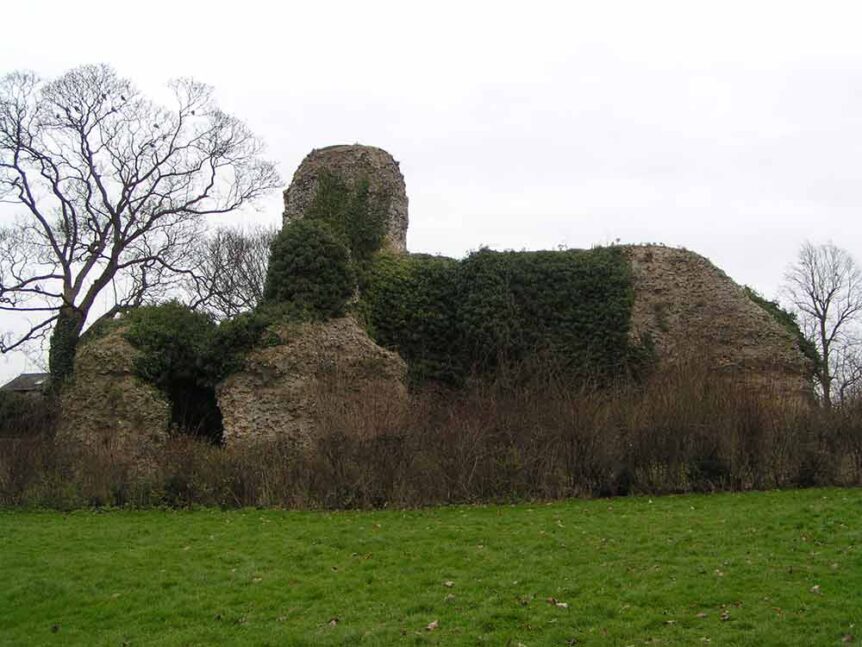
The above image is a recent photograph of the remains of Saffron Walden Castle
© Sibyl Thomas
Reprinted from: Saffron Walden Historical Journal No 21 Spring 2011
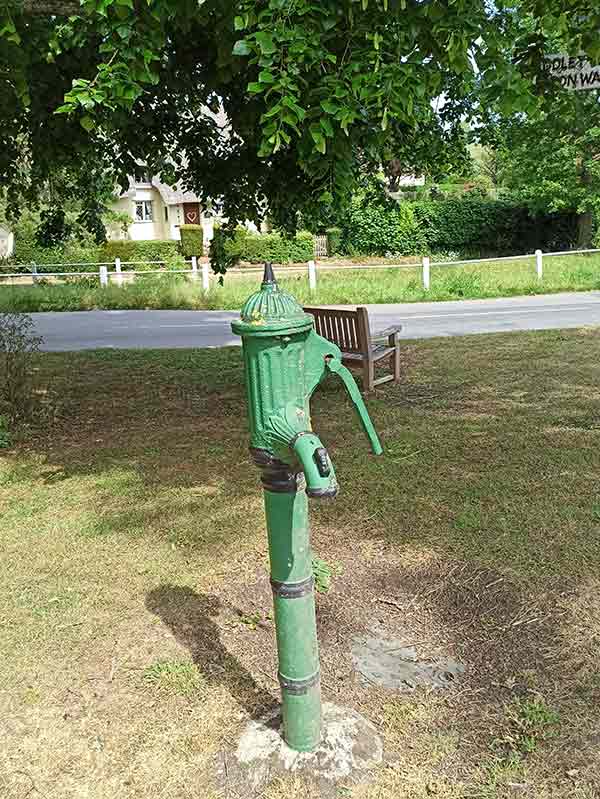
‘At present we get our water from pumps which are worked by hand but in 12 months time we shall have water taps in our houses.’
(Written in Ruth Clewer’s exercise book dated 16 July 1936 at Birchanger School)
At one time, the centre of any successful settlement was a fresh, clean water supply, but now many of the historic wells, their wellheads and handpumps are no more, and there is no understood programme for their conservation.
The location of a natural source of water has for centuries influenced the siting of human settlements. If a water supply was not available on the surface from a stream or pond, wells were dug. The term ‘well’ did not always mean hole in the ground: the Old English word Wella indicated a spring where the waters welled up to reach the surface.
Early Wells in Uttlesford
Shaft digging went back in Britain at least to the Neolithic, but the Iron Age is the earliest known archaeological recording of a well in Uttlesford, found at Woodside Industrial Park, Birchanger. Following on from this the next wells we know of in the district date to the Roman period and were documented in the Roman town of Great Chesterford, where there are four records among the National Monuments Records. The author was unable to discover the construction of these wells but, using evidence provided by other excavations of Roman wells in Essex, it is probable that they were wicker or timber plank lined and either circular or square in plan.
Essex and Uttlesford occupy the London Basin, which has for its framework the great chalk formation. The northern rim of the basin appears in the uplands of Saffron Walden where chalk occurs, and in the surrounding villages such as Newport and Berden. The Anglo-Saxon buildings found in Uttlesford seem to be constructed from flint and mortar (Priors Hall, Widdington and the former Chapel of St Helen, Bonhunt Farm, Wicken Bonhunt). It might be possible, therefore, that flint-lined wells were first constructed in the Anglo-Saxon period, but this is yet to be confirmed. Indeed flint-lined wells have been excavated in Uttlesford, such as the one found in Mill End, Thaxted opposite the Rose & Crown.
The medieval period contains varied examples of well construction in Essex – some of the Roman methods of timber plank and wicker lining were still being used in this period and it is possible that flint lining was also undertaken. Another known method in Essex was that of timber barrel lining, which was a very simple method found at Waltham Abbey. There is a documented Norman well at Walden Castle (see featured image above) constructed during this period, described by S.R. Bassett:
In the north-west corner of the keep is a circular well shaft. Its robbed remains can be discerned as far as the surviving top of the north wall, and it is shown clearly by Gough… Just above basement floor level, some fragments of the shaft lining, of clunch blocks, remain in situ. It seems probable, although only excavation can determine the point, that the shaft was fully enclosed within the basement and first storeys, and extended at least as far as our putative gallery level. The well was cleared in 1881. It was found to be more than 25 m deep, cut through the solid chalk.
The Norman well at Walden Castle, Op.cit unlike the one at Colchester Castle, is cut directly into the chalk walls which are self-supporting. There was therefore no need for a lining (also called steining when the lining is brick or stone). The upper portion of the well head was constructed of clunch, a chalk-based stone. Both the Walden Castle well and the Colchester Castle well share the similarity of a circular plan.
There are still examples of barrel-lined wells being constructed into the post-medieval period, and it is possible that flint-lined wells also continued to be constructed in this period. Wells also continued to be cut directly into the chalk, such as the post-medieval well at Berden Priory, which is four feet wide and 120 feet deep, with a 17th century well house and donkey wheel, which was replaced with a new wheel at a later date. There is a post-medieval well at Brickhouse Farm, Margaret Roding, which is circular in plan measuring four feet in diameter. The house is said to date to c.1680. The bricks are red and measure 230cm long x 55cm high; they are a single brick thick and are not shaped, but laid with the inner edges touching. The bricks are dry laid (i.e. not laid in mortar). The well at Millers Cottage, Little Hallingbury is also post-medieval, c.17th century and constructed in the same way.
19th-20th Century Wells and Boreholes
The construction of wells continued in the same manner, typically using brick in Essex, but stone in those areas of the country where this was readily available. The 19th century saw the introduction of the imperial brick size, which helps make it easier to date wells from this period.
Special well bricks also started to be used at this time, with a concave curve on the inner face and convex on the outer. Therefore when the steining was laid, the perp-ends meet. Wells also started to be mortared in this period with hydraulic lime mortar, which is able to set underwater. The large well sunk at Felsted School by C. Isler in 1921 has hydraulic lime mortared shaped bricks.
The 19th century also saw the introduction of driven and bored tubes made of cast iron (boreholes). Many of the 19th century wells are a combination of a hand-dug brick well shaft with the final depths of the sinking completed by borehole, which is the case at Felsted School. Some sinking was undertaken without a shaft, using just a borehole, as found under the pump at Mallows Green Cottages, Manuden.
Wells were still known to be built for properties into at least the 1930s, before mains water was brought to many of the villages. The houses on Stane Street, Takeley, which were being built in the early 1930s, have wells to the front which are square and brick cement mortared.
Positioning the well
The position chosen for the well relates to the people and buildings it was used for. In domestic situations the well is most commonly found located at the rear of the property near the service end of the house and usually very near the rear door. Examples are at Laddersway, a medieval hall house in Felsted, where the well is located directly in line with the passage rear door; and at Brickhouse Farm, a 16th century property in Margaret Roding, where the well is located again at the rear of the house. This position was likely to have been chosen for its convenience, as the daily tasks such as cooking and laundry, which required water, were located at the rear, especially in the later 19th century. Medieval hall houses have service ends, rather than rear service buildings. Sometimes the well is located at the side of a building and it is thought that this again relates to ease of access between the service rooms, such as the buttery and pantry, and the well.
The position of a well can therefore start to reveal how a house might have been used in the past. Some wells at the larger estate and manor houses are found in the cellars. These include Radwinter Manor where the well is accessed via a small tunnel from the cellar, and Audley End House which still has its well in the cellar. The location of the well here allows us to understand that the cellar was a place of service activity for the house.
There are a few examples of wells located at the front of the house, for example at. Bullocks Farm, Takeley (c.1600) and High Easter, Great Canfield (c.1500). Both of these were farmhouses, so it might be that the well was positioned at the front to provide water for the farmyard, or was put in a position where horse and carts could pull up next to it to fill barrels, so water could be distributed around the farm. Some wells are at the side of a farmhouse, possibly for the same reason.
The presence of a well or pump at the front of a public house is also typical, for example The Cock at Henham and The Rose & Crown, Stansted Mountfitchet. Communal wells and pumps are very commonly found on village greens, for instance at Aythorpe Roding village green and Arkesden village green. If not on a green, village communal pumps were often located on the side of the road near the centre, as at Stebbing.
Communal wells in town were commonly placed on the high street, as found at Thaxted High Street and Great Dunmow High Street. Another common place to find wells is outside the village school, for example Radwinter Primary School has a pump located at the front of the school adjacent to the entrance, and Henham School also has its pump located at the front on the verge.
Water-raising Methods
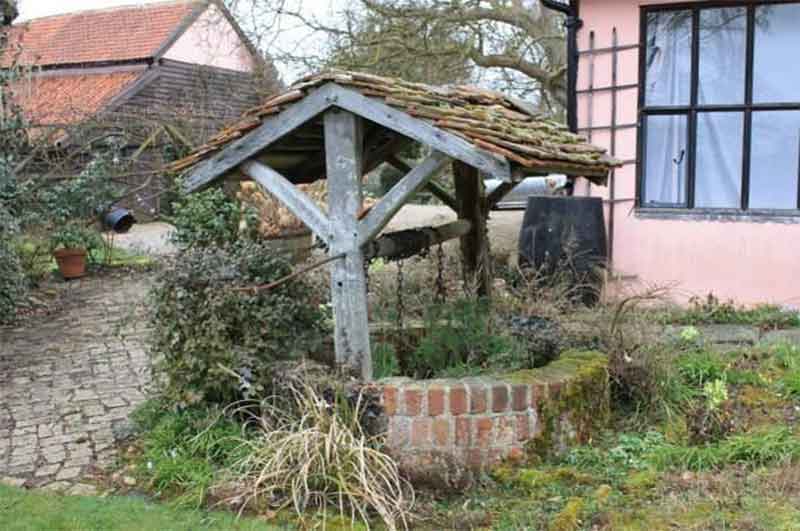
Water lifting devices reveal developments in technology and changes in lifestyle over time. Buckets were simply used to lift water from shallow wells, retrieving water which was beyond reach, with the help of a long handled bucket hook. Where the water was slightly deeper, winches and wellheads were used to raise the bucket and chain by turning the handle. These would have been a common sight outside houses, farms and workshops across the district, but surprisingly very few now survive, being replaced by handpumps or demolished once public supplied water arrived and the well became redundant. There are still some examples of wellheads in Uttlesford, such as the thatched well-head at Green Easter, Great Canfield, the Millers wellhead in Radwinter and a tiled winch and well-head in Felsted. They all have a roof to protect the turning mechanism, which varies in size. The most modest winch housing is that of the Millers Well which, unlike the other two, does not have a protective upstand, as found on the domestic wells. The brick upstand not only stops people and animals from falling in the well, it prohibits contaminated surface run-off water from seeping into the top of the shaft. All the winches share a timber barrel connected to a wrought iron handle. This mechanism, like the one at Green Easter, Great Canfield, can have a break feature that stops a full bucket of water from dropping back down, if control is lost of the handle. The support frame is oak or elm in the case of the Great Canfield and Felsted wells, while the Millers well, which was actually used by a blacksmith in the 19th Century, is only soft wood with a trap door.
All of the wellheads encountered by the author in the district are thought to date to the 19th century, and earlier well-heads seem to be rare, having been superseded by the handpump. The first known type of handpump is the wooden pump. This is a pump constructed entirely from a bored elm trunk with an internal wooden leather plunger and external iron handle. There are no known examples of wooden handpumps left in Uttlesford and indeed they are almost all destroyed across the country, with the exception of one known example.
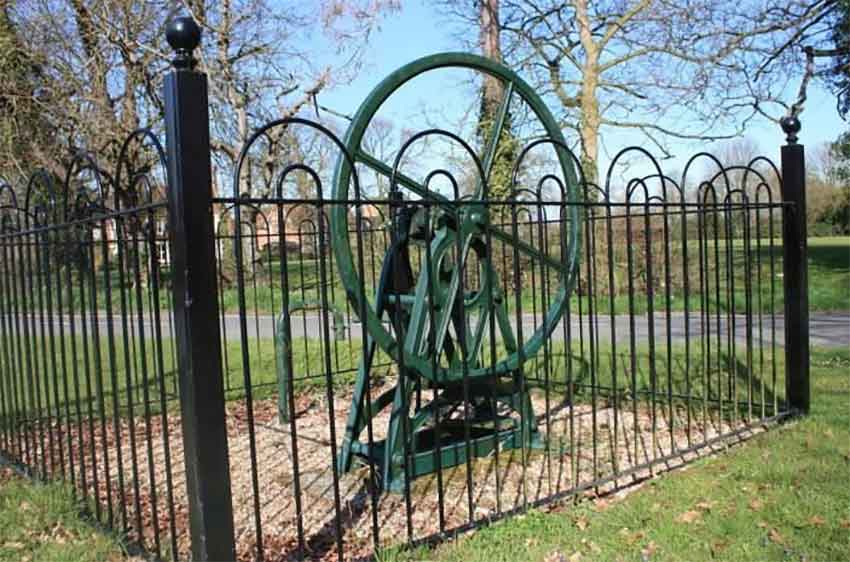
When a well was very deep, it often required a device with more power than the common wellhead and winch to lower and lift the bucket. This resulted in the construction of donkey wheels or horse wheels, both sometimes referred to as gins. The use of animals such as horses to raise water goes back to the prehistoric period. There are no known examples of horse wheel left in the district, but there is a well-maintained donkey wheel at Berden Priory. Although this wheel is 15 feet diameter by 3½ feet wide and therefore large enough to be worked by a donkey, it was invariably worked by two men. The axle is rectangular and this carries a wooden drum 3ft 4in diameter on which the rope was wound.
Long Case Pumps
From the 18th century, lead pumps started to be used, replacing the wooden handpump. They were not so difficult to construct and were easily repaired. There is a good example at High Easterbury House in High Easter which has sea monsters detail; others have flowers or a date and the initials of the owners or plumber.
Long-case pumps were also located inside the house. There is still an example of an internal long-case handpump in the rear room of Elms farmhouse, Great Canfield, with the pump located on the wall with a sink below. A lead pipe goes from the pump to the well outside the door. Lead was expensive, and many of these pumps were stolen and sold. The casing to protect the lead is often made out of elm wood with a door at the top for maintenance, to access the wooden bucket, rod and cistern. The lead spout is also known as the ‘nose’, and the handle is known as the ‘rat’s tail’. One way of preventing the water from freezing inside was to wrap the pump in straw and sack with string to insulate it in the winter months.
Cast Iron Pumps
Generally, lead pumps stopped being produced in the 19th century, as pumps from then onwards were mass produced from cast-iron producing cheaper pumps, which were not prone to theft. For a shallow well, it cost much less and a recording in the trade catalogue of Denning & Co., Engineers and Iron Founders (1886) states that, for three feet of lead pipes and a handpump in 1896, the cost was £1.15s. Cast iron was also less easy to damage, not being prone to bumps and dents, and was therefore well-suited to the tough conditions of farmyard and industry.
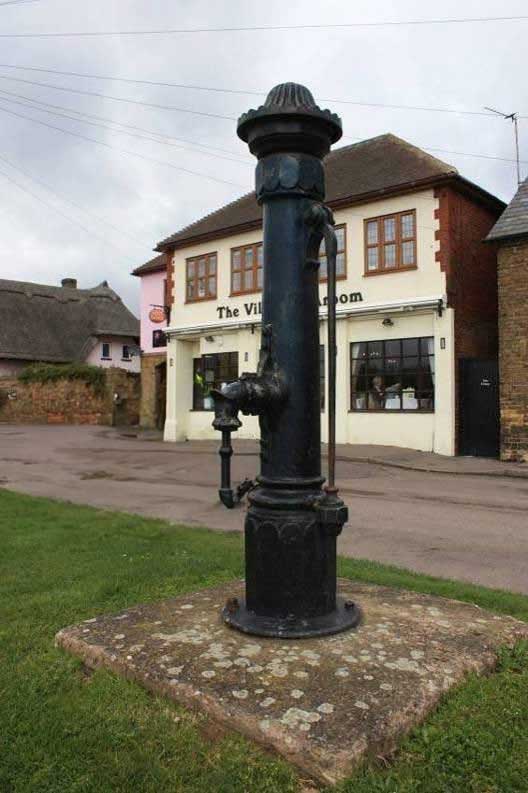
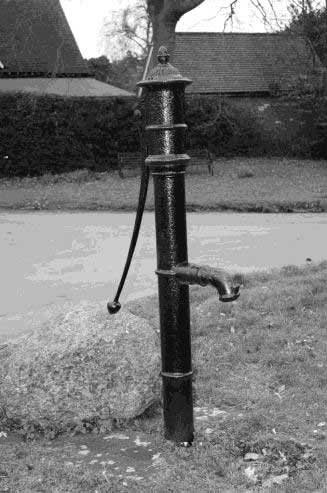
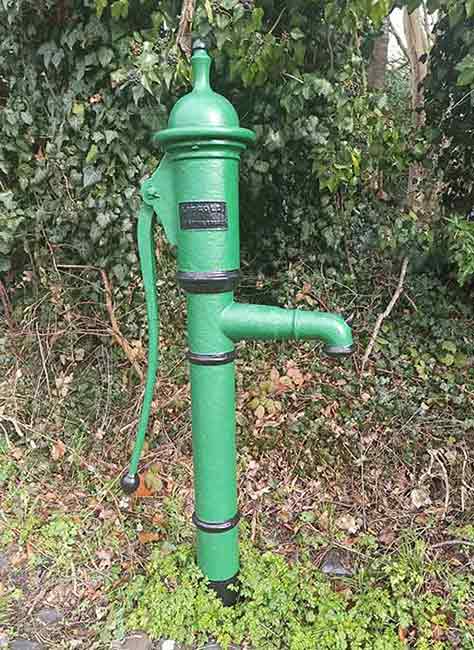
The prolific introduction of cast-iron handpumps and their systematic replacement of earlier pumps, has resulted in this type being the most commonly visible handpump in Uttlesford today, with many found on village greens, verges, outside schools, and at the ends of cottage rows. A good example can be found at Hatfield Heath.
The lift pump is the most common cast-iron pump found on the village greens of Uttlesford, such as the one on Ugley Green. The force pump was used when deeper water needed to be obtained.
Mass production of cast iron allowed affordable pumps to have decorative embellishments, such as acanthus leaves on the spouts and sometimes on the body of the pump, symbolising enduring life. Pineapples are another common feature on the top of caps, symbolising generosity.
Foundries used this embellishment to include makers’ marks and indeed particular features can be traced back to an individual foundry. The Warner Foundry, for example, seems to have produced pumps with fluted heads, and distinctive spouts, proudly displaying the name ‘Warner’.
Demise of the Well and Handpump
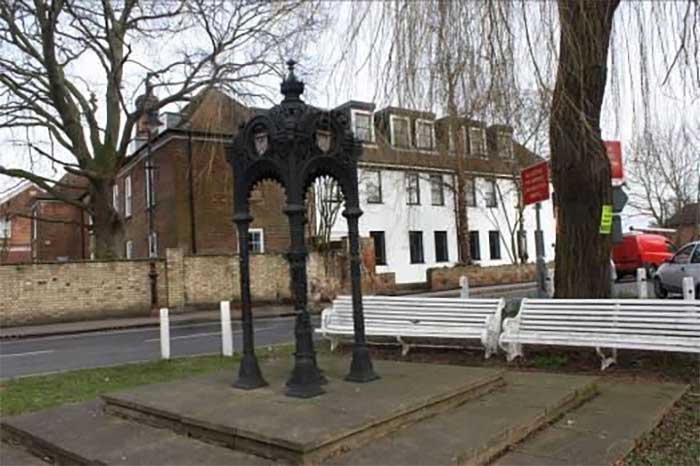
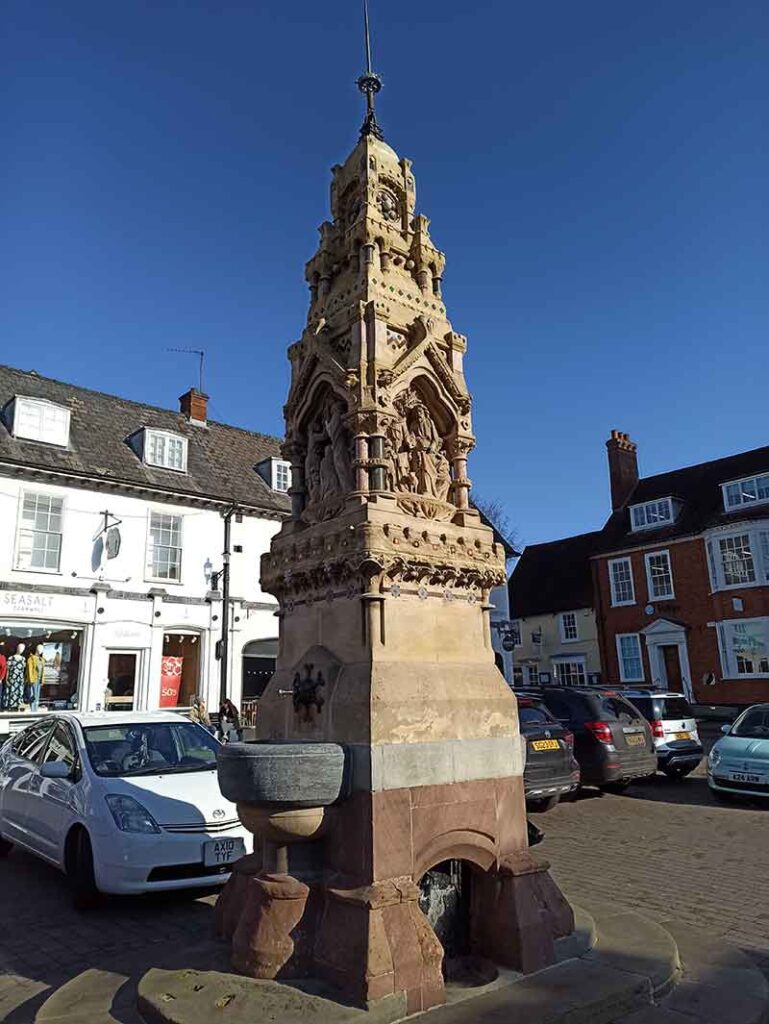
Disease was rife during the 19th century and culminated in the Great Cholera plague of 1832. The 1854 Broad Street cholera outbreak in London is one of the best- known cases, since cholera was spread by contaminated water. By the end of the outbreak, 616 people had died. The source was the public water pump on Broad Street. When it was finally established by the medical profession that there was a direct link between various levels of insuforia and water-borne infections, especially cholera, the connection between contaminated water and illness was proven. This prompted many public-spirited landowners and local worthies to provide a supply of pure piped water to fountains in many small towns and villages, removing and replacing the proliferation of shallow wells and pumps which they now realised could be polluted by animal and human ordure. Such a supply fountain was provided by the Gilbey family for the people of Stansted Mountfitchet to replace their pump. Decorative fountains providing fresh piped water were also commonly placed in market squares and on commons, as found in Saffron Walden. It is obvious from The Water Supply of Essex that disease was commonly spread by pumps and wells throughout Uttlesford. One such record relates to a typhoid fever outbreak at Wicken Bonhunt in 1869:
The water supply of the village is partly from the parish well used by the inhabitants of 19 houses; partly from private wells which supply the other 21 houses… The parish well by the roadside is four or five paces from the brook channel, and it has been observed that after heavy rains, and when the brook is flowing, the water of this well is discoloured… At the upper or west end of the village, water is constantly running, in a strong stream along the brook, but after receiving sewage from the drain it disappears near where the road and brook cross. The parish well is sunk through and evidently derives its water from this sandy portion of the gravel, thus intercepting in its course water which within a distance of 250 yards, sewage matter has been discharged… 88 persons … had no source of water supply except the parish well… of persons getting water from the parish well, over 46% were attacked [by typhoid]. The fever originated from two cases imported from London and then distributed by the water… the water was the immediate cause of the epidemic… The measures that seem necessary for the permanent improvement of the village, and for putting it in a condition in which such epidemics as the present should be impossible; are essentially the supply of pure water and the safe disposal of all excrement… The existing wells will, after the effect of their recent cleansing and disinfecting has passed away, remain sources of danger to the people for some time after the necessary action has been taken for keeping all excrementitious matter out of their neighbourhood; and it is desirable that a new well be sunk into the chalk at the lower or east end of the village, in a place distant from the houses, and beyond the reach of any contamination.
The main towns of Saffron Walden and Great Dunmow, and some of the village centres, had sewage systems installed near to the time of their new main water supplies. This was to ensure that the new central water system, which still utilised wells underground, would not be contaminated.
In 1848 the Public Health Act set up Boards of Health, and in 1875 these became Sanitary Authorities. Following this, in 1894, the Local Government Act was passed, establishing the Rural District Councils.
Although not all properties in the district were connected to mains sewage, these Acts marked the start of the public water supplies to all the towns and villages of Uttlesford. The earliest public water supply seems to have been in Saffron Walden in 1836. The waterworks were located in Hill Street where the fire station is now, and one of the deep wells is still visible in the forecourt under a manhole. Interestingly, Stansted Mountfitchet Fire Station is also located on the site of its old waterworks, presumably making use of the good water supply to fill the engines. A history of the Walden waterworks can be found in a letter by Mr Jabez Gibson, who paid for, and organised the wells: ‘The Wells in general are not abundantly supplied with water, yet sufficiently so in most seasons for general purposes; but the last year and the previous one proving so dry, many of the Wells were obliged to be deepened in order to obtain a better supply.’ This led him to decide to experiment with a borehole and he employed S. Purkiss to dig the bores:
The work was commenced… by sinking a Well or shaft 20ft deep, which brought us to the upper land spring… The first 10ft was alluvial gravel, then came the upper chalk, with flint, but of the latter minerals we came upon very few… After boring about 50ft we reached a very hard substance, which proved to be a bed of inferior Oolite of about 4ft in thickness, after which chalk again made its appearance… to the depth of 277ft, when a very fine spring of water was reached, laying on a bed of fine sand of about 7ft in thickness. This spring has yielded 80 gallons of water per minute upon being pumped for 3 days and nights, without at all lowering the spring.
A footnote by Mr C. Long, adds that pumping had gone on since 1862 at the rate of 166 gallons a minute, without lowering the water below a given point. A newer well was then dug in 1900, made by Le Grand and Sutcliff and communicated by H. G. Featherby of Bishop’s Stortford. The following information about the Saffron Walden Waterworks is from the Water Works Directory 1911:
The works were established in 1862 and purchased by the local Authority in 1878. The population supplied is 6,300. The District supply is Saffron Walden and the hamlet of Sewards End. The yearly supply is about 42,465,750 gallons; the daily consumption per head, domestic 14 gallons, trade 9. the maximum daily supply was 153,303 gallons, in June, 1910.
The following list shows in chronological order when pumping stations were first built in the parishes, marking the date when these and the surrounding parishes first received public supplies:
1. Saffron Walden 1862, Waterworks, Hill Street.
2. Stansted Mountfitchet 1895, Lee Valley Water Co. Waterworks, Chapel Hill.
3. Great Dunmow 1907, Lee Valley Water Co. Pumping Station, Mill Lane.
4. Newport 1931, Lee Valley Water Co.
5. Thaxted 1934 Waterworks, Bardfield Road.
6. Arkesden & Wendens Ambo 1935, Lee Valley Water Co Pumping Station, Royston Road.
7. Radwinter, Hempstead & Sampford 1935, Lee Valley Water Co.
8. Henham, Elsenham and Ugley 1935, Lee Valley Water Co.
Water towers were built where parts of towns or villages were too high to be supplied. The water was pumped using steam and later diesel up to the top of a tower from the centralised water works. Sewards End still has its water tower, built in 1901: ‘The supply is pumped up from the Water Works into a small tower in the Hamlet, holding 500 Gallons.’ The water tower on Debden Road in Saffron Walden was erected in 1913; and large estates built water towers to provide for all the buildings and land on the estate, as at Easton Lodge in Little Easton in 1902. Farms still relied on their own supplies, usually with tall wind pumps, as remembered by a local farmer at Bendysh Farm, Radwinter.
The introduction of a public supply took around a century across the whole district and there remain a few properties which have never been connected. The well records of 1965, which re-recorded many of the wells and boreholes first recorded in 1916, show that following the introduction of the public supply many of the wells and boreholes were quickly abandoned, with them recorded as being either ‘sealed’ or ‘disused’.
The Value of Historic Wells and Pumps
English Heritage define conservation in terms of evidential, historical, aesthetic and communal value. The presence of a well or pump can inform us of the location, size and type of early settlements found in the locality. The uncovering of the timber/wicker Iron Age well in Birchanger, for example, informs us that this was the position chosen for early settlement in the district, while the multitude of Roman wells in Great Chesterford can help us build up an idea of the size and layout of the Roman town.
Wells were very important in the past. The tradition of worshipping water gods and spirits at wells, springs and rivers was deeply embedded in the Pagan mind. There is still the ‘Holy Well’ at St Botolph’s, Hadstock, now without its wooden pump above. The Christian concept of the living waters survives, as does the Christian dedication given to areas which had these wells, such as Ladywell in Little Hallingbury. Wells can be found at St Mary’s Church, Little Chesterford and the Church of All Saints, Great Chesterford.
Some wells of the healing kind were chalybeate, that is, containing iron. Such wells were of special medicinal value and it became fashionable in the 18th century to create spas like the one in Harrogate, where people could ‘take the waters’ by drinking and bathing. According to Miller Christy’s notes at the Essex Record Office, there was supposed to be a medicinal well in Little Dunmow.
The symbolism embodied in this basic element of life has attracted man down the ages. Most of us today have performed the tradition of throwing in a penny and making a wish. The location of a well or pump, as already explained, can tell us where the service rooms such as the pantry and laundry were located in a house, as the well would have been placed nearby. If the well or pump is older than the house, it may tell us of the presence of a previous building. Many wells and pumps are also located near churches, on village greens, by schools and public houses. The pump sunk by Ingold on Bustard Green, Lindsell in 1873 is located next to Bustard House, but at the front near the road. This is an unusual position for a domestic water supply, so it suggests that the house may have had a different use. Indeed upon further research it transpires the building used to be The Fox public house.
Pumps and wells can begin to adduce past activities that might have taken place there. Public notices were pinned up on pumps to inform the community of recent crimes. Different types of water were utilised for different jobs. Rainwater tanks, for example, were built with handpumps above, so that the softer water could be used for washing clothes. Food was taken to pumps to wash, and notices were pinned up discouraging people from washing the more smelly food. Water carts were filled at pumps and wells and taken to the more remote houses. Men and boy water sellers were known to sell water door-to-door for halfpenny a bucket in 1841.
Well Sinkers and Pump Makers
Upon inspection many pumps bear either the name of the well sinker or pump maker. Therefore, many of the cast-iron pumps in Uttlesford have marks which can give us a clue to the well sinkers or iron foundries that were used. Possibly one of the most common names to be found on pumps and in the historic records in Uttlesford is G. Ingold & Sons of Bishop’s Stortford. The cast-iron body of the pumps with Ingold’s name are thought to be cast at the iron foundry of William Hughes in the Causeway, Bishop’s Stortford.
Pump Makers and Iron Foundries
Some of the markings found on pumps are from the iron foundries where they were made, rather than from the well sinkers. Many of the same foundry names can be found on pumps in Uttlesford. The name of John Warner & Sons of Cripplegate, London is found on many of the spouts of lift pumps and at the base of more elaborate pumps such as Little Dunmow. Some of the pumps in Uttlesford have the iron foundry markings of Hayward Tyler. This company is still in existence today. A marking found on a number of pumps in Uttlesford is E. Watson, Church Street, Bishop’s Stortford, but little is known about this pump maker.
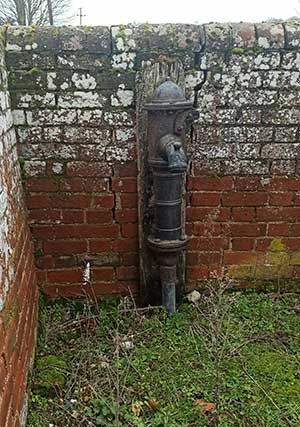
With the typical flag trademark, Lee Howl pumps are found all over the country, and there is a good example of a Lee Howl pump at the end of a row of cottages in Audley End Village, Saffron Walden, bearing their flag mark.
(see image on left) . © SWHS 2026
The mark of Charles Lack & Sons of Cottenham, Cambs, is found on the pump at Hadstock Green, and a similar plaque used to be affixed to a wooden box, now lost, which surrounded the wheeled pump at Hill Green, Clavering.
Pump and Fountain Houses
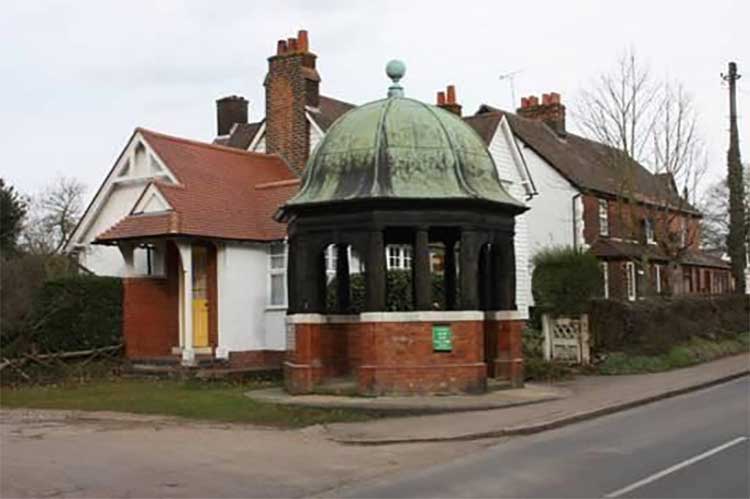
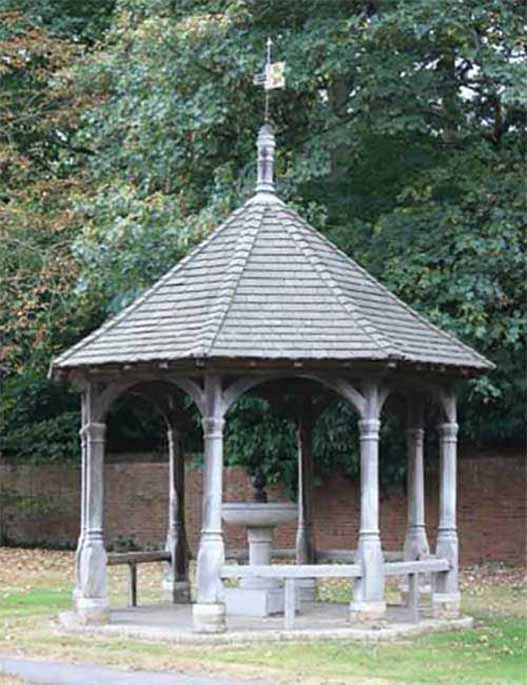
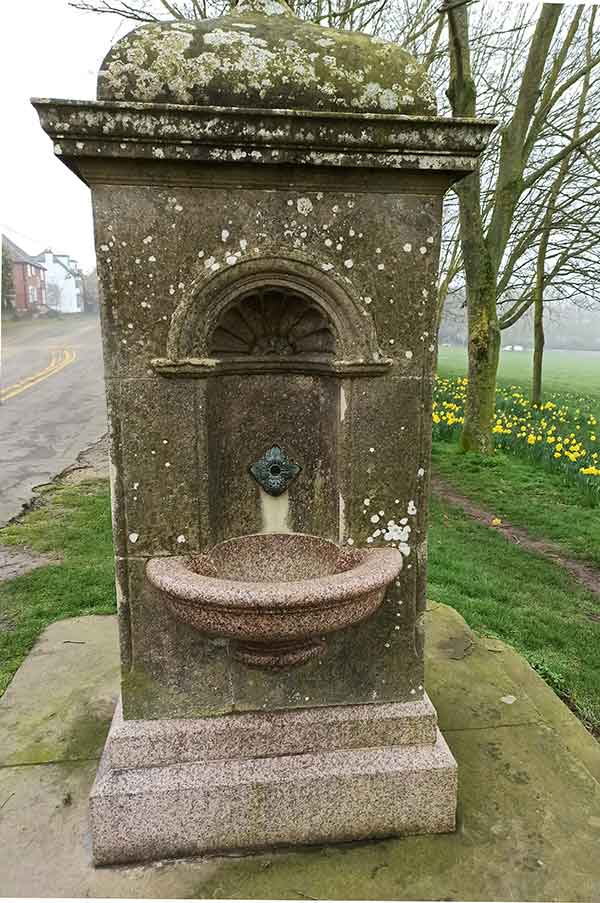
After the cholera plague landowners started donating water supplies within elaborate housings, and dedicated them to loved ones. There is a memorial well house at Elsenham, sunk in 1896 by Ingold, which still exists today, albeit without its pump. It has the inscription: ‘Erected by Sir Walter Gilbey Baronet in memory of his wife’. The Gilbey family also donated the decorative cast iron drinking fountain at Stansted Mountfitchet in 1871. The fountain house and trough at Quendon, recently demolished in a road accident, were donated to the people by Henry Tunell Esq, in memory of Col. Cranmer-Byng of Quendon Hall.
Elaborate new pumps and fountains were erected around the district to celebrate Queen Victoria’s Jubilee in 1887, such as the very decorative jubilee pump in Little Dunmow, and the jubilee fountain erected at the top of the Common in Saffron Walden.
Decorative Features
Some foundries can be connected to a pump not only by the cast markings which include their name and foundry address, but also by the decorative features on a pump. For example, a typical Warners pump at Sheperds, Stebbing has a banded downpipe, a fluted head and cap with pointed acorn finial, but most distinctly acanthus leaves on the base of the spout, a central band with Warners’ cast on the side of the spout and then a figure-of-eight scrolled bucket hook. A typical Hayward pump, as found at Radwinter Primary School, also has a banded downpipe, with highly fluted head and fluted cap with bulbous acorn finial – the handle this time is on the rear and distinctive fleur-de-lis style leaves at the base of the spout, figure-of-eight foliage on the side of the spout and a duck bill bucket hook.
Pumps in the Community
The Great Dunmow pump (located on the High Street, but which was presumably a long-case pump, then replaced with the cast-iron 19th century pump) has, it seems, always been valued by the community. In 1786 the Riot Act was read from the steps of the Saracens Head when violence flared after a new landlord broke the ancient town pump and filled the well with stones, as noted on the Francis Frith website:
1786 marks the Dunmow pump riot. The authorities removed the pump that stood here, only to have it reinstalled by the townspeople. This happened more than once. The affair finally escalated into a full- scale fight, which ended with twelve pro-pump protesters being thrown into Chelmsford Gaol.
Interestingly, we still see our pumps as focal points of community life. ‘The community magazine for village life in Debden’ is called Parish Pump and displays a picture of their (Warners foundry) village pump. Communities are proud of their public pumps and wells and many are seeking to repair them, as they have done in Hempstead with the help of grants.
Protection for Wells and Handpumps
Having been superseded by public supplies, most pumps and wellheads were removed and the wells beneath capped with concrete or stone slabs. Having written to many of the properties where records were found of wells, most owners wrote back not knowing where the well was located, as it had been sealed or in-filled. Historic winches and well-heads have almost all vanished from Uttlesford, apart from a few examples, and most of the winches inspected date from the 19th century. There seem to be no wooden handpumps left in the district and it is possible only one survives in the entire country. Relatively few long-case pumps exist. Berden Priory has managed to conserve the last remaining donkey wheel in the district. The cast-iron pump is the most common water-lifting mechanism to survive in the district but, upon inspection, many of these are in poor condition and broken. Only a few handpumps visited to date in the district were in working order (e.g. Kiln House, Little Hallingbury). The close proximity of the well and pump to the rear of many properties has further jeopardised their survival when extensions have been built. Building Control Officers instruct them to be removed and in-filled, rather than incorporating them into the design. The obsolete nature of our historic water supplies has led to their destruction and dilapidation.
These structures and mechanisms hold many heritage values, so their protection and conservation must be encouraged to avoid the loss of their evidential value and in turn their relative significance. Designating them as Listed Buildings is one course of action. There is only one individually listed well-head in the whole of Uttlesford, which is a Grade II Listed, 19th century thatched well-head in Great Canfield. The only other well (which does not have a pump over the top) protected by listing is the donkey gin/wheel and well at Berden Priory. There are at this time 73 individually listed handpumps in Uttlesford and some other pumps are mentioned in the house listings. An example of a listed pump is the cast-iron one on Ugley Green. None of the pump listing descriptions actually describe the well below, but as the well is a structure which is fixed to the handpump and has an associated function, it is probable that the well would also be protected by the handpump listing. Many handpumps are not listed in the district. There seems to be no obvious reason why these pumps are not listed – it just seems that some parishes have had pumps listed and other parishes, such as Clavering, which has some interesting flywheel pumps and a very unusual chain pump, has no pumps listed.
Some wells are protected as Scheduled Monuments rather than as Listed Buildings, but they tend to be part of a larger scheduled site. There are various Scheduled Monument Records, where wells have been recorded on larger monument sites in Uttlesford:
- Great Chesterford Roman town; Crown Orchard; Domed Well at Brettanby Cottage.
- Great Dunmow – rear of 37-61 High Street.
- Hadstock – St Botolph’s Church in churchyard and under the old pump.
- Hatfield Broad Oak Priory.
- High Easter – west of Chapel Field House.
- Newport – former Hercules public house.
- Saffron Walden – 100 High Street/1 Debden Road.
- Saffron Walden – 19-21 High Street.
- Saffron Walden – north Side of Emson Close.
- Takeley Street well.
- Wicken Bonhunt – Bonhunt Farm Middle Saxon settlement in a field adjacent to St Helen’s Chapel.
It is important to note that if your property is listed and it has a well or pump outside, or on a nearby building – the well or pump are protected by that buildings listing, even if they are described in the description.
Therefore any work to in-fill, remove or alter them must have listed building consent and the Conservation Officer must be made aware if one is found during construction. It seems that raising awareness with the Conservation Officer is a good start to ensure wells and pumps are not needlessly destroyed, especially when it is now clear that they are protected by their associated listed building, when in the past this was a grey area. But when wells are found during construction, it does not always prevent them being infilled. Listing them does not always seem to prevent dilapidation, as found with the roadside public pump in Barnston. The main problem is that they are not valued, in some cases are in very poor condition and the majority are not in working order. Some parish councils in the district do understand the value of their village pumps and no doubt the listing of some pumps and wells has helped parishioners and owners realise their worth. Hempstead village for example repaired their fountain by replacing the pipe between the high-level well which runs down to the water fountain, thereby allowing it to function once more.
There are a number of commercial buildings that still abstract their historic water supplies in Uttlesford. Felsted School use their (rather terrifyingly large) 7ft. 6ins diameter x 180ft deep well and additional 100ft borehole (sunk in 1880 by Mr Easton & Anderson) to supply the washing machines, dishwashers and toilets within the School. The water level is approximately 81ft down, pumped and filtered electrically to the water tower. Saffron Walden Laundry is another building which still uses its historic water supply, this time from a shallow well and deep borehole which was sunk by Le Grande of London in 1934.
Conclusion
Wells and pumps are not just redundant quaint relics of our past, but are significant structures and mechanisms which hold many heritage values and have the potential to be re-used in light of the current and potential crisis in water supply. Growing awareness and support from Conservation Officers can start to ensure that owners are more aware of the protections governing wells and pumps, including the relatively unknown fact that many of these are protected by their associated buildings listing. Pumps and wells can be added to Conservation Area Appraisals, to ensure communities maintain them. The knowledge imparted to Building Control Officers can begin to address and eradicate the needless destruction and infilling of wells and pumps during works on site, which happens typically when a capped well is unearthed during works. Having knowledge that wells and pumps are listed as curtilage structures, they can request an application to be made and, importantly, can advise owners on positive conservation alternatives to destruction through good design.
The real saviour of the well and handpump could be its relevance in the current and future water crisis. Felt most heavily in the south-east, water boards are inflicting hosepipe bans and increased proposals to meter water, while the Government and building regulations set tighter restrictions on mains water consumption. Repairing and re-using our own old wells and pumps not only provides a financial incentive, but can reconnect and restore the respect and understanding we have for water, its cycle, sources, availability and the amount we use.
Bibliography
Bassett, S.R., Saffron Walden to AD1300 (1982).
English Heritage, Conservation Principles, Policies and Guidances for the Sustainable Management of the Historic Environment (2008).
ESAH, Essex Archaeology & History, Vol 12, p.75.
Firth, F. (2009), Great Dunmow, website: http://www.francisfrith.com/ Geological Survey, Well Series, Saffron Walden (1965).
Medlycott, M., Essex Archaeology & History Vol 25 (1994), pp 28-45. Norwich Geological Society (1878), pp 28-30.
Sayer, A. & Harvey, B., (1965) Well Catalogue Series, Geological Survey of Great Britain, Department of Scientific and Industrial Research.
Takeley Local History Society (2008), ‘The Takeley Pump Company’.
Thresh, J., The Water Supply to the Rural Districts Of Essex, Great Britain (1905). Whitaker, W. & Thresh, J., The Water Supply of Essex from Underground Sources (1916).
NOTE: See gazetteer of pumps and wells on the website Recorders of Uttlesford History
A SELECTION OF PUMPS & WELLS IN UTTLESFORD