

© John Shaw-Ridler
Note: The article below was published in two parts in Spring 2003 and Autumn 2004 issues (Nos 5 & 8), a detailed description of the history of the Town Library up to 1989, just before the author retired as head librarian at the branch. But a third and final instalment planned (from the section headed 150th Anniversary) was unfinished, and therefore the period from 1989 to 2007 awaits another author, since sadly John Shaw-Ridler died before the review could be completed. Since 1989 there have been further changes with the total internal renovation of the building in 2007 – represented here with some photographs of the newly-refurbished library.
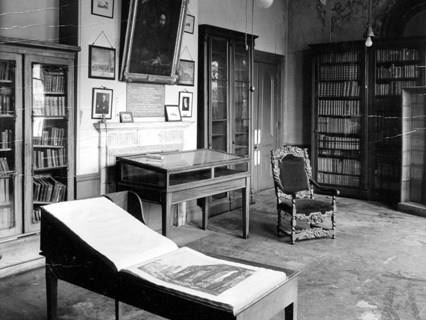
The Town Library in Saffron Walden was founded in 1834 by a group of Nonconformist local business men who were concerned to provide more opportunities for self help education in the town.
It was a time of reform: the Reform Bill of 1832 had recently been added to the statute book and local schemes for improvements in housing, health and education were being introduced all over the country. They varied in scale and efficacy but all were characterised by a sturdy spirit of independence, a sense of pride in locality and an awareness of local needs. Saffron Walden Hospital, Library, Museum and Swimming Pool were all provided in this way, long before any acts requiring such provision. The men responsible for these amenities were all reformers who had a clear vision of the improvements they wanted to bring and the ability to realise their ideas. The comparison that is sometimes made with today’s modernisers is not one that will bear much scrutiny; this is largely due to the reformers’ local involvement with particular schemes and their need for strict accountability within a specific environment.
Libraries and Mechanics’ Institutes with libraries were founded all over the country and their purpose was to provide educational and developmental opportunities for those who lacked the ability to make provision for themselves. Usually a library and programme of lectures were provided for members – in no sense were these institutes intended for basic or primary education. Most of them provided for what today we would call continuing education, and the level at which this was provided was at today’s second year sixth-form level and above. Another common provision was for community activity which included play readings, meeting places for clubs and exhibition space.
Many of these institutions survived into the 20th century, and then slowly after the First World War they were closed and their book stock either dispersed or amalgamated with that of a public library. Some still survive and they range in size and importance from the Linen Hall Library in Belfast and the Morab Library in Penzance, to the Tavistock Library which is contained in one small room. They are not only valuable survivals of our library heritage, providing fascinating and often instructive glimpses into the growth of public library provision, but also continue to function as libraries and centres of community activity. There are also some, like the Linen Hall Library and the Town Library, which have developed special study centres.
Transfer to County Council
The founders of the Town Library had difficulty at first in settling on a name. It was initially called the Working Men’s Reading and Improvement Society and quickly followed by the Philosophical Book Society, finally settling down as the Saffron Walden Literary and Scientific Institute, which name it kept until the trusteeship was transferred to the County Council in 1967. The library quickly flourished and attracted many members. It was not without benefit to those it was intended to help but quickly became a largely middle class society. Over the years it flourished and was the recipient of a number of important donations, the best known being the Gibson Collection of natural history books.
By the 1930s it was declining and the arrival of the County Library, which originally occupied a room in its building, marked the beginning of the end. When the County Library moved to Cambridge House after WW2 and increased its book stock, membership of the Institute declined still further. Attempts had been made to improve the financial situation by renting out the Librarian’s house to James the Jewellers as a shop, but by the early 1960s it had become clear to the trustees that the only way forward was to transfer the Trusteeship, on terms that would preserve the Library in Saffron Walden and ensure its continuation as an institution for the benefit of the people of Saffron Walden. Eventually a new trust deed was drawn up in 1967, and the trusteeship transferred to Essex County Council. The Town Library was to occupy the first floor of the building in King Street and the basement. The jeweller’s shop was to remain an investment property; the monies from the rent being used for the purchase of new stock and the repair of existing book stock. The County Council were to occupy the ground floor and the room on the half-landing for a rent in kind which consisted of staffing, services and maintenance.
As part of the agreement the County branch library was to be moved to the ground floor at King Street, the children’s library occupying the front of the room and the adult library the rear; the reference library sharing the Town Library’s study room and the staff work room located in the basement. This arrangement was temporary pending the planned extensions. In the event the extension was into the Corn Exchange and the temporary period lasted five years. Throughout this period Cambridge House continued to be used as a store and community activities venue. The complexity of the operation was clear from the beginning, compounded as it was by such severe space constraints. After some discussion it was decided, in view of the importance of the local aspects of the scheme, to give the Librarian some basic training in project management and the development and use of flow charts, rather than create another level within the existing structure.
The Building
The first task of the new trustees was to evaluate the stock and refurbish the building. The oversight of this project was given to the Librarian at the Saffron Walden branch library. It is difficult to imagine what the condition of the building was like in 1967. The front of what is now the children’s library with its windows onto King Street was a small assembly and reading room with facilities for its members to make coffee and it was quite common for members shopping in the town to take coffee here. At the time the loss of this facility was keenly felt by members who made attempts to have the coffee room retained as part of the new development. The rear of the children’s library and the workroom was occupied by a long table with periodicals and newspapers, the east and west walls of the room were shelved with reference books and many leather-bound volumes of the Annual Register, the Gentleman’s Magazine, Punch and Notes and Queries, amongst others. The overall impression was one of rather faded dusty Victoriana.
In the basement there was a huge coke-fired boiler, cheek by jowl with a partitioned-off portion used by the Camera Club as a dark room, another facility whose loss was keenly felt by members, who continued to lobby to have it reinstated for a number of years. On the half landing in the room now occupied by the staff room, was the Bible room, a small room lined with bookshelves which contained the Bible collection and some theology. This small room was the darkest and gloomiest in the building, permeated with a faint but ineradicable smell of gas, from an insecure fitting. Some of the older members believed that the gas was beneficial in preserving the bindings, and indeed the state of the leather on some of these books was in a slightly better condition than books in the main library. On the main landing, in addition to the door giving entrance to the Town Library there was on the west wall a contrivance consisting of a letterbox flap and chute for the return of books when the library was closed. This had formerly been the ladies’ entrance.
The main room where the microfilm readers now are presented a very similar appearance to the one it has today. As now it was dominated by the glass-fronted cases on the east and west walls. These were brought from Hill House in the 1920s to house the natural history collection, the botany books on the east wall and the zoology on the west wall. The Librarian had her desk in this room and it was here that books were checked out. There was also a glass-topped display case exhibiting some of the mediaeval manuscripts. The room at the rear, where the bulk of the books are now to be found, was much as today with lower bookcases and a higher ceiling. The room that is now the librarian’s office housed the literature collection: before the library house was rented out as a shop this room was the librarian’s sitting room and the double doorway still remains as evidence of this. The plan was for the county branch library to be housed on the ground floor in King Street with the children’s library to the front and the adult lending library to the rear. The staff work room was to be located in the basement and the reference library and local studies library were to share the Gibson Room with the Town Library. The community activities were to be transferred to Cambridge House where storage for excess books was also provided. This arrangement was temporary, intended to last for about two years pending the completion of a Phase 2 development at King Street.
The Books
The first task after the trusteeship had been transferred was to prepare the building for the contractors. It was not possible to arrange for the storage of books other than in Saffron Walden because the County had given assurances that the books would be kept in the town. Before we could make arrangements we had to consult with the architect to find out what his requirements were and also find out the extent to which it would be possible to store books on site. Preparatory to this we had to make a survey of the stock to establish how many books were involved and how much storage space was required. A decision had been made to transfer the 3,000 or so new books (that is books published after 1920) to the County Library. The number of books requiring storage was about 15,000 but before a credible storage plan could be devised we needed to know how many were large books requiring special shelving. It was also important to define categories of risk and fragility. We identified three categories: those books which in their present state presented no problems and could be moved without risk or special safeguard; the second category were those books which presented with a degree of fragility that demanded extra care in handling, and finally there were those which required individual wrapping before they could be moved. The books in the glass-fronted cases were thought not to be at risk but did require individual wrapping to protect them from dust. The next stage was to match available storage space to the books. We hoped to keep all the books .in Saffron Walden and, by making rooms available at Cambridge House and careful programming of the works, this was almost achieved. There was however a surplus of about 2,500 books for which we could not find room. A decision was made to house the collection of Victorian fiction in a spare room in the new library at Clacton and permission to do this was given.
The various stages of the process were quite complex to combine with the building works. To deal with this a separate flow chart was designed for book storage and movement which linked in with the architect’s planned sequence of works. Although the chart was quite time-consuming to prepare and adjust, it did enable us to be in control of operations and proved its worth. When we discovered we were not able to store all the books in Saffron Walden the chart proved a useful tool in the discussions that were necessary before taking books out of the town. Once the plan was prepared and we were clear about how many books we had to move and where they were to be stored and for how long, we had to consider how they were to be moved. The problem was that the majority were shelved on the first floor in a back room and they would all have to be moved to the ground floor, in addition to which they needed vacuuming before they could be moved. A test batch of about 600 books was prepared and they were divided into batches of 200 and shelved in the front, middle and back of the room. Over a period of about a fortnight various methods of moving them to the ground floor were tried. The preferred method for taking them downstairs was by human chain: but first they were moved to a holding bay of bookshelves containing about 1,000 books erected at the head of the stairs.
The next stage was wrapping the books which required special attention – this included all the books in the glass-fronted case. These books were wrapped in old newspapers and marked on the outside with their accession numbers. After we had assessed the space requirements, special shelving was ordered and erected in a designated area to the rear of the children’s library on the ground floor. The majority of the books in categories 1 and 2 were shelved and secured in this area. The books which were to be stored in rooms at the branch library in Church Street were moved first, then the Victorian fiction was despatched to Clacton. Finally the bulk of the library stock was taken downstairs. The County had agreed to overtime payments for staff to come in on Wednesdays and the books were moved in about seven days, excluding the time taken to fill the holding bay. Access to the secure area through a specially constructed door meant that it was possible to continue with the work of assessing the repair and rebinding needs.
Moving the Town Library
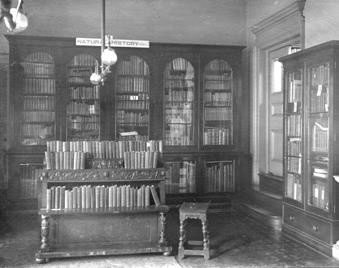
Photograph © Saffron Walden Town Library.
Once the books had been moved to their initial storage sites and the contractors had begun the work, progress, apart from one or two unforeseen incidents, was fairly steady. The staff at the library continued with preparations for moving the branch library: revising the stock, planning the new layouts and arranging for the purchase of new furniture and shelving. These tasks were interrupted by occasional sorties to King Street to make adjustments to the storage arrangements as the contractors’ various stages were completed. The work took about two years from 1968 to 1970. During the last six months while the finishing stages were in progress the library staff had more continuous access to the building.
The old wooden shelving in the Gibson Room had been sold largely because it presented an uneconomic use of space. The decision to confine the activities of the Foundation to the first floor and basement meant that many more books would have to be shelved in the Gibson Room. In order to make this possible the decision was made to use steel storage shelving. This was less deep than the old wooden shelving and went up to a height of twelve feet. Once work on the renovation of the Gibson Room had been completed, work began on erecting the new steel shelving so that the books stored on the ground floor could be moved upstairs and the contractors proceed with the final stages of the work downstairs. The books once moved needed considerable work and rearrangement because, although every attempt had been made to keep them in order, there had been inevitable breakdowns in continuity. The contractors proceeded at roughly the same pace as the library staff on this stage of the works and by the time the books were sorted upstairs, the room downstairs was ready for occupation by the County lending library. About two months were allowed after the contractors had finished in order to prepare for the day when both libraries opened on the same site.
Whilst the contractors were proceeding with the works and plans were being made for housing the two libraries in the same building (dubbed by one temporary assistant, ‘operation quart into pint pot’) the future development of the Town Library was being considered. The new trust deed stated that the trustees ‘should manage the library as if it were provided under the 1964 Public Libraries Act’. It also stated that provision should be made for ‘a service not normally associated with a public library’. The purpose of these clauses was threefold; firstly it would ensure free access to the collection, which had until its close, been for the benefit of fee-paying members; secondly it would ensure that the library did not become a museum piece, available to be viewed but not for use; and thirdly by defining a purpose the library would remain a living collection able to respond to the needs of those working in its special field. There was some concern at first about the first clause – this was because most people associate public libraries with the free loan of books for home reading, particularly in rural areas where large specialised reference libraries and other specific services were not normally found. Once the purpose of the clause was explained and the full range of library services provided under the act demonstrated, the concerns were allayed. This was done by mounting a small exhibition in the reference library at Cambridge House called ‘Public Libraries’ and concentrating on non-lending services.
Deciding on a special subject area that would be able to use the existing library as a base collection was much more difficult. The richness and breadth of the collection was quite staggering and at first several subjects presented, almost as contenders there was a particularly fine natural history collection, a very good collection of topographical books, some excellent architectural books and a very complete local studies library with long runs of journals. None on their own though were quite good enough and in any case presented the intractable problem of the relevancy of those portions of the library that were not supported. In default of an immediate solution the Librarian was asked to investigate further and prepare a report with a firm recommendation. This was done and 19th century studies was agreed on. There were a number of reasons for this, the most cogent being that although the collection was very wide-ranging in the number of subjects covered and also in the dates of the books, which ranged from mediaeval manuscripts to examples of art nouveau book production, there was a common factor: they had all been purchased or acquired during the period and all represented interests of the period. Purchasing in the field did not begin immediately as the money was all initially earmarked for the work on repair and restoration. However a start was made on preparing lists of books for possible purchase and scanning publications in the field. It became clear that the field we had defined in fact lacked definition, nothing particular happened in 1800 and 1914 was a more significant date than 1900. Another fact which emerged was the high volume of publication in the field which reflected a growing academic and public interest. After some discussion a decision was made to appoint a working party to make some recommendations, defining the field more sharply. This group reported in 1971 after the library was reopened. It suggested that Victorian Studies would be more appropriate, but omitting some subject areas that were less applicable to the Foundation library e.g. music, economics, sport, science other than natural science and some others. This report and its forward planning recommendations were the basis on which the library has been developed.
Opening Ceremony
After March 1970 parts of the building began to be completed and, as the contractors slowly made more rooms available, the library staff started on the formidable task of preparing the building for opening to the public in October. The size and complexity of the task were such that permission was given for extra staffing. New shelving and furniture had to be planned and put in place, a new guiding system devised and above all thousands of books moved and sorted. In addition preparations had to be made for the public opening. Brig. T. Collins, Chairman of the County Council, agreed to open the library, a guest list was prepared and the press informed. Because of the lack of space in the library the opening ceremony was conducted in the Town Hall which created some further logistical problems. On the day all went well, the weather was fine and the guests walked across from the ceremony to inspect the library without any untoward incident. The public opening the next day was tumultuous with a record for the number of books issued on a single day. Putting both libraries in one building had been achieved more or less to plan but adjusting to running two separate libraries and the cramped conditions would take time. The library staff became aware that the move had created some radical changes that would test them quite severely: they were not aware that the cycle of moving and storing books was about to begin again.
After the formal opening of the restored library building in King Street in 1970, and the beginning of the new arrangements whereby the county library service shared the premises of the Town Library, there was a period of adjustment. This was essentially a time for both the staff and members to get used to an enhanced service in a much smaller space.
Both the adult lending library and the children’s library were housed in what is now the children’s library; and the reference library, newspapers and periodicals were available in the Town Library study room. As a result of the publicity surrounding the move, the improved book-stock and more central position, there was a flurry of new applications for membership and many old members who were only occasional users became regular visitors again. There was also a tendency for individuals to borrow more books and visit more frequently: the first Saturday more than 1,500 books were issued; at Cambridge House on the busiest Saturdays about 1,000 books were loaned with occasional peaks of 1,200. All the clerical aspects of the service were also stretched with more queries, reservations and overdue notices to deal with and on top of this, work had to begin on the various tasks associated with the Town Library that had been listed in the forward plan published before the works began. The most urgent tasks were the restoration work and the re-binding and cataloguing of the collection.
The problem of space however was most urgent. This had been foreseen and had already received attention. It had been decided to redevelop the shop site and gardens in a way that would leave the shop as a separate unit for letting but make use of unused space on the first and second floors for the expansion of the library. This plan was pursued vigorously and the architects had already made some preliminary drawings of levels. This was necessary because the library premises were on two storeys and the shop was on three, but before any serious work could begin another problem became apparent. The excellent central heating system that had been installed had stimulated the growth of latent wood-rot spores. This first became apparent with some quite modest undulations in the paintwork on the main door.
Dry Rot
Investigation established that it was dry rot and Rentokil were called in. They established that the infestation was centred in the north-east corner of the Town Library study room. It was imperative that work began immediately, so the study room was closed and the reference library facilities were withdrawn pending the completion of the work. A barrier was put up at the bottom of the stairs, to minimise the problems caused by dust. This had the effect of closing one of the doors into the lending library and so frustrating traffic flow. After about three weeks it became clear that the infestation was more extensive than had at first been thought and that the landing and stairs would have to be replaced and the walls of the stairwell treated and re-plastered. The original estimate was that the extra work would need a further six weeks for completion. It was decided to continue with a reduced service in spite of the very trying conditions for staff and members.
About three weeks into the work in the stairwell it was discovered that the infestation had penetrated the floor of the Gibson room and that this would need several square metres of the floor and ceiling below removing in order to deal with it. It was clear that such an extensive operation would inhibit any joint use of the building by the library service while the work was in progress; fortunately Cambridge House was still in the control of the County Library service and being used to store some books. An emergency meeting was held and the decision was made to transfer the service back to Cambridge House pending the completion of the works by Rentokil. The estimated time for completion was three months. The librarian was asked to prepare a plan to transfer the lending and reference libraries back to Cambridge House as speedily as possible and with the minimum of disruption in order to avoid adverse publicity. Three mobile libraries were provided by county HQ and a team of workers. With these resources it was estimated that the move could be made in one day. Then, as now, the library was closed on Wednesday and a notice was posted in the library and announcements appeared in the press informing members that after closure on Tuesday the library would re-open in Cambridge House on Thursday morning. The operation involved transferring the books to trugs, loading the trugs into the library vans, unloading the trugs at Cambridge House and transferring the books onto the shelves in order. An initial twelve-foot run of empty shelves was erected at Cambridge House to take part of the first load. Thereafter shelves were dismantled at King Street, to be re-erected at Cambridge House. The problem was for the people dismantling and re-erecting the shelves to keep pace with the team moving the books. At the end of the day a backlog of books had built up pending the erection of shelves to take them. The job was eventually completed at 8 o’clock in the evening and the library was ready to open at 9 the next morning.
The move meant that library staff were again working on two sites because a presence had to be maintained at the Town Library in order to make sure that the books were properly protected from the works and that any books needing to be moved were handled by library staff. The majority of the books in the Gibson Room were again moved downstairs so that the contractors could have proper access. Altogether the works took nearly six months and there was a corresponding delay in the works planned for the Town Library and for the extension. It was some time before things were back to normal, partly because there was less time for planning the movement of the books. All moves were driven by the contractors’ demands for access to infected areas and consequently had to be done on an ad hoc basis. Once the contractors had gone and the books were back in their original places the effects of these hurried moves became apparent and quite large sections of the stock needed resorting. A year after the official opening the library was back, as far as the forward plan was concerned, where it had been on that opening day.
The Arts Centre
Some work had been done and during this year the plan to expand onto the rest of the site owned by the Trust had been completed, and work was already proceeding on the timetable for implementation when news was received that the Corn Exchange might become available for redevelopment.
Some work had been done and during this year the plan to expand onto the rest of the site owned by the Trust had been completed, and work was already proceeding on the timetable for implementation when news was received that the Corn Exchange might become available for redevelopment.
This eventually matured into a scheme to provide a library extension and create an Arts Centre under the same roof. Before this could happen, there was quite a long period when the direction of the future expansion was unclear. The possible redevelopment of the Corn Exchange created considerable interest in the local press. A multi-storey car park and a supermarket were amongst the suggestions that were proposed for its re- use. However, its status as a listed building was secured due to the representations of Nigel Weaver and Angus Lamont, ably supported by photographs taken by Edwin Smith. This protected it from the more outrageous suggestions. Eventually the proposal that it should be used as additional library space combined with an Arts Centre was supported by the Maltings community arts group and backed by Eastern Arts and a number of local artists; this support persuaded the County Council to endorse the idea. Once this had happened the whole process of planning and preparation for the necessary works began again and the librarian was asked to cooperate with the architect in preparing a scheme for dual use. The County Architect, Ralph Crow, was interested in the scheme and became personally involved. Responding to the challenges presented by dual use, involving occupation by two departments, both requiring public access and public assembly areas, he produced an imaginative and, at the time, innovative scheme. It is interesting that the recently completed new library in Norwich, though on a much larger scale, has adopted many of the features he introduced to Saffron Walden in 1972: the public library sited on the first floor, an open assembly area on the ground floor and a coffee bar. The brief that Ralph Crow was given demanded more than this and provision was also made for a versatile performance area capable of hosting theatre, cinema and concerts. The constraints imposed by the space demanded a rigorous consultation process. Initially the librarian was asked to consult with potential users in the community and arts organisations, his brief to establish the potential range and volume of use that could be credibly expected.
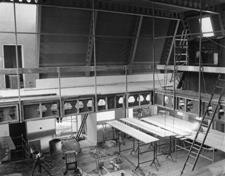
© Saffron Walden Town Library.
The County were concerned to provide a viable scheme but at the same time wanted to ensure that their response was to genuine requirements and not to the unrealisable hopes of enthusiasts. The consultations and preparation of the report took three months and recommended that the scheme, with some modifications, proceed. The architect’s department developed the ideas they had suggested into a complete proposal and eventually work began on the renovations and alterations. The scheme provided for the library to be accommodated on a mezzanine floor which would also provide gallery space for exhibitions and a projection area for showing films. The library would have primary use of this floor. The ground floor, which included a bar, dressing rooms, toilets and a box office facility would be a multiple use performance area with an audience capacity of about 200. The children’s library was to be accommodated in the south-west corner of the ground floor on mobile book stacks. All the furniture on the ground floor was mobile and could be wheeled away when the space was being used for performances. The Arts Centre was to have primary use of the ground floor. The architect developed the primary use concept to facilitate multi-purpose use within a framework that permitted spatial identification. The finished scheme attracted considerable interest in professional circles and won an architectural award for disabled access. The works took about two years to complete and the opening took place in June 1975.
A week long festival of music and drama was organised by Janet Tomblin, and Edward Bawden, who had advised on the installation and management of the gallery, very generously agreed to provide works for the first public exhibition. Soon after the opening it was suggested that the Arts Centre apply to the Edwin Austin Abbey Foundation to commission a mural for the west wall of the centre. After the application had been filed a visit was received from Sidney Hutchinson, President of the Royal Academy, who expressed a keen interest in the design of the building and approval of the scheme. The application was eventually agreed by the foundation and Sheila Robinson was commissioned to paint the mural. She commenced work and produced a design but her deteriorating health obliged her to resign the commission which was then given to Anthony Deigan who completed the mural now on the west wall of the Corn Exchange. Changes in the layout of the ground floor now obscure the force of the original view which was quite striking.
After the grand opening and associated festivities the primary task was to develop appropriate management structures for the three separate parts and, as far as was possible, integrate the organisation and management. Some preparatory planning work had been done but the practical implementation was no easy task, involving as it did, three separate budgets and chains of command. There was also the question of staff training for a new role; the excitement of the ongoing changes had carried everyone forward but the realities of the changed conditions and the new tasks needing to be learned presented real challenges for some. The first few months presented a steep learning curve for everyone involved. No longer just dealing with books for home reading and the associated tasks, duties now included selling tickets for events, manning the enquiry desk in the special studies centre, negotiating the sale of paintings and much more. Fortunately everyone responded well and, although some took longer to adjust than others, by the end of four months new systems had been developed, implemented and in some cases modified, and the staff were adjusting to the new environment and changed roles.
The Town Library
It was time to proceed with work on the Town Library, which had effectively been delayed for about four years. The first task was to respond to a request from the British Library that we contribute catalogue entries to the ECSTC. This was not part of our original plan but did contribute to the re-cataloguing and also revealed some quite interesting items which we had not been aware of. Because of the delays in commencing work on the implementation of the plan some quite serious backlogs had occurred. The restricted access to large sections of the book-stock had prevented any attempts to initiate a re-binding and restoration programme on the scale envisaged. The establishment of the special studies centre had also been affected, although some purchases had been made and the exact scope of a future purchasing policy for the collection defined. Facilities for users were not yet adequate: the continuing split of the collection between two sites in Saffron Walden, and the whole of the Victorian fiction being still in store and inaccessible at Clacton, created problems of access. On the plus side work on the ECSTC was progressing and the list of subscriptions to specialist journals was quite respectable.
More importantly the new direction that had been taken by the Town Library was beginning to be more widely-known and the numbers of students using the library were increasing. The completion of the building works and the opening of the Arts Centre marked an important milestone in the history of the Town Library. In a sense it was restored to its former place of eminence in the town and both its original functions were again being fulfilled. The library was once more being used in the way its founders had intended, as a serious educational institution: its use as a local social centre was also restored and a number of clubs and associations returned to use the venue that had formerly been their home. The annual exhibition of the work of members of the Camera Club returned to its former venue after a lapse of seven years and many more groups, new to the venue, joined them.

This use by the public was instrumental in making the continuing existence of the Town Library more widely known. The period of disruptions and breaks in service had lasted in all for about seven years and the staff had responded loyally to conditions of work that were, at times, very difficult. The members and public who used the library during this period were, without exception, patient and understanding; the time had now come to demonstrate that the years of inconvenience and discomfort had produced a better service for the town. A series of leaflets was prepared to inform the public of the changes and improvements to the service. Two exhibitions were mounted: one to show the alterations to the Corn Exchange for which help was given by the architect’s department; and another describing the new services available through the Town Library. Both were well-received as were the changes they explained; comment from the public was uniformly favourable and the provision of a lift had pre-empted the one criticism we had anticipated, the moving of the lending library and issue desk to the first floor. The increased use of the library and the very full events calendar at the Arts Centre were further evidence of the positive public response.
The next phase was to tackle the many remaining tasks that were contained in the new action plan that had been drawn up for the Town Library. The first was to prepare a timetable with start and finish dates for discrete tasks and targets for continuing activities: this was for a five- year period up to 1980, when a review would take place. A start was made by returning those books that were still being stored off-site and then seriously tackling the outstanding re-cataloguing.
‘Fisher’s list’
During this period the cataloguing was completed and many books on the notorious ‘Fisher’s list’ were found safe and well. Fisher, a former librarian, had in the late Thirties, taken his annual leave and failed to return. His failure to return prompted the trustees to initiate a stock check which revealed that a number of valuable items were missing including a first edition of Gulliver’s Travels. In the course of the next few months a list of the missing books was circulated to booksellers and a number were eventually returned. It became clear to staff as they re-catalogued that, over the years, ‘Fisher’s list’ had become a sort of catch-all location for any misplaced and missing books, a number of which turned up in the course of the renovation works.
The Fisher trail was picked up again, when work started on calendaring the archives of the Literary & Scientific Institute, in a letter from the police. This letter, from the Essex Constabulary and dating to the early part of the war, regretted that owing to the national emergency, the Fisher investigation would have to be closed until things returned to normal. After this there are no further references to the affair but it was apparent that the list of Fisher’s swag had been enhanced over the years, whether from malice or convenience we will never know. Some older members of the institute were able to recall that it was believed at the time that he had had a passage booked to South America, sailing a few days after the start of his holiday, and allowing just enough time to dispose of the stolen books.
The work on the archives brought a number of incidents to light: the first minute book could not be found in spite of an exhaustive search, but eventually it was discovered that it had been burnt in the boiler by a caretaker in a fit of pique or rage with the Trustees about his conditions of service.
A Growing Resource
One of the most demanding of the items in the plan was implementing the decision to keep the institution alive by using the collection as a foundation for a special studies centre rather than keeping the collection as a museum piece. The plan to keep the Town Library as a living growing local heritage was welcomed by members and public alike and served to allay the second most serious local concern about the transfer of the trusteeship, that the library would be mothballed and become inaccessible to members. The first step in translating this goodwill into active support was to establish a public information programme that would clarify just how the new developments would be introduced and also show the full potential of the library as both resource and heritage. The method used was to prepare a list of talks, tours and exhibitions and distribute this to local societies and schools. The response was uniformly positive and often enthusiastic, some groups booking to attend more than once. The programme included a variety of talks which were available in the library or at the chosen venue of the group; some talks were based on the history of the library, its development and place in library history; others were more book-based and demonstrated the richness and interest of the collection in particular subject areas. The purpose of all these activities was to increase public knowledge of the collection and to demonstrate its continuing vitality and value as a resource for the whole community. In addition to this outreach programme, exhibitions were held in the library, giving the public further opportunities to view some of the contents. These were very successful and stimulated further use of the library by members who had been unaware of the variety and interest of its book-stock.
The Victorian Studies Centre
In 1980 the librarian was able to report steady progress towards meeting the objectives that had been set in the 1975 forward plan: the re- cataloguing had been completed; the calendar of the archives finished and about a dozen copies produced and distributed; the backlog of binding and repair work had been cleared; a re-binding programme was continuing, keeping pace with the available funding. Most importantly the provisions in the scheme for the use and development of the collection as a Victorian Studies Centre were being applied and a viable study centre had been established where students could consult original material from the foundation collection and enhance that reading by consulting more modern literature and journals. Various study programmes had been developed in co-operation with sixth forms. One of the most successful was based on a study of Victorian homes and home life using art historical, architectural and literary sources. The progress report was considered at a special meeting when a further forward plan was to be prepared. At this meeting representatives for the old Institute asked that consideration be given to celebrating the 150th anniversary of the foundation, which would fall due in summer 1984. This request was occasioned by the discovery, by a group of volunteer helpers, of a number of programmes of the pageant that was performed in the Museum grounds in 1934 to celebrate the centenary. The interest of the discovery was enhanced by recognition (when much younger) of a number of the participants. The interest caused by the discovery stimulated the suggestion that a concert or performance should be organised in the Art Centre to celebrate the 150th anniversary. It was eventually agreed that a celebration should be organised but that it should be limited to a reception and two exhibitions, one showing the history and treasures of the library, the other, the achievements of the new trustees in their first 15 years. The request that a performance of some sort or a concert be staged was not agreed. One result of the request was that the second forward plan was adjusted to four years to finish in 1984 and coincide with the anniversary celebrations.
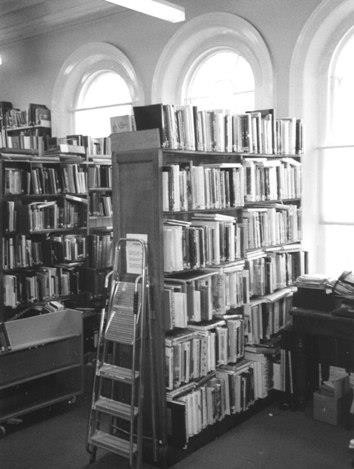
The Study Room bookshelves before renovation. Photograph © Jacqueline Cooper.
In spite of covering a shorter period the new plan was more difficult to formulate than the first, because in addition to the developmental issues it had to address the problems caused by the success and popularity of the scheme. The combination of public library, arts centre and special study centre had worked remarkably well with associated benefits for each activity. However what had been adjudged sufficient space for the foreseeable future in 1975, when the Corn Exchange extension was opened, was by 1980 looking to be far less adequate. From the Town Library’s point of view, the erosion of the study area with inappropriate use was the most urgent problem needing a solution.
The number of students using the centre had steadily increased: they were mainly A-Level and first-degree students, Open University and distance-learning, with some second-degree students in the vacation periods, but there was also a regular use by school children with project work. A regular quarterly programme of exhibitions had now been established to make members more aware of the extent and range of the collections.
Generally members were happy but there was one persistent criticism concerned with the facilities for students, the librarian and his staff had identified the number of study places available for use at any given time as the principle problem but not the only one. Another related factor was that the staff had begun to take work into the study room using the study places. This on occasion tended to be disruptive and was outside the terms originally agreed. The original agreement had allowed staff manning the enquiry desk to do appropriate work but this had been quite carefully defined in order to avoid the very problems that were being experienced. One of the chief items in this planning stage was to investigate and define this problem and make recommendations if possible providing a solution before the 150th anniversary celebrations.
Various solutions were attempted for improving the study area: none of these provided a real solution but in spite of this the facility continued to be well used. The question to resolve was how to approach the difficulties that students were experiencing in the study area. It soon became clear that there were two causes. The first was the volume of work in the public library which had increased by about 25% since 1975; the second was the tendency of staff to gravitate to the relative calm of the study room when there were free spaces available. This had become habitual, the habit could only be broken though if more workspace could be allotted. The only space that could be identified was the dressing rooms which were not generally used in the daytime. These had been designated as prime use space for the arts centre so some negotiation was necessary. Eventually an agreement was reached that staff could use the dressing rooms during the day providing they were left clear for evening use. The county librarian was concerned that the space retained by the trust for its own use had been used in a way that was contrary to the agreements. The staff were reminded that only the agreed tasks could be undertaken in the study room at the enquiry desk and that the study spaces were for the sole use of the Town Library’s readers. The new arrangement worked well, with some grumbles from staff who disliked the less congenial work environment. The rest of the work in the forward plan was completed or initiated before the 150th anniversary celebrations which took place in June 1984.
There was a also a need to deal with some aspects of purchasing policy. The library was by now sufficiently well known for Longman’s to request the loan of a number of books for their bi-centenary exhibition in London, including a first edition of Jonson’s Dictionary. The purchasing policy was revised so that all book purchases were made locally and whenever possible from a local bookseller, periodicals were put onto a standing order at Blackwell’s. Other items in the plan were: the return of the Victorian fiction from store in Clacton; the compilation of a list of recommended subject areas where the purchase of new books was to be discontinued; the listing and cataloguing of the incunabula; devising a system to ensure that books being proposed for withdrawal in other parts of the county that were of interest to the centre, were transferred to Saffron Walden; the consideration of the purchase of microforms where appropriate and of equipment to use them. Provision was also made for training a member of staff (in addition to the librarian) in special and academic library skills and Victorian studies.
ADDITIONAL SECTION (UNFINISHED)
150th Anniversary
The Saffron Walden Literary & Scientific Institute had been founded in 1834, and in June 1984, the 150th anniversary celebrations of its successor, the Saffron Walden Town Library took place. These took the form of a reception to which county, district and town were invited. It was a truly grand occasion with speeches by the Chairman and the County Librarian celebrating the success of a truly cooperative community scheme. An exhibition was set up which showed the progress that had been made with implementing the new scheme for the Town Library. The exhibits were chosen to illustrate the work that had been completed, one panel showed pages from the recently compiled calendar of the records alongside photocopies of records from the archives, these were chosen to highlight changes in fashion and referred to subjects like the admission of lady members and the censorship activities of the books committee. There were also panels of photographs showing the library as it was immediately prior to the closure of the old institute and others showing the restoration work in process and the completed works. The work on rebinding and restoration was also shown in a series of before and after photographs. There was also a display of old publicity material for events held by the Literary and Scientific Institutes in the 19th and early 20th centuries, e.g. a talk entitled ‘On disposing of the dead bodies of our friends’, given in 1890. These were shown alongside recent publicity material for events in the Arts Centre showing a continuity of community involvement in the activities of the library. One of the more important outcomes of the 150th anniversary celebrations was the foundation of the Town Library Society.
The Town Library Society

Up until this time local interest had been expressed through consultations with an informal group of members. This arrangement was formalised with the setting up of the Town Library Society which in addition to a general watching brief organised a programme of events based on the Town Library and sought ways of making it more widely known.
This change in the nature of the local involvement meant that the forward plan which finished in 1984 was the last to be prepared. It was felt that the committee of the TLS should prepare any plans of this nature if it was necessary. During the next few years work continued and steady progress was made with the development of the Victorian Studies Centre and the restoration work on the books in the old library. A group of experienced volunteers had been recruited to go through the books on an individual basis and treat those that were in a treatable condition and report those that needed more specialist attention. The plan was for the workers to begin again as they finished, rather on the principle of painting the Forth Bridge. The committee meetings of the TLS produced an interesting programme of talks by eminent scholars and specialists on various aspects of the collection, in addition a good programme of exhibitions resulted.
Expanding the Collection
At about this time the County Library decided to set up a conservation committee to report on the needs of the County. Because of the expertise in the field of the care and management of rare books the Librarian of the Town Library was approached and was asked to provide advice and when the committee was set up, became a member. This committee continued to meet for about three years and did some valuable work in defining the problems faced in the field of restoration and preservation by the county as whole. Its report was wide ranging and covered in addition to the measures relating to books, advice on dealing with newspapers and periodicals and a strategy for the provision of micro materials where this was appropriate and possible. One of the results locally was that a decision was made to provide sets of local newspapers in microform. These were acquired from the British Library Newspaper Library at Colindale. This gave the library a more complete run of local newspapers than they had had as hard copy and freed space for other uses. Provision was also made for the purchase of microform readers. As microfilms developed from simple microfilm to quite sophisticated CD-ROMs, the library where appropriate, added these to stock particularly in the field of reference works, bibliographies and collected works. Thus CD-ROM editions, when available were provided; examples include the DNB, the OED and Ruskin’s collected works. There were two benefits to this form of purchase; they were much more easily stored and using them prevented wear and tear on the originals, which in some cases were kept. They also provided a much more flexible access to the contents, particularly where multi volume works were concerned.
Use of the Building
During this period the use of the Town Library and the County Library increased and pressures again developed for the County Library staff who were again working in the study area. It was clear that some more radical solution was needed. At this point there was an hiatus in the separation of the management of the Trust Library from that of the public library occasioned by the vacancy for the post of County Librarian and the reichsunmittelbar status was put in jeopardy. The situation was exacerbated by the retirement of the community education officer to whom the Librarian was responsible for the management of the Art’s Centre. The West Essex libraries’ local middle management stepped in to fill the gap and proposed radical changes which, if imposed, would have completely upset the delicate balance of independence and co-operation that had been developed over a number of years.
The division of the space between the library and arts centre, and its management and possible operational difficulties, had been carefully considered by the architect before the preliminary plans were drawn up. The concept of prime use was defined as a management tool to create an environment that was essentially flexible. Near to completion and just before the building was handed over the architect had met with the Librarian to discuss the practical implications for organisation and management of the tri-partite use of the building.
Particular attention was given to the developmental implications and the potential these would create for change in the balance of use as between the parties and within the units of use. The discussions resulted in a document designed to give guidance in dealing with problems in the organisation of space. The advice had proved invaluable in dealing with the questions that had arisen as the scheme developed, one of the more difficult had been the allocation of booking slots between occasional and regular users. Basically, how to deal with the conflicting claims of a group who wanted to book for regular meetings every Thursday throughout the year and a group meeting three or four times a year, traditionally on Thursdays. The newly-perceived problems were more difficult than this example and involved all three parties, but with a degree of inequality that upset the sensitive balance of interests. The architect had calculated that the building as designed would meet the anticipated use outlined in the original brief but that this use would evolve and could in the future set up tensions that would question the boundaries of the prime use areas and would require solutions outside the scope of the guidance document. His advice was, that when this situation arose, because of the complex balance of use, it would be necessary to seek professional advice from the architect’s department and resist the temptation to rearrange the furniture.
Unfortunately, in spite of the proven good advice contained in the guidance document and the contribution it had made to the success of the scheme, this particular piece of advice went unheeded. As a result a series of changes were initiated that lacked the support of any external professional advice and in so doing upset the balance of the original prime use areas. When completed these saw: the children’s library moved into the ground floor of the Trust building, the adult library lending desk moved to the ground floor of the Corn Exchange and the Tourist Information Centre desk moved upstairs to the mezzanine floor. The attempt to move the reference library into the Town Library study room was prevented because it contravened the conditions of the Trust.
The changes were introduced gradually and their success was various. The first to be completed was the move to a new site for the children’s library. It provided a more discrete and friendly environment and was generally approved by members. The move of the lending desk which took place about two years later was not so successful, it had no clear advantages and created some staffing and invigilation problems as well as problems with light. The dual-use capacity was not affected to any great extent and any difficulties were soon resolved, but the decision to disregard the basic management principles in favour of one of the parties was unfortunate, as was the fact that, when completed, the problem of adequate study places remained unresolved.
The Gibson Room
A new County Librarian, G. Hare took office in 1983 and visited soon after his appointment, he felt that new and larger study tables would be helpful and engaged to provide them. He acted quickly and soon two fine large oak tables arrived from the reference library at Colchester; for a while there was an improvement, but the passage of time eroded this. A session of lateral thinking produced a fairly radical idea: to change the orientation and spacing of the store shelving in the Gibson Room. This, it was suggested, would create a substantial work space and provide more shelving. The plan was accepted and work began quite quickly, it was a formidable task and took months to complete. When finished it did provide, for a while, the anticipated relief ;but this also was relatively short lived and it was estimated that soon after 2005 the problem would become severe. The question was discussed at the TLS committee meetings and eventually a decision was made to provide rolling stacks for the store in the basement. The committee co-operated closely with the county authorities and the scheme was completed. It did provide more relief and a re-arrangement of the stock took place which did give more study space and make the management of the stock easier. It was clear that this improvement, though bringing substantial benefits, was like all the others not the solution and the committee decided to continue to look for a more permanent answer.
Essex Heritage Year 1989
In 1988 the Committee were approached by Essex Heritage and asked to take part in the celebrations that were being planned for Essex Heritage Year. The committee had already been considering how to mark the 21st. anniversary of the transfer of the trusteeship to Essex County Council which also fell in 1989. The committee agreed that the best way for the Library to contribute would be to combine both occasions with an exhibition to celebrate this anniversary as a part of the county-wide Essex Heritage Year programme. A small sub-committee was appointed to make recommendations and advise on ways and means. They proposed an exhibition that would be a showcase for the range and variety of the Library’s holdings and suggested as a title, ‘Books through the Ages’. They further proposed that the exhibition be opened with a reception and private view and that it be accompanied by a full catalogue. Most of the Library exhibitions that had been mounted so far, with a few notable exceptions, had had catalogues that were little more than lists with brief notes. It was envisaged that the exhibition would continue for a fortnight, this was all agreed and the date for the private view set for 26 October 1989. The sub-committee were asked to prepare the exhibition and copy for the catalogue. They selected 29 books from the 17th, 18th and 19th centuries; chosen because they demonstrated the development of book production and illustration and gave some idea of the variety and richness of the collection. No incunabula, manuscripts or 16th century books were shown because of the problems associated with display. Books with an Essex association were included where this was possible including: John Ray’s Historia plantarus generalis, 1693-1704; Thomas Rickman’s Styles of architecture in England 1862, and an account of John Bradford’s martyrdom in 1551 reprinted in Saffron Walden by Boardman in 1882. Famous books included a 1st edition of Johnson’s Dictionary, Owen Jone’s Grammar of Ornament and Fox Talbot’s Pencil of Nature; this last, though specially restored for the exhibition, was not exhibited because it was not possible to meet the quite stringent conditions that were necessary for its exhibition, though it did appear in the catalogue. Full catalogue entries were prepared for each item in the exhibition by library members and a series of illustrations selected. However the cost of production for the sort of publication that was planned could not be met. The committee decided to proceed with a more modest publication, which was to be published by the Town Library Society. The County Librarian agreed to provide the labour for the production and eventually it was produced in house at the County Library in Saffron Walden. In spite of these problems the catalogue served the purpose for which it was intended and was well received by visitors. Attendance at the exhibition was good both from the immediate locality and the wider county.
APPENDIX – Recent changes.

Visit by the Recorders of Uttlesford History to the Town Library – examining volumes in the rolling stacks of the Gibson Room (left)
Taking part in discussions in the Study Room (right). Visits by local groups are a regular feature hosted by Town Library Society Chairman, Martyn Everett.


The exterior of the newly repainted library in 2007
An internal view of the glass dome added to the roof.

The above images are © Jacqueline Cooper.