

© Michael Furlong
Reprinted (with minor changes ) from: Saffron Walden Historical Journal No 37 Spring 2019
If you happen to drive or walk down Saffron Walden High Street and glance behind the War Memorial on the right, you will see a Victorian Baptist Chapel. It is unlikely, unless you were seeking it out, that you would notice another, much older building attached behind it. Little did I imagine when I moved from Hertford to this town more than 40 years ago that the church would have such significance in my family history. Although baptised and confirmed into the Church of England I started attending the family friendly Saffron Walden Baptist Church with my wife and three young sons, not knowing that I was following in the footsteps of my 4 times Great Grandfather, Richard Pettit (maternal grandmother’s line) who was a Dissenter. Furthermore the North West Essex Branch of the Essex Society for Family History, of which I am secretary, meets in that older building which is in fact the original chapel built exactly 200 years before I moved to the Town in 1974. With the wonders of the Internet I recently discovered that Google Books (1) had digitised information relating to Baptist Church History “The Baptist Magazine 1824” and within those pages I stumbled upon the fulsome and somewhat wordy obituary of Richard Pettit. Until then, although obviously I had considerable information about him in my family tree, I was completely unaware of his involvement with my local church. Every time I attend a Branch meeting I have to remind myself I could well be sitting (or standing) in the same spot as he did all those years ago.
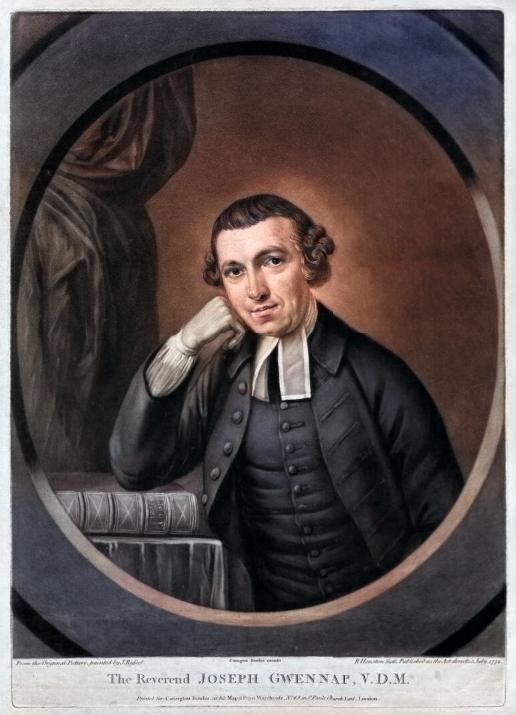
So enthused was Richard by the preaching of the controversial but renowned orator, Joseph Gwennap who was the Saffron Walden Baptist minister at that time, he decided to do something about it, spiritually speaking, in his own village, but more about that later. The colourised mezzotint on the left is of Joseph Gwennap in 1774 (when the new church opened in the High Street in Saffron Walden) Source: British Museum/National Portrait Gallery.
Richard Pettit was born about 1752 at Home Farm in Little Sampford (4), a small village on the River Pant in the North West corner of Essex. He succeeded his father at Home Farm and also took over what was then Stanton’s Mill on the hill overlooking the river valley. This is where he made his first astute move. The mill was on the land of Sampford Hall which was owned by the wealthier Portway family. Richard proposed marriage to one of the Portway girls who was under age at the time. As part of a pre-nuptial agreement, (2) the ownership of the mill was granted to Richard and thereafter it became known as Pettit’s mill. Before she died Sarah bore Richard 13 children; Richard then went on to marry twice more.
At that time milling was a lucrative trade and Little Sampford mill became the focus for moulding many apprentice Pettits over the next 100 years or so. Richard also set out to acquire farm land and property over an increasingly extensive area, so not only in the Sampfords but other towns and villages including Debden, Finchingfield, Romford, Bardfield, Hempstead, Saffron Walden and many more; (2) clearly his business model was paying dividends.
The Pettit name is Huguenot but, despite extensive research back to the mid-17th century I have never been able to make the connection with my Pettits. Several publications mention Pettit clockmakers and it is possible Richard’s father was a clock maker as well as farmer as I have found the apprenticeship record for Richard’s brother John to his father and who set up a clock & watchmaking business in Epping (5). At one time John was contracted to maintain the original Finchingfield church clock.
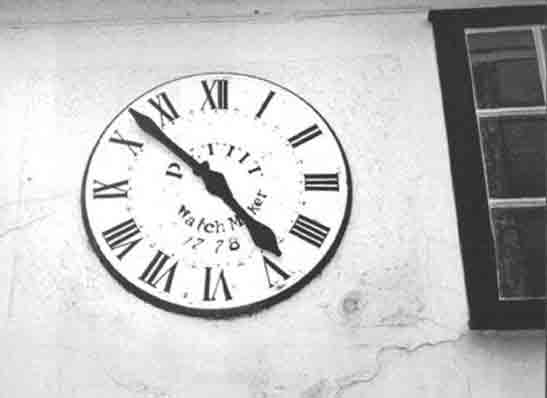
It is quite likely that Richard commissioned his brother John, or asked for his help in installing a clock in the farm house wall facing the road from Great Sampford to Finchingfield. This clock was installed in 1778 and thenceforward the farm became known as “Clock House Farm” (Grade II listed). (4) Two stories prevail about why Richard installed the clock. The first relates to his public spiritedness as there was no public clock between the two important villages, so travellers were given an opportunity to check their watches, or tell the time when they were about halfway along the road. The other, more cynical story is that it was so Richard’s farm workers (Aglabs) could not skive off early to the Fighting Cocks ale house behind the farm as they could see the clock face from the fields.
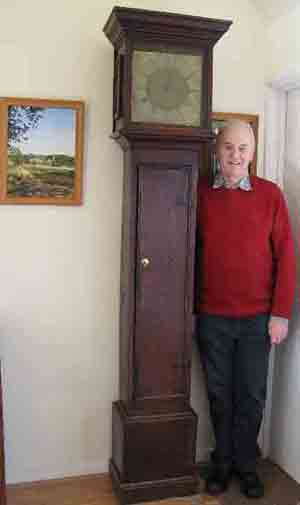
We do know that Richard made clocks; after many years of searching I have found 3 Pettit long case clocks. This first one on the left, originally made for Clock House Farm is now in Thaxted.
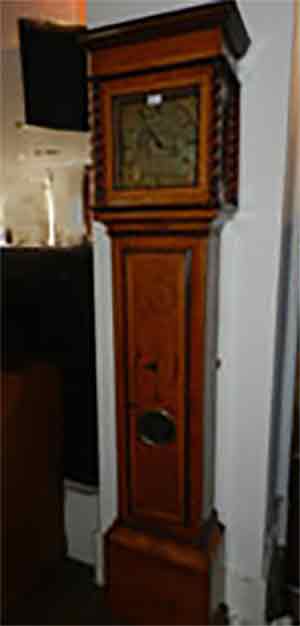
The second one (a cottage clock) on the right, has been sold at auction twice for several thousand pounds but again with my research I have found an expert whose comment about it in 1995 was “very much a made-up clock……altogether …… to be avoided”! (6)
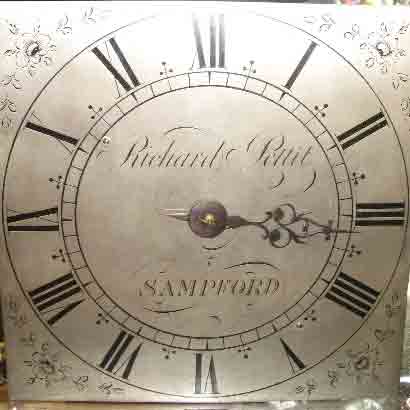
By another amazing coincidence I located a third clock (above) in a private collection in Saffron Walden. I was fortunate in finding a local horologist who was able to tell me much about this clock which is of the “transitional” period i.e. c1790 and still with only one hand so it fits exactly into the time Richard was at Sampford. {Update- in 2021 I had an opportunity to purchase this clock which is now happily ticking away in my house}. The clock faces have the Pettit name and Sampford engraved on them. Although it seems the mechanisms and engraving were generally of a high standard the cases were bodged together, often from re-cycled old furniture which leads me to believe it was merely a hobby of Richard’s rather than a livelihood.
Apart from running farms, a mill with mill-house, making clocks and becoming Overseer of the Poor, Richard rigorously pursued his religious beliefs. As I have already mentioned he was inspired by his time at Saffron Walden Baptist Church, indeed undergoing full adult baptism there.
In Great Sampford, which he would always pass through on his way to Saffron Walden, he decided to found a ministry by preaching on Sundays in Stow Barn, (since burnt down) adjacent to the Parish Church. At that time Great Sampford was suffering from a religious drought. There had not been a vicar there for many years (since 1776) and curates came & went so Richard was filling that spiritual vacuum. He must have been doing something right, as regular congregations exceeding 100 persons were recorded. This continued for about 6 years until Richard, who clearly was creating a significant income from his commercial activities, made his next move.
In the centre of the village, almost opposite the Parish Church was a piece of glebe land. Richard purchased the land, somewhat ironically I think, from the vicar of Little Sampford church. I just wonder if Richard told the vicar what he intended doing with that plot. Richard proceeded, out of his own pocket to build a Particular Baptist Chapel which opened for Divine Worship in 1802 “which he afterwards enlarged, and made comfortably to accommodate four or five hundred persons”; (1) if he filled it I think the congregation must have all been standing up! He also built a modest house for a minister, again at his own expense. Sadly Richard buried his wife and 3 of his children in the ground in front of the church in the same year. In June 1805 the Church was founded and Richard was invited by the members to become the minister which he eventually accepted. Thereafter he became known as the Reverend Richard Pettit. In church terms that was very early as the Baptist Union of Great Britain was not founded until 1813 so Richard’s church would have been one of its first affiliates.
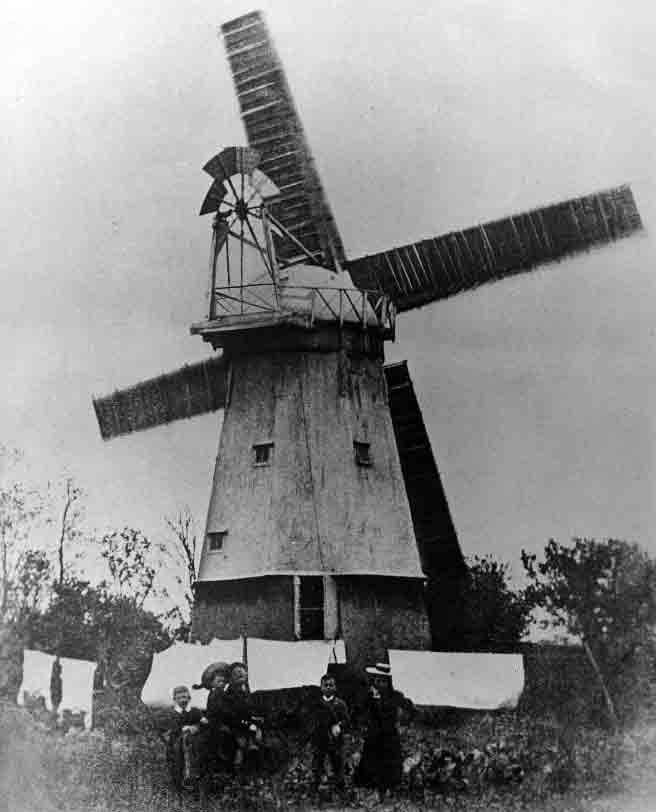
I consider Richard to have been somewhat shrewd as he had already acquired control over the Little Sampford mill and, with the glebe land being substantial in size and having built the chapel, he proceeded to construct a windmill and miller’s cottage just up the hill from the church. We know this as in Richard’s long and quite complex Will with 2 codicils he states “…I have built a mill”.(2) (See picture at left) (3) Decommissioned before the Great War it’s a house today with a value in excess of £700,000; additionally the Mill House is Grade II listed.
Interestingly in the second codicil he disinherits two of his children “I have struck out the names of Samuel & Susan on occasion of their conduct”. (2) I would love to find out what that meant; it’s quite possible it related to their non-attendance at his church but I am not sure.
Now Richard had a mill in both the Sampford villages, thus monopolising the trade in that area. He ensured family members took over the business and in subsequent years we find many Pettits mentioned occupying either the mills or mill house and registered as miller, and this continued until the early 20th century. As the young Pettit millers grew up and sought to obtain their master’s ticket they became journeymen, moving on to other areas; to date I have discovered Pettits working in at least 18 mills stretching from Waltham Abbey up to Ramsey in Huntingdonshire-they are all direct descendants of Richard.
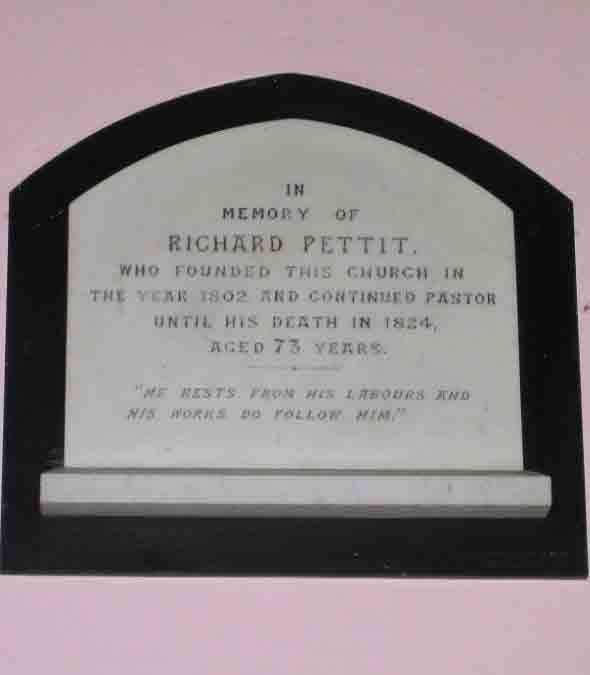
Richard passed away on 30 July 1824 in Clock House Farm; his obituary even tells us how he died- “he had not been long in bed when he was seized with a difficulty of breathing… he went to the window for air…” (1) and further on after his death it states “at the particular request of friends & relatives of the deceased” his body was “interred beneath that pulpit, from which he had so often expounded the word of life”. (1)
On the left is the picture I took of the plaque in the church commemorating Richard’s burial. The church was subsequently “deconstructed” and re-built in 1875. It still thrives today, but with a much reduced congregation.
Richard’s Will and codicils take up several foolscap sheets of closely written lines and when the inventory was drawn up after his death it filled a number of books of the local valuers, Messrs Franklin & Son Auctioneers. At a conservative estimate, if he owned one farm in all the villages mentioned, plus two mills and their attendant cottages his estate today would most likely exceed £14,000,000 not including contents thereof! With every item meticulously listed, the entries “8 day clock” (see above) “milk kettle” , “quantity of lime”, “two old wheels”, “1000 white bricks” and “lump clay” caught my eye. Even the livestock were recorded by name; cows such as “Whiteback, Cherry, Blackbird, and Beauty” together with horses, “Tulip, Bonny Mare, and Smiler” – shades of Animal Farm, although the pigs all seemed to be nameless “Two pig sows & 17 fatting”. (2)
With all that money and goods listed you would think the family were well-off. Hardly! By the end of the 19th century it had been dissipated, with mills almost defunct through foreign grain imports killing their trade, and no doubt all the descendants getting a slice, plus Richard’s wish to ensure the Church and minister’s house remained “free of any encumbrance” (2) by putting it into some form of trust.
My research on the Pettit line has been on-going for almost 20 years, but it still surprises me when I stumble across another nugget of information which sets me off chasing after that elusive bit of material to complete the jigsaw.
Sources:
(1). Google Books.
(2) Essex Record Office-Documents, Wills & Great & Little Sampford Church Records
(3) “Essex Windmills, Millers & Millwrights” by Kenneth G. Farries
(4) “A History of the Sampfords” by Gerald Curtis
(5) British Horological Institute Apprenticeship Records 14 October 1774
(6) “The Longcase Clock” by Tom Robinson