
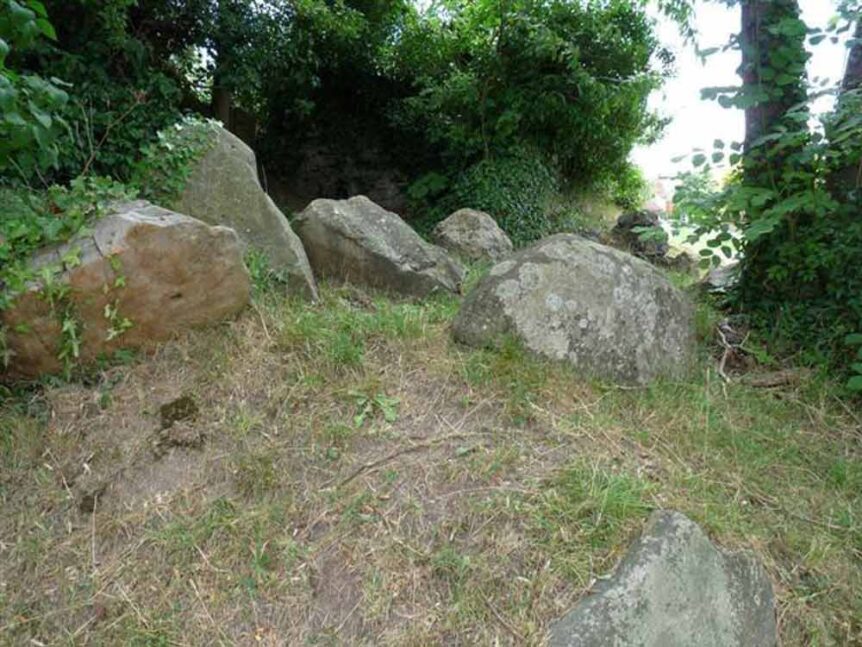
The image above is of the boulders. Photograph © Gordon Ridgewell.
© Gerald Lucy
Reprinted from: Saffron Walden Historical Journal No 5 Spring 2003
At the junction of Gibson Gardens and Margaret Way in Saffron Walden is a mound of grass with a few trees. On closer inspection it becomes apparent that there are also a number of large boulders here, some lying on the surface and others poking through the grass. It is fashionable nowadays to use imported boulders for landscaping schemes but these boulders are different. They have been here for at least 120 years and are all local Essex rocks, providing us with an insight into the landscape of Essex during the Ice Age.
The Gibson Gardens estate was built on land that was formerly the magnificent gardens at the rear of Hill House in the High Street. The mound was a feature in the gardens and covered an ice pit, access to which was through a tunnel entrance, the remains of which can still be seen. On top of the mound was a summer-house that is clearly shown on an 1877 map of the town held in the library’s Victorian Studies Collection. Until his death in 1883, the house and gardens were owned by George Stacey Gibson, naturalist and author of the first Flora of Essex that was the standard work on Essex botany until the 1970s. Gibson also had a great interest in geology (his collection of over 6,000 fossils was donated to Saffron Walden Museum on his death ) and there seems little doubt that he must have formed this collection of unusual boulders in his garden.
There are at least 25 boulders here, most obscured by vegetation and some almost completely buried. At least nine different rock types are represented, some of which are distinctive rocks form the north of England and Scotland. The boulders are typical ‘glacial erratics’, in other words they are typical of rocks that have been transported south to Essex by the great Anglian ice sheet which covered almost the whole of Britain during the coldest period of the Ice Age, some 450,000 years ago. Gibson was one of the largest landowners in the area and boulders such as these would have been frequently found on his land, particularly in gravel pits that were common around Saffron Walden in Victorian times. The most famous glacial erratic in Essex is the Leper stone, a hard sandstone boulder (known by geologists as a sarsen stone) by the side of the road just north of Newport.
This mound contains the largest number and greatest variety of erratic boulders in Essex. The rock types include sedimentary rocks such as sarsens, puddingstone, sandstone, millstone grit, limestone and septarian nodules. There are also igneous rocks such as granite, dolerite and basalt. The largest boulder is a slab of colourful puddingstone approximately 1.2 metres (4 feet) long lying on its side in the centre of the mound.
The study of glacial erratics can provide valuable clues to the flow of ice across Britain and the nature of the landscape during the Ice Age making this site educationally and scientifically important. For these reasons the mound has recently been formally notified to Uttleford District Council as a Regionally Important Geological Site (RIGS) by the Essex RIGS Group.
George Stacey Gibson died in 1883 and his only child, Miss Mary Gibson, inherited the house and gardens. The Essex Field Club, in the report of their excursion to Saffron Walden in June 1910, describe being entertained in the gardens by Miss Gibson but surprisingly do not mention the boulders. Their report in the Essex Naturalist states that the Club was ‘most hospitably entertained to tea served on the lawn’ and ‘the extensive and charming gardens, with the fernery and hot-houses, were then explored’. The archive of photographs in Saffron Walden Museum contains several photographs of Hill House and the gardens in their heyday.
Mary Gibson died in 1934 and the house was taken over by the military authorities during the Second World War. Hill House later became a GPO sorting office and the gardens were sold for housing. It is very fortunate that the mound has survived the subsequent development. A photograph of the summer-house was taken by David Campbell in 1952, and it shows a few boulders at the base of the mound. The mound is at National Grid Reference TL 5369 3817.
Notes
Anon. ‘Meeting at Audley End and Saffron Walden’ Essex Naturalist. Vol 16 (1919), pp 188-9.
Campbell, D. 2000. Saffron Walden through David Campbell’s Camera (2000) Lucy, G., Essex Rock: a look beneath the Essex landscape (1999)
Pole, L., Britain in Old Photographs: Saffron Walden (1007), pp88, 92.