
© Colin Bazley
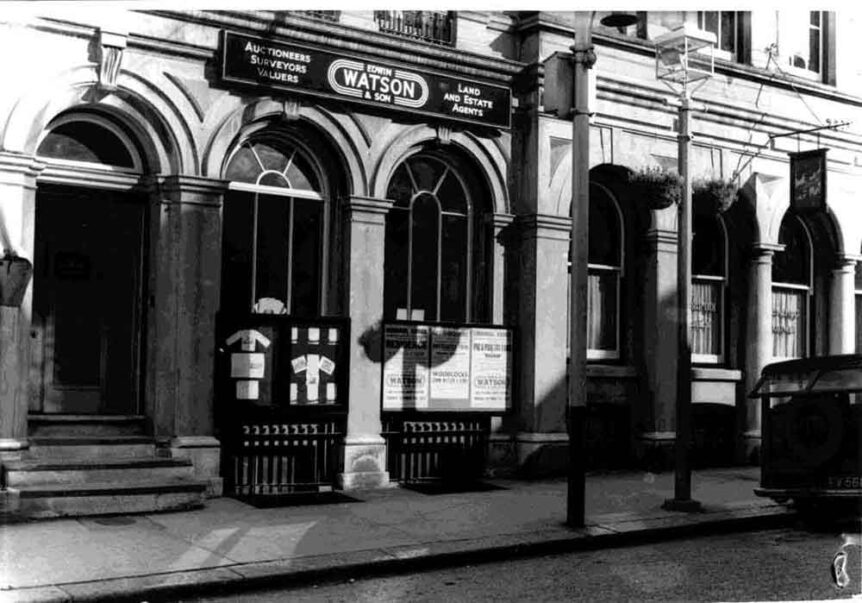
The above image is of Watsons office in King Street Saffron Walden in 1954.
Reprinted from: Saffron Walden Historical Journal No 25 (Spring 2013)
The profession of auctioneer is very old and well-respected. It can certainly be traced back to Roman times when, amongst other things, slaves were sold by auction. There is also a record in the Old Testament of some land being sold by a method which is very similar to a sale by auction.
The earliest record I can find of an auction sale in Saffron Walden is by an auctioneer who rejoiced under the name of Hannibal Dunn – some would say an appropriate name for an auctioneer. He conducted a sale of stoves, grates, coppers, beer casks and other effects at The Old Workhouse on 24 January 1839.
Edwin Watson and Son had been founded by Edwin Watson in 1890 at Bishops Stortford. After the Second World War he was joined by his son John who had a very distinguished war record in the R.A.F. and was awarded the D.F.C. They were later joined by Ted Rowe and opened a second office in Saffron Walden in 1953, a few months before I joined the firm.
In the summer of 1954 when I was about to leave Newport Grammar School my Father approached Ted Rowe who lived on Curles Farm, next door to our home at Parsonage Farm, Clavering. Ted was a partner in the well- known firm of Edwin Watson and Son who were Auctioneers and Estate Agents. He asked him if there was a chance of a job for me and was there any prospect of me being able to earn one thousand pounds a year. This figure would have seemed an awful lot of money to him as at the time farm workers were only earning about five pounds a week. Ted replied that if I worked hard there would be a chance and so began my introduction into the world of auctioneering.
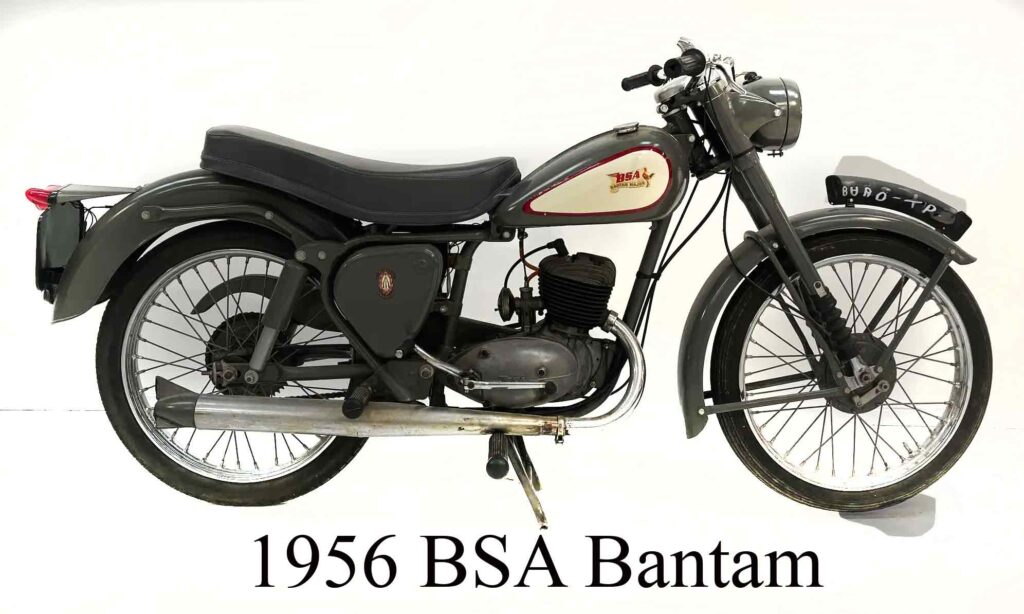
My first weeks wages was 25 shillings – pretty low even in those days, but it was quite common then for your parents to actually pay for you to learn the profession. On some days I used to cycle in from Clavering and sometimes I had a lift in with Ted. After a while I had an old autocycle but it kept on breaking down and I found myself walking half the time. I graduated on to a B.S.A. Bantam 125cc motor-bike – you did not break any speed records but it at least it got you there.
My first experience of auctions was at the saleroom in Bishops Stortford. We held weekly sales of general dead stock and monthly sales of antique furniture, etc. One of the characters that I remember from those days was a general dealer from Takeley who went by the name of Gunboat Smith. To say that Gunboat was dirty and scruffy would be an understatement. He ran out of petrol one dark night and was refilling his petrol tank when he struck a match to see how much more he needed to fill the tank. Unfortunately, he became engulfed in flames and spent some time in hospital. When he returned he was so clean and tidy that no one recognised him!
In 1956 my firm acquired the old-established business of Woodward & Priday, who were the proprietors of four poultry markets. The business was founded by Mr Harold Woodward in 1903 at Saffron Walden. The firm expanded over the years and eventually there were six markets at Bishops Stortford, Braintree, Colchester, Hertford, Hitchin, in addition to Saffron Walden. They were all run and administered from Saffron Walden.
Unfortunately, when we took over they were already in decline, but in their heyday in the 1920s and 1930s they were really big business. In fact, their rise and fall mirrored the changes that were taking place in agriculture and country life, not only in this area but in the country as a whole.
Market day on Tuesday was by far the most important day in the town. The cattle market flourished on the site where the Saffron Building Society is now, the pigs and sheep were sold where Waitrose has been built, the Corn Exchange is now the Library and our poultry, egg and produce market has turned into an up-market off licence! The pubs were open all day and the town was alive with farmers, dealers and people from the villages all coming in to transact their business.
A typical market day would begin at about six o’clock when the first crates of poultry, eggs, etc would arrive. Quite often these would be delivered from the local railway station as we used to receive eight-week-old growers from as far away as Yorkshire. These had the reputation of being very hardy as they had been reared on the Yorkshire Moors.
The deliveries continued to build up during the course of the morning. These would come from a wide area, often by horse and cart, pony and trap, and motor vehicles. Each village had its own carrier who would go round in the morning collecting up chickens, eggs, rabbits, and produce that were to come into the market that day. My grandfather was the carrier for Berden, but I think he took most of his lots to Bishops Stortford.
Soon the dealers would arrive and these would come from a wide area such as Chelmsford, Cambridge, Braintree, Colchester and even as far away as Canvey Island. There was always a strong contingent of Jewish buyers from the East End of London. One morning Percy Bedford was coming in from Haverhill when a swarm of bees flew into his lorry cab and he almost died. These were hard and shrewd men who would work to small margins of profit such as one (old) penny per bird.
The Jewish buyers were, in particular, quite prosperous and one Maurice Marks, known to everyone as Mocky, would always arrive in a Humber Super Snipe car. This was one down from Rolls Royce in those days. He would usually buy a lorry load but sometimes he would buy only a few pens and he would then ask the porters to put the birds loose in the back of this luxury car .Goodness knows what state the car was in when he got back to London!
The auction would commence at 11 o’clock and went on for several hours. It was very exciting and the bidding was fast and furious. Quite often it could develop into a battle of wits between the auctioneer and the dealers. Sometimes the dealers would band together and agree not to bid against one and other. This is known as an auction ring and is strictly illegal but is extremely difficult to prove. However, the auctioneers had their own methods of counteracting this – but these must remain their secret!
At other times the opposite would happen, the dealers would become infuriated with each other and on extreme occasions the argument could only be settled by a fist fight! Each dealer developed their own style of bidding and one I remember, in particular, Blondie Harris from Chelmsford, was always bidding whilst he was smoking a cigarette.
Some of the hardest work at the auction was done by the girl clerks who were in the office. They had to be brilliant at mental arithmetic as there were no calculators in those days. Everything had to be worked out as it was sold, for instance you might have nine hens at 1s 3d, or 14-score of eggs at 2s 7d. Multiply this by many hundreds of times, then you can see how difficult the work was. The books had to balance at the end of the day down to the last penny and, if they did not the girls had to stay behind, sometimes up to eight or nine o’clock at night to look for a penny. If they failed to find it, then Mr. Woodward would stop it out of their wages!
The decline of the markets began with the outbreak of the Second World War when rationing was introduced and all sorts of regulations and controls were applied to the auctions. Eggs were rationed and were not allowed to be sold at the market. Poultry was strictly controlled and purchasers were not allowed to buy birds for slaughter. Later, the rules were relaxed but all poultry had to be slaughtered before they left the sale yard. This meant that the Jewish buyers had to bring a Rabbi along with them to slaughter the birds by the kosher method..
After the war times had begun to change, it was becoming no longer fashionable to keep a few chickens in the backyard, and farms were beginning to specialise in arable or just one form of livestock. Large poultry farms were becoming established where the birds were no longer kept on the old free range methods. The hens were kept in large deep litter houses – the battery cage system was just starting to come into force. There was still rationing and restrictions on the sale of poultry and eggs were also still being enforced. In addition to this, changes were taking place on how food and other products were being marketed. Deep freezers and eventually the supermarket style of shopping were all factors which contributed to the slow demise of the poultry and produce auctions.
When Edwin Watson & Son took over in 1956 they were only a shadow of the business that existed before the war. However, there was one aspect of the business which continued to flourish and this was the Christmas Market. In the run up to Christmas, over the four auctions, we would sell many thousands of turkeys, chickens, geese, ducks, and game. These birds were dead, plucked but not eviscerated and were sold individually. This enabled private buyers to purchase their own individual Christmas dinner. It was quite common for people to wait around for hours in the freezing cold just to purchase one particular turkey they had their eye on. It would then have to be carried home and eventually gutted before it was ready for the oven. If you asked them why they went to so much trouble they would simply say that it had always been part of their Christmas!
We should not leave the Woodward & Priday era without mentioning that in the early part of the 20th century this firm used to hold the Horse Repository Sales on the Common. These sales would be held twice a year, when horses, carriages and other horse drawn vehicles were put up for sale. It was a great day for the Town and it would take up a large part of the Common. They would run the horses up and down King Street so that prospective purchasers could see whether they were sound.
In the late 1960s the old poultry sale yard was demolished and a new covered- in saleroom was built. We continued with the market auctions on Tuesdays but now they included modern and household furniture, china and glass, copper, bronze and a wide range of sundry bric-a-brac. Once a month we used to hold a sale of Antique Furniture and Effects.
One of the most poignant sales occurred when we were instructed to sell all of the salvageable effects from the old Rose & Crown Hotel in 1970. This was literally right next to our saleroom and the fire resulted in the tragic loss of 11 lives.
The most expensive lot we ever sold came not from a grand country house but from a humble one-bedroom council flat in 1985. We had been instructed to clear and sell the contents of the flat which had been occupied by an elderly gentleman who was now deceased. Normally, the value of the whole contents would be barely enough to cover the expenses. In this case it turned out to be a veritable treasure trove with a number of valuable items including a gilt brass carriage clock by Breguet & Compie which was sold for the remarkable price of £25,000. Abraham-Louis Breguet was born in Switzerland and is regarded as one of the leading clockmakers of all time. There were several other valuable objects in the property including another clock which fetched £2,000 and a watch which made £1,600. The total raised was well in excess of £40,000.
No article on auctions would be complete without mention of the saleroom porters who contribute so much to the atmosphere and success of the sales. At Saffron Walden there were two names which stand out – Stan Gibbs and Bert Covill. They both had their own lorries – Stan was the carrier for Hempstead and Bert did the same job for the Linton area. Stan was reputed to be the only man who could load up and unload a piano on his own. What state the piano was in when it came off the lorry has not been recorded! Bert Covill was the strong, silent type and a man of few words except on one notable occasion when we were selling a glass case full of humming birds. These are tiny little birds and as Bert held up the case, he said, ‘These would not take much stuffing, sir’. The assembled company in the saleroom fell about both in surprise and laughter.
In 1987 there occurred the first and only change in my career. In those heady days, banks, building societies and insurance companies were buying up estate agents for extraordinarily high prices. Watsons, as our firm was known by then, sold 17 offices to General Accident and I was appointed Regional Director for auctions of a large group covering Essex, Suffolk, Cambridgeshire and Hertfordshire. However, it soon became obvious that G.A. were not interested in auctions and after three years they sold the saleroom at Saffron Walden back to me. Shortly afterwards I acquired the Estate Agency business, so after four years I was back where I started. In the 1990s we began to look around for other avenues to explore in order to increase our turnover. Oddly enough there appeared to be a gap in the market for specialist sales of rock and roll, film and theatre memorabilia, rare records, vintage slot machines and juke boxes, old toys, etc. These sales proved to be very popular, sometimes attracting up to 800 lots and buyers from all over the country and from abroad. I never thought that one day I would be selling John Lennon’s overcoat or a piece of Elvis Presley’s shirt! Some of the lots proved to be quite valuable, for instance a rare 1956 Wurlitzer Centennial 2000 juke box realised £5,200.
It was as a result of these sales that a remarkable collection of autographs came to light, found in the attic of a house near Cambridge. They were collected by a young stage-struck girl called Joyce Dean in the 1930s and 1940s. There were signed photographs of Hollywood stars such as Bing Crosby, Errol Flynn, Cary Grant and Gary Cooper, as well as British stars, Vera Lynn, John Mills, Arthur Askey and Jack Hawkins. There were hundreds of autographs and photographs and their discovery created a great deal of interest, with interviews given to national and local radio stations, and the Daily Mail printed an almost full-page feature. The sale was very successful and the collection raised over £20,000.
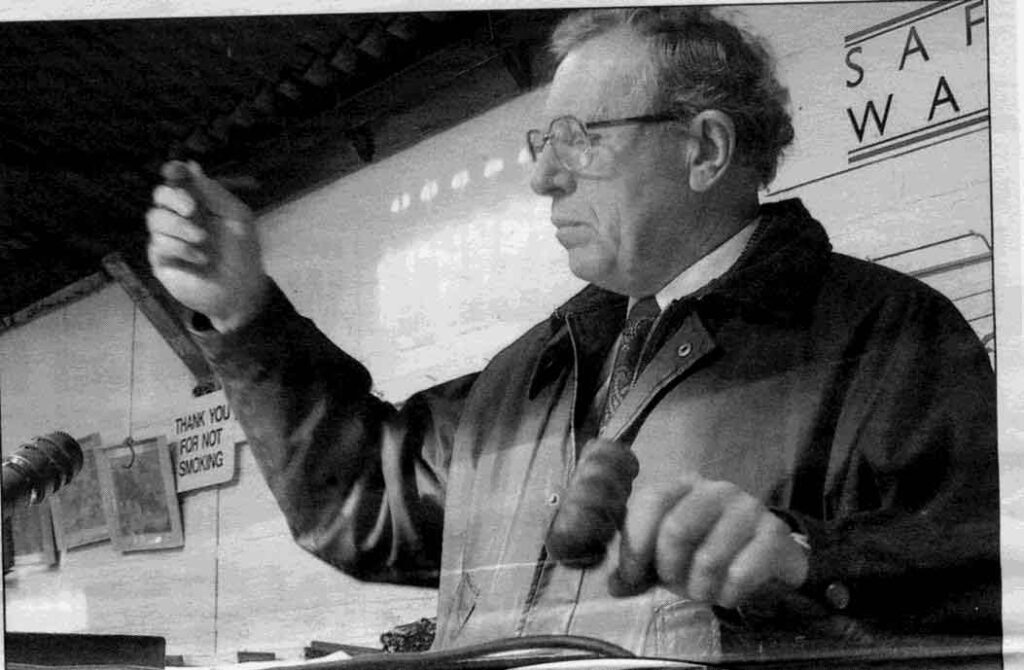
All good things must come to an end and we held our last auction sale on Tuesday 27 March 2001, some 98 years after Mr. Woodward started the first auction and 47 years after I first became involved. The Walden Local reported the event under the headline: ‘Town’s best social club closes’. It certainly had been a lot of fun.
NOTE:
The photograph of Watsons office is copyright © The Gibson Library, Saffron Walden, part of the David Campbell collection. The photograph of Colin Bazley is © Walden Local.