
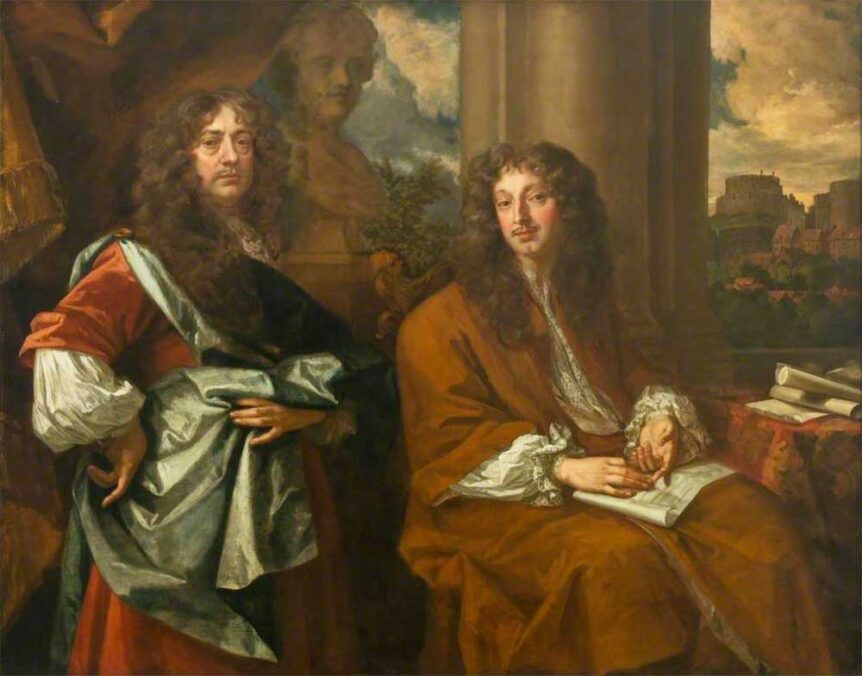
Painting is to be re-instated at Audley End after two years of restoration
The above image is © Mark Asher Photography/Historic England Archive
The 17th Century portrait of the artist Sir Peter Lely with his close friend, architect Hugh May is due to go back on display at Audley End House this year.
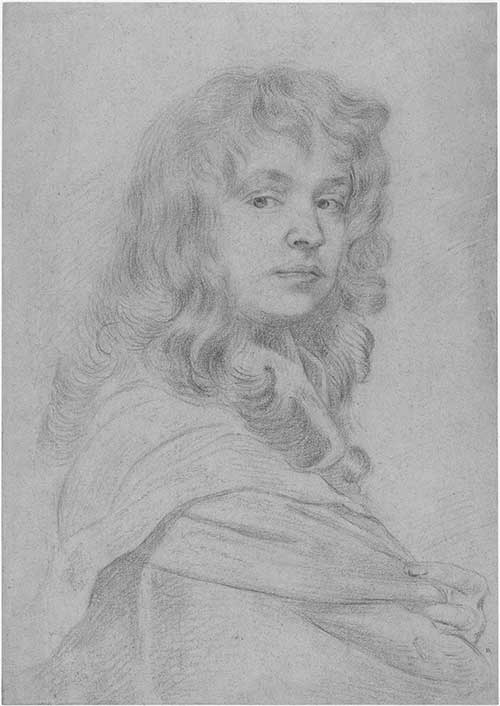
Sir Peter became the most fashionable portrait artist in England. He was a portrait artist to Charles I. His talent ensured that his career was not interrupted by Charles’s execution, and he served Oliver Cromwell, whom he painted “warts and all”. As one of England’s most celebrated artists, and after the English Restoration in 1660, Lely was appointed as Charles II’s Principal Painter in Ordinary in 1661. Demand was high, and Lely and his large workshop were prolific.
Funding for the restoration was provided by The Friends of Audley End, and English Heritage led the project. Peter Moore, curator of Audley End for English Heritage, said ‘ This portrait was painted at the very moment Charles II was re-making Windsor Castle into a symbol of revived monarchy’. At its centre, we see Sir Peter Lely alongside his close friend, the architect Hugh May, while the great woodcarver Grinling Gibbons is represented through the finely carved portrait bust beside them. All three men depicted were friends and collaborators and played influential roles in shaping the artistic legacy of Charles II’s court. Their talents blended through their contributions to Windsor Castle. Peter Moore added, ‘It’s no coincidence that Windsor Castle appears in the background: each of these men in different ways contributed to some of the most significant royal commissions undertaken there’. Hugh May oversaw the rebuilding works there between 1673 & 1677. Ironically, King Charles II bought Audley End House in 1667 as a royal palace, but it was rarely used after 1670.
Mr Moore continued: “It is believed to have hung at Frogmore House on the Windsor Estate, after May’s nephew, Thomas May, took up residence there in the 1780s. The house later passed through the Neville-Aldworth family, who would eventually settle at Audley End, before being sold to Queen Charlotte in 1792. In many ways, the portrait has travelled through the very orbit of the royal residence it depicts. The work was subsequently transferred to Audley End in the early 19th century, when the Neville-Aldworth family inherited the estate”.